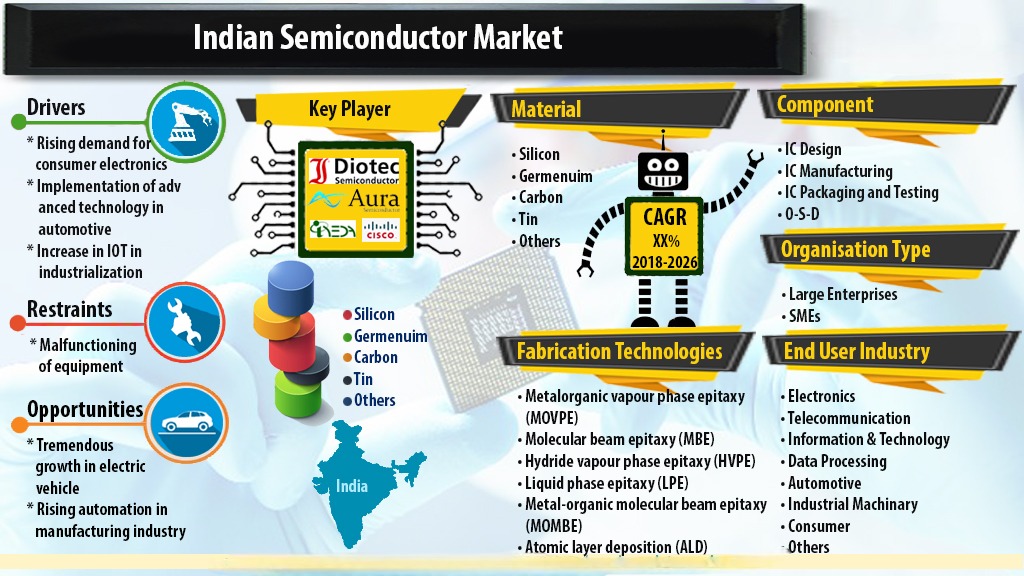
Semiconductors: what exactly is India going to manufacture?
Context:
India is just now realizing its potential in the field of semiconductors; having access to the underlying technology has long been a goal of our country. If this effort is successful, India will join a select group of countries with access to the technology and will create thousands of high-paying employment.
What is Semiconductor Chip?
Transistors comprised of carefully chosen materials, often silicon, make up a semiconductor chip.
Transistors modify information that is encoded as 0s and 1s to create new information.
The source, the gate, and the drain (or sink) are the three components that make up a transistor.
The voltage applied to the gate controls how much current flows between the source and drain.
Each bit on the semiconductor chip represents a logical state (0 or 1) and is used to store information.
What are the Nodes in Semiconductors?
The manufacturing process used to create transistors on a semiconductor chip is referred to as a “semiconductor node”.
The gate length and the pitch—the separation between adjacent metal strips connected to the gate—were formerly used as the basis for node names.
For instance, the metal pitch and gate length for the 500-nm node were both 500 nm.
The naming practice based on gate length and pitch became less important as technology evolved and transistors shrunk.
NodeNumber and Meaning:
When it comes to actual physical dimensions, node names are no longer significant.
The “nm” prefix in the node name may be used differently by different companies.
The node number is mostly used in marketing to show that a certain node is an upgrade from its forerunner.
For instance, the node numbers for Intel’s 10-nm node and Global Foundries’ 7-nm node do not adequately reflect the physical dimensions because both have equal gate lengths and metal pitches.
What do we know about The semiconductor industry in India?
The prospects in the semiconductor sector are beginning to be recognized in India.
When Foxconn Technology Group withdrew its backing from the joint venture with Vedanta, Ltd., the construction of a semiconductor manufacturing facility in Gujarat suffered a setback.
Incentives have been implemented by the Indian government to support the semiconductor industry.
Legacy Nodes
Instead of the most cutting-edge nodes like 10 nm or 5 nm, India is currently concentrating on nodes at 28 nm or above.
Numerous industries, including robotics, defence, aerospace, tools for industry automation, autos, the Internet of Things, and image sensors, continue to use legacy nodes in a variety of ways.
Starting using legacy nodes can provide benefits, such as cost-effectiveness and long-term success planning.
What is the Potential Development for India’s Semiconductor Industry?
Future growth prospects for India’s semiconductor industry are provided by the demand for semiconductor technologies in several sectors, such as electric vehicles and infotainment systems.
While sophisticated nodes predominate in devices like smartphones and laptops, legacy nodes will still be necessary to meet the demands of particular applications.
🕒 Weekend Batch Details
Class: Saturday & Sunday
Time: 10:00 AM – 05:00 PM
Test : Every Sunday
For more details, contact us 9611451616 [email protected]
Evening Batch
🕒Evening Batch Details
Class: Monday to Friday
Time: 05:00 PM – 08:00 PM
Test : Every Sunday
For more details, contact us 9611451616 [email protected]
Regular Batch
🕒 Regular Batch Details
Class: Monday to Friday
Time: 07.00 AM to 10:00 AM and 11.00 AM to 02.00 PM
Class: Saturday & Sunday
Time: 10.00 AM to 05.00 PM
🕒 Morning Batch Details Class: Monday to Friday Time: 07:00 AM – 10:00 AM Test : Every Sunday For more details, contact us 9611451616 [email protected]