
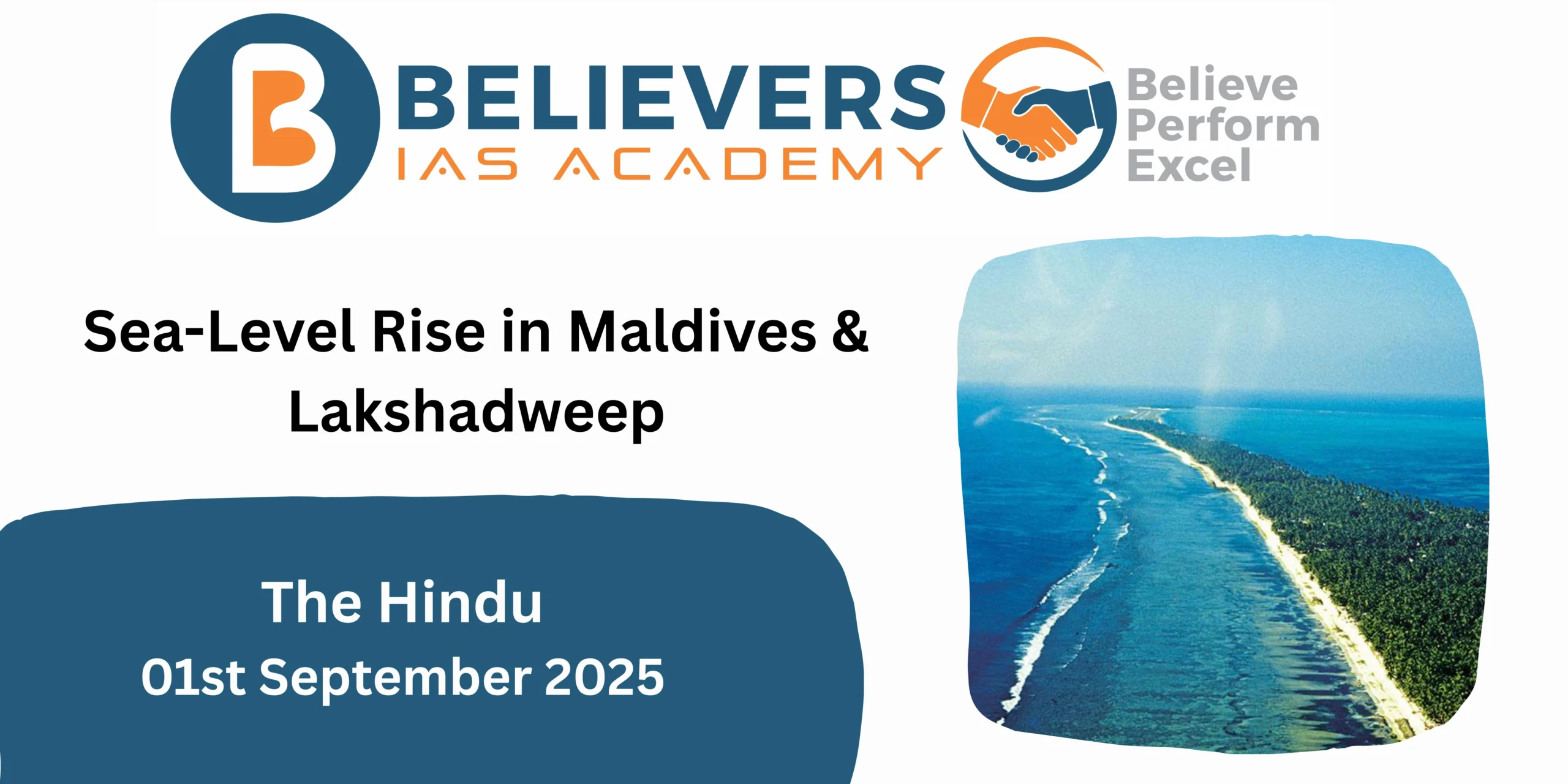
Sea-Level Rise in Maldives & Lakshadweep – New Findings from Coral Microatolls
Context
-
A new study (led by Paul Kench, NUS) using coral microatolls has extended sea-level records in the central Indian Ocean by 90 years.
-
Findings: Seas around Maldives, Lakshadweep, Chagos have been rising faster and earlier than previously assumed.
About Coral Microatolls
-
Disk-shaped coral colonies → upward growth limited by lowest tide level.
-
Act as natural sea-level markers since their surface reflects lowest water levels over time.
-
Can live for decades–centuries; growth bands similar to tree rings.
-
Useful in data-sparse regions → provide long-term sea-level history.
Key Findings of the Study
-
Location: Mahutigalaa reef platform, Huvadhoo Atoll, Maldives.
-
Period reconstructed: 1930–2019.
-
Sea-level rise (SLR): ~0.3 m over 90 years.
-
Rates of SLR:
-
1930–1959 → 1–1.84 mm/yr
-
1960–1992 → 2.76–4.12 mm/yr
-
1990–2019 → 3.91–4.87 mm/yr
-
-
Major revelation:
-
Acceleration began late 1950s (not ~1990 as commonly believed).
-
Since 1959: ~3.2 mm/yr, rising to ~4 mm/yr in last 20–30 years.
-
-
Total rise over 50–60 years: 30–40 cm.
Wider Implications
-
Maldives, Lakshadweep & Chagos → among world’s most vulnerable islands.
-
Sea-level rise threatens → coral reefs, coastal ecosystems, communities & infrastructure.
-
Challenges adaptation models that assumed significant SLR only after 1990.
Additional Insights from Coral Records
-
El Niño & Negative IOD events → linked to slowed coral growth & bleaching.
-
18.6-year lunar nodal cycle → influences tides & sea levels.
-
Tectonic stability of study site ensured data reliability.
Why Indian Ocean is Critical
-
SLR in Indian Ocean: ~3.3 mm/yr, above global average.
-
Region also warming faster than global average → amplifies bleaching, circulation shifts, and extreme events.
-
Regional drivers:
-
Intensified Southern Hemisphere westerlies.
-
Increased ocean heat uptake.
-
Possible shifts in ITCZ (Inter-Tropical Convergence Zone).
-
Significance of the Study
-
Fills data gaps in central Indian Ocean (least monitored basin).
-
Offers historical context to refine SLR projections.
-
Critical for climate adaptation planning in island nations.
UPSC Relevance
-
GS-1 (Geography): Sea-level rise, coral reefs, climate change.
-
GS-3 (Environment & Disaster Mgmt): Vulnerability of small island states, Indian Ocean dynamics.
-
Essay: “Rising seas and sinking shores: the climate crisis in small island nations.”
-
Prelims Pointers: Coral microatolls, Indian Ocean warming, El Niño & IOD linkages.
Way Forward
-
Expand long-term monitoring (satellite + tide gauges + coral proxies).
-
Strengthen adaptation measures for Lakshadweep & Maldives.
-
Global cooperation for climate finance & resilience.
-
Integration of indigenous knowledge + scientific data for coastal planning.
Related Posts

Ethanol Blended Petrol (EBP) programme
Posted on
Advanced Medium Combat Aircraft
Posted on
