
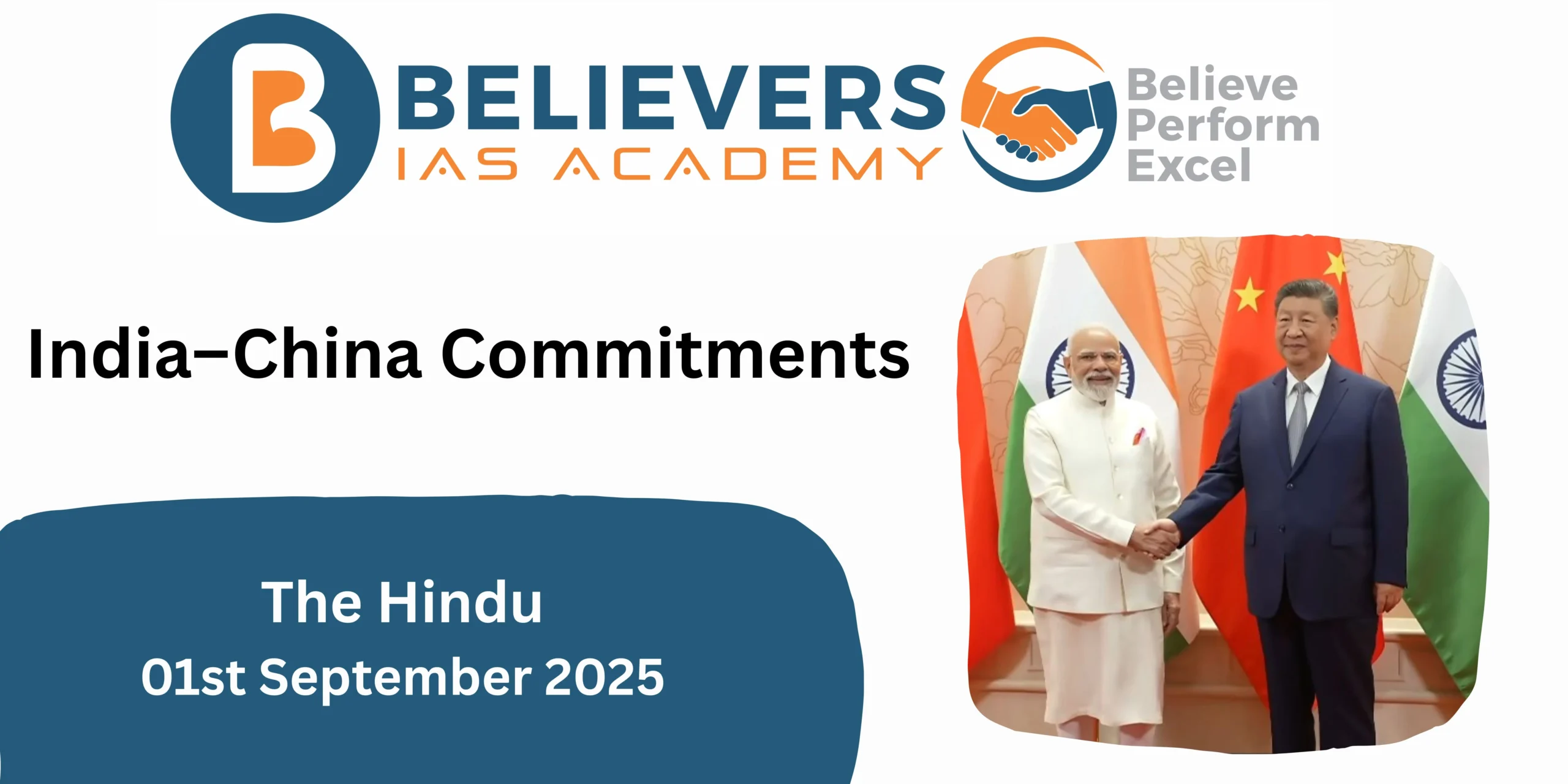
India–China Commitments
Context
-
PM Modi & President Xi met in Tianjin (Sept 2025) amid strained post-Galwan ties.
-
Objective: Reset ties through peace, trade & cooperation, while navigating U.S.–China trade tensions and South Asian competition.
Key Outcomes
1. Border Peace & Security
-
Modi: Peace & tranquillity on LAC = prerequisite for better ties.
-
Both leaders: Commitment to “fair, reasonable, mutually acceptable” boundary resolution.
-
Xi: Border should not define entire bilateral relationship.
2. Trade & Economy
-
Agreed on balanced trade, reduce India’s deficit.
-
Encouraged mutual investments.
-
Both see themselves as stabilisers of world trade amid U.S. tariff wars.
-
Modi: Growing India–China trade can “change world’s perception of China”.
3. People-to-People Links
-
More direct flights & visa facilitation.
-
Kailash Mansarovar Yatra resumed.
4. Global Cooperation
-
Counter-terrorism support.
-
Coordination in multilateral forums on fair trade & global governance.
-
Both stressed strategic autonomy, avoided “third-country lens” (subtle U.S. reference).
5. Optics & Messaging
-
Xi: India & China are “partners, not rivals” → “dragon-elephant cooperative pas de deux”.
-
Modi: “Development partners, not rivals”.
⚖️ Opposition Criticism (Congress / Jairam Ramesh)
-
Govt. “legitimising” Chinese aggression post-Galwan 2020.
-
Modi’s June 19, 2020 statement = gave China a “clean chit” despite Army’s demand for status quo ante.
-
Govt. accepting a “new normal” of aggressive Beijing + passive India.
-
Concerns:
-
China–Pakistan coordination (Operation Sindoor, July 2025).
-
China’s Yarlung Tsangpo hydel project → risk for NE India.
-
Chinese dumping → hurting Indian MSMEs.
-
🌏 Regional Context
-
Myanmar: Modi → support for peace process, free elections, development aid.
-
Maldives–China: Xi–Muizzu → FTA implementation, Belt & Road projects, fisheries/environment cooperation.
-
Maldives continues “India Out” tilt.
-
📊 Strategic Takeaways
-
India’s Approach → De-escalation + balancing: keep trade & multilateral cooperation alive while shelving hard border issues.
-
China’s Approach → Decouple border dispute from overall ties, present itself as cooperative power.
-
Domestic Politics → Opposition: reconciliation without restoring pre-Galwan LAC status quo = surrender.
-
Geopolitical Lens → Both avoid U.S. angle; prefer narrative of strategic autonomy.
-
Neighbourhood Angle → China deepening Maldives presence; India holding ground in Myanmar.


