
UPSC Interview Notes – Dakshina Kannada
Introduction & Geographic Profile
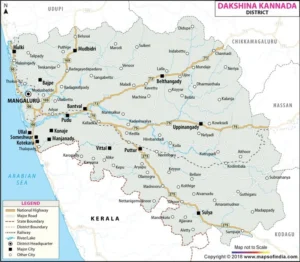
Dakshina Kannada (DK), with Mangaluru as its headquarters, is one of Karnataka’s most dynamic coastal districts. Located between the Arabian Sea on the west and the Western Ghats on the east, the district has a unique physiographic diversity—coastal plains, hilly midlands, and high-altitude ghats. It spans roughly 4,800+ sq km.
The district receives heavy monsoonal rainfall—often among the highest in Karnataka—creating a humid, tropical environment. The major rivers like Nethravathi, Kumaradhara, Shambhavi, Nandini, and Phalguni drain westward into the Arabian Sea, shaping agriculture, settlement patterns, and industry.
Expanded Historical Evolution
Ancient & Early Medieval Period
- Historically known as Tulu Nadu, the region has a distinct identity shaped by the Alupa dynasty, which ruled for almost 1,200 years.
- The region was a flourishing coastal trade centre connecting South India to Arab, Greek, and later Portuguese merchants.
- The Alupas contributed significantly to early Tulu culture, temple architecture, and maritime trade.
Vijayanagar & Keladi Influence
- With the fall of the Alupas, the region came under the Vijayanagara Empire, integrating it into one of India’s most prosperous political economies.
- Post-Vijayanagara, parts of Dakshina Kannada witnessed administrative influence of the Keladi Nayakas, especially in inland areas, which introduced new administrative mechanisms and temple patronage.
Mysore Sultanate
- The region was annexed by Hyder Ali in 1763 and later by Tipu Sultan, who strengthened Mangaluru as a strategic port town.
- Several forts, road networks, and port-related infrastructure were strengthened during this period.
Colonial Era & Administrative Reorganization
- After Tipu Sultan’s fall in 1799, the British took control and included the region within their Madras Presidency.
- The district became known for its missionary-led educational and health institutions, which sowed early seeds for DK’s high literacy and cosmopolitan character.
- In 1860, the large Kanara district was divided into North and South Kanara.
- After the linguistic reorganization of 1956, the district was integrated into the Mysore (now Karnataka) State.
- In 1997, the northern part of Dakshina Kannada was carved out to form Udupi district, giving DK its present boundaries.
Cultural Heritage Over Time
- Dakshina Kannada has preserved several indigenous cultural practices—Bhootha Kola, Yakshagana, Kambala—through centuries of cultural layering from Jain, Shaivite, Vaishnavite, and Islamic traditions.
- Moodabidri, called the “Jain Kashi,” preserves some of the finest Jain monuments including the Thousand Pillar Basadi.
Demographics & Social Profile
- The population is a little over 2 million, with one of Karnataka’s highest literacy rates (close to 88%).
- Sex ratio is favourable compared to many districts, with over 1,000 females per 1,000 males, reflecting social indicators above the national average.
- The society is multi-lingual and multi-ethnic:
- Tuluvas form the cultural core.
- Beary, Konkani, Kannada, Marathi, and Are Bhashe speaking communities coexist harmoniously.
- SCs form around 7%, and STs around 4% of the population.
- The district’s HDI is among the highest in Karnataka, with long-standing emphasis on education, health, and human capital.
Expanded Economic Profile
Dakshina Kannada has one of the most diversified and modern economies among Karnataka’s districts.
Agriculture & Plantation Economy
- Agriculture is dominated by plantation crops such as areca nut, coconut, cashew, pepper, cocoa, rubber, banana, and various spices.
- More than 90% of agricultural holdings are small and marginal, making DK a classic example of smallholder agriculture.
- Organic and traditional farming practices continue in the Western Ghats belt.
- Paddy cultivation, though declining due to labour shortages, remains prominent in river valleys.
Industrial & Manufacturing Hub
- Dakshina Kannada is one of Karnataka’s most industrialized districts, especially with regard to petrochemicals, fertilizers, and heavy engineering.
- Major industries include:
- MRPL (Mangalore Refinery & Petrochemicals Ltd)
- Mangalore Chemicals & Fertilizers (MCF)
- KIOCL
- BASF
- Multiple oil storage terminals and logistics hubs.
- A Petroleum, Chemicals and Petrochemical Investment Region (PCPIR) and industrial clusters near Mangaluru reinforce the district’s importance in national energy security.
Port-led Economy
- The New Mangalore Port is one of India’s major ports, handling petroleum products, LPG, LNG, timber, edible oil, fertilizers, coal, and container cargo.
- It is a major gateway for Karnataka’s imports and exports, particularly coffee, cashew, and containerized goods.
- The port catalyses logistics, warehousing, shipping, and transport services.
Banking & Services Sector
- DK is famously called the “Cradle of Modern Indian Banking”.
- Syndicate Bank, Canara Bank, Corporation Bank, Vijaya Bank, and Karnataka Bank all have roots in DK/Udupi region.
- The district has strong presence of:
- IT services
- Professional education
- Healthcare systems
- Hospitality and tourism
- The secondary sector contributes around 35%, and the tertiary sector around 55% to the district economy, reflecting its modernized socio-economic structure.
Fisheries & Marine Economy
- As a coastal district, DK has a significant deep-sea and mechanized fishing sector.
- Mangaluru is a major fish-landing centre with processing units, ice plants, and export-oriented seafood industries.
- Concerns include marine resource depletion, trawling impacts, and climate-induced disruptions to fisher livelihoods.
Expanded Culture & Heritage
Dakshina Kannada’s cultural landscape is one of the richest in South India.
Tuluva Culture
- The region is the nucleus of Tulu Nadu, with its own language (Tulu), scripts historically, and folk traditions.
- Society is known for distinctive matrilineal systems among certain communities (Aliyasantana).
Folk Traditions
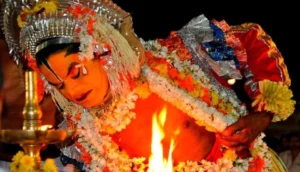
- Bhootha Kola: A spiritual performance tradition blending dance, trance, and community rituals.
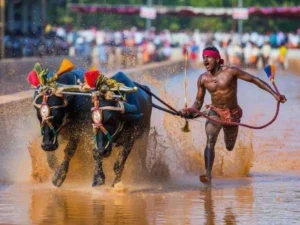
- Kambala: A traditional buffalo race held in water-filled paddy fields.
- Yakshagana: A vibrant dance-drama form combining music, dialogic narration, mythological themes, and elaborate costumes.
Religious Pluralism
- The district is home to major Hindu, Jain, Christian, and Islamic heritage sites:
- Dharmasthala Manjunatha Temple
- Subrahmanya Temple
- Moodabidri Jain Basadis
- Ullal Dargah
- St. Aloysius Chapel, known for its frescoes comparable to European Renaissance art.
Cuisine
- The cuisine is coconut-rich, with dishes like neer dosa, kori rotti, fish curry, patrode, and a variety of Beary and Konkani delicacies.
Festivals
- Dasara in Mangaluru, Keddasa (Tulu agricultural festival), Mosaru Kudike, and temple chariot festivals add to cultural vibrancy.
Developmental Challenges
Even with strong indicators, DK faces several governance challenges:
- Coastal erosion and climate vulnerability affecting fisherfolk and port infrastructure.
- Urban congestion in Mangaluru due to rapid industrial growth and migration.
- Declining enrollments in small rural schools due to demographic changes and preference for private/English-medium education.
- Shortage of social infrastructure such as hostels for minority and rural students.
- Balancing industrial growth with environmental sustainability, especially in the petrochemical belt.
Strategic & Administrative Relevance
- Critical gateway for India’s west-coast maritime trade through New Mangalore Port.
- Example of how a district can combine human development, economic modernization, and cultural preservation.
- Acts as a case study in coastal governance, port-led development, industrial-environmental regulation, and communal harmony.
- Its plantation economy and smallholder agriculture model are often cited in discussions on crop diversification and rural sustainability.
- UPSC Interview Relevance: How to Use This
Interviewers may test:
- Your understanding of coastal district development
- The district’s role in India’s energy and trade ecosystem
- The cultural uniqueness of Tulu Nadu
- Environmental challenges like coastal erosion
- The balance between industry, ecology, and society
- The region’s contribution to banking, education, and human capital


