
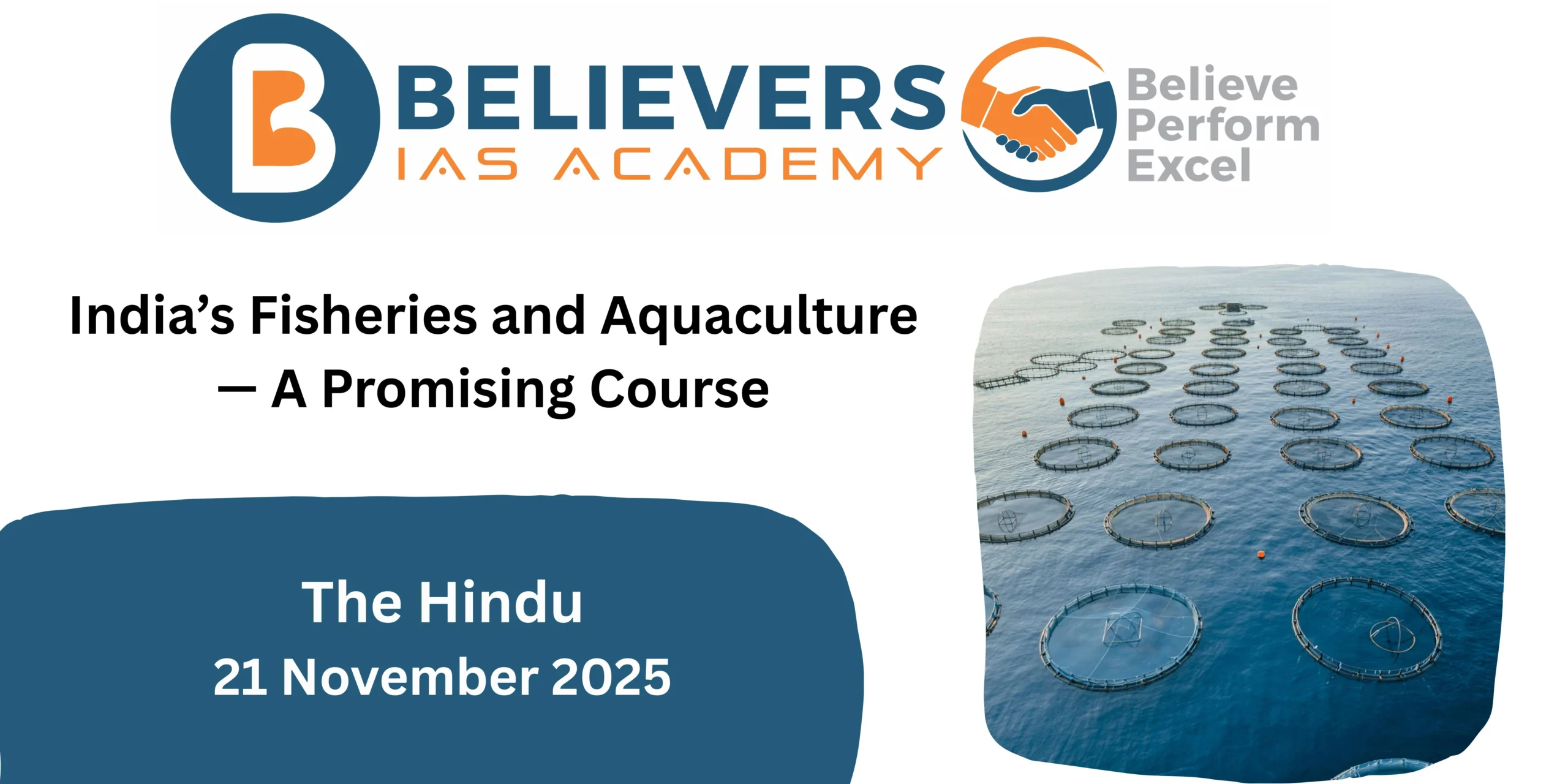
India’s Fisheries and Aquaculture — A Promising Course
Fisheries and aquaculture are among India’s fastest-growing food-producing sectors, supporting livelihoods, nutrition, and trade. India has seen a remarkable rise in aquatic food production driven by technological progress, institutional strengthening, and policy initiatives. However, environmental pressures and socio-economic challenges continue to constrain sustainability.
Growth & Transformation
-
As per SOFIA 2024, global aquaculture reached a record 130.9 million tonnes (2022).
-
India contributed 10.23 million tonnes, becoming the second-largest aquaculture producer in the world.
-
Total aquatic food production increased from 2.44 million tonnes (1980s) to 17.54 million tonnes (2022–23).
-
Growth driven by inland and brackish water aquaculture, improved infrastructure, and institutional and private-sector support.
Key Drivers
-
Institutions: ICAR fisheries institutes, MPEDA, National Fisheries Development Board, Coastal Aquaculture Authority.
-
Government Initiatives:
-
Blue Revolution
-
Pradhan Mantri Matsya Sampada Yojana (PMMSY)
-
Safety, digital and credit reforms (vessel transponders, KCC for fishers, Matsya Seva Kendras).
-
Climate-Resilient Coastal Fishermen Villages Programme
-
Draft National Fisheries Policy 2020
-
Challenges
-
Overfishing, habitat degradation, water pollution, climate change.
-
Inadequate traceability and post-harvest handling.
-
Poor access to finance, technology, and markets for small-scale fishers.
-
Risk of Illegal, Unreported and Unregulated (IUU) fishing.
FAO’s Role in India
FAO has been a long-standing partner in strengthening sustainable fisheries:
Major Collaborations
-
Bay of Bengal Programme (BOBP):
-
Improvements in small-scale fisheries, sea safety, post-harvest management.
-
-
Bay of Bengal Large Marine Ecosystem (BOBLME):
-
Ecosystem Approach to Fisheries Management (EAFM).
-
Support for tackling IUU fishing.
-
Conservation of endangered species.
-
-
GEF-funded project in Andhra Pradesh:
-
Promotes climate-resilient, sustainable aquaculture.
-
Guided by Guidelines for Sustainable Aquaculture (GSA) and Ecosystem Approach to Aquaculture (EAA).
-
-
FAO Technical Cooperation Programme (TCP):
-
Strengthening fishing ports (Vanakbara and Jakhau).
-
Focus on environmental, social and economic sustainability.
-
Way Forward: Sustainability at the Core
To sustain and enhance India’s fisheries sector:
-
Science-based stock assessment to manage fishing pressure.
-
Co-managed Monitoring, Control and Surveillance (MCS) to reduce IUU fishing.
-
Adoption of ecosystem-based approaches in both fisheries and aquaculture.
-
Improvements in traceability, certification and digital monitoring.
-
Ensuring inclusive development for small-scale fishers.
Conclusion
India’s fisheries and aquaculture sector is poised for continued growth within a Blue Economy framework. With sustainability, climate resilience, and smallholder inclusivity at the centre, FAO and India aim to build a robust aquatic food system that strengthens food security, reduces environmental impacts, and enhances global competitiveness.
Related Posts
Believers Mantra Magazine September-2025
Posted on

