
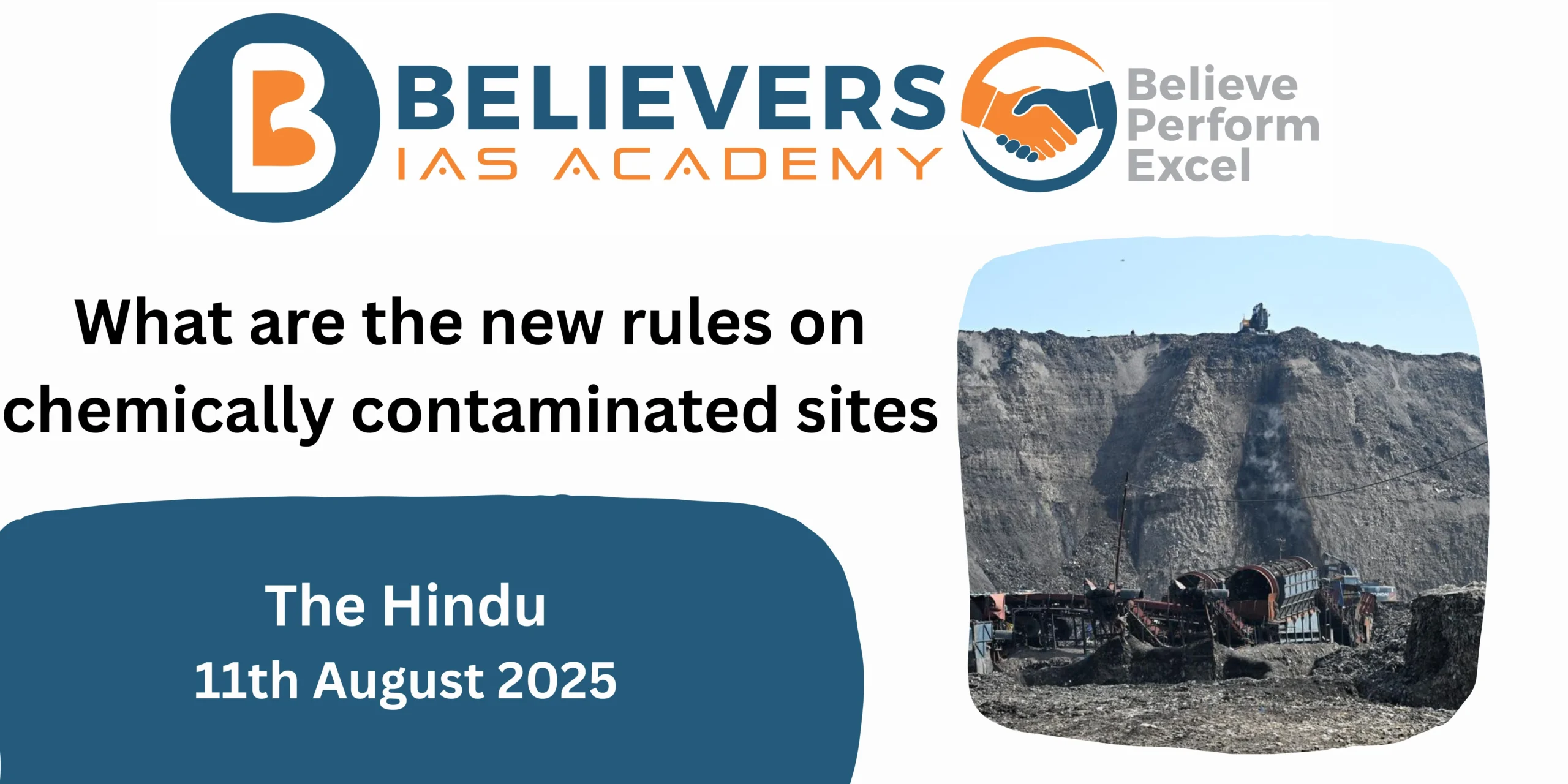
What are the new rules on chemically contaminated sites?
Context
-
Background: India has long faced issues with chemically contaminated sites — areas where hazardous wastes dumped in the past have polluted soil, groundwater, and surface water.
-
Gap in Regulation: Until 2025, there was no dedicated legal mechanism under the Environment Protection Act (EPA), 1986 to systematically identify, assess, and remediate such sites.
-
Government Action: On 25 July 2025, the Ministry of Environment, Forests and Climate Change (MoEFCC) notified these rules, providing the missing legal codification for contaminated site management.
What are Contaminated Sites?
-
Definition (Central Pollution Control Board – CPCB): Sites with historical dumping of hazardous or other wastes, leading to:
-
Soil contamination
-
Groundwater pollution
-
Surface water pollution
-
-
Sources:
-
Old landfills and dumps
-
Waste storage & treatment sites
-
Spill-sites
-
Chemical waste handling/storage areas
-
-
Scale of the Problem:
-
103 sites identified across India.
-
Remediation started in only 7 sites.
-
Many sites pre-date waste management laws.
-
Polluters often closed operations or cannot afford clean-up costs.
-
Tasks under the Capacity Building Program for Industrial Pollution Management Project (2010)
Objective: Develop a National Programme for Remediation of Polluted Sites.
Three Major Components:
-
Inventory Creation – Prepare a list of probable contaminated sites.
-
Guidance Development – Formulate standard methods for site assessment and remediation.
-
Legal, Institutional & Financial Framework – Establish enforceable rules and mechanisms for remediation costs (fulfilled now through the 2025 rules).
Key Provisions of the 2025 Rules
-
Identification & Reporting
-
District administration to prepare half-yearly reports on suspected contaminated sites.
-
State Pollution Control Board (SPCB) or a reference organisation to conduct:
-
Preliminary assessment within 90 days.
-
Detailed survey and contamination confirmation within 3 months.
-
-
-
Contamination Criteria
-
Assessment based on 189 hazardous chemicals listed under Hazardous and Other Wastes (Management and Transboundary Movement) Rules, 2016.
-
If levels exceed safe limits:
-
Public notification of the site.
-
Restrictions on access.
-
-
-
Remediation Process
-
Reference organisation to prepare a remediation plan.
-
SPCB to identify responsible party within 90 days.
-
Polluter Pays Principle – Responsible party bears full remediation cost.
-
If no responsible party identified or unable to pay, costs borne jointly by Centre & State.
-
-
Liability
-
If contamination caused loss of life or injury, criminal liability under Bharatiya Nyaya Sanhita, 2023.
-
-
Exemptions
-
Not covered under these rules:
-
Radioactive waste contamination.
-
Mining-related contamination.
-
Marine oil pollution.
-
Solid waste dump sites.
-
-
These are covered under separate laws.
-
Concerns & Limitations
-
No fixed timeline for completing remediation once a site is identified.
-
Potential delays due to bureaucratic and technical processes.
-
Dependence on State capacity and funding in case polluter is untraceable.
Conclusion
The Environment Protection (Management of Contaminated Sites) Rules, 2025 mark a significant step in closing India’s regulatory gap for legacy hazardous waste sites. By legally mandating identification, public disclosure, and remediation responsibilities, these rules operationalise the polluter pays principle and enhance environmental governance. However, the absence of strict remediation deadlines and exemptions for certain categories of contamination may dilute their impact. For effectiveness, the rules need strong institutional coordination, adequate funding, and community participation in monitoring.


