
The Ordinance Question Before the Supreme Court
Why in News?
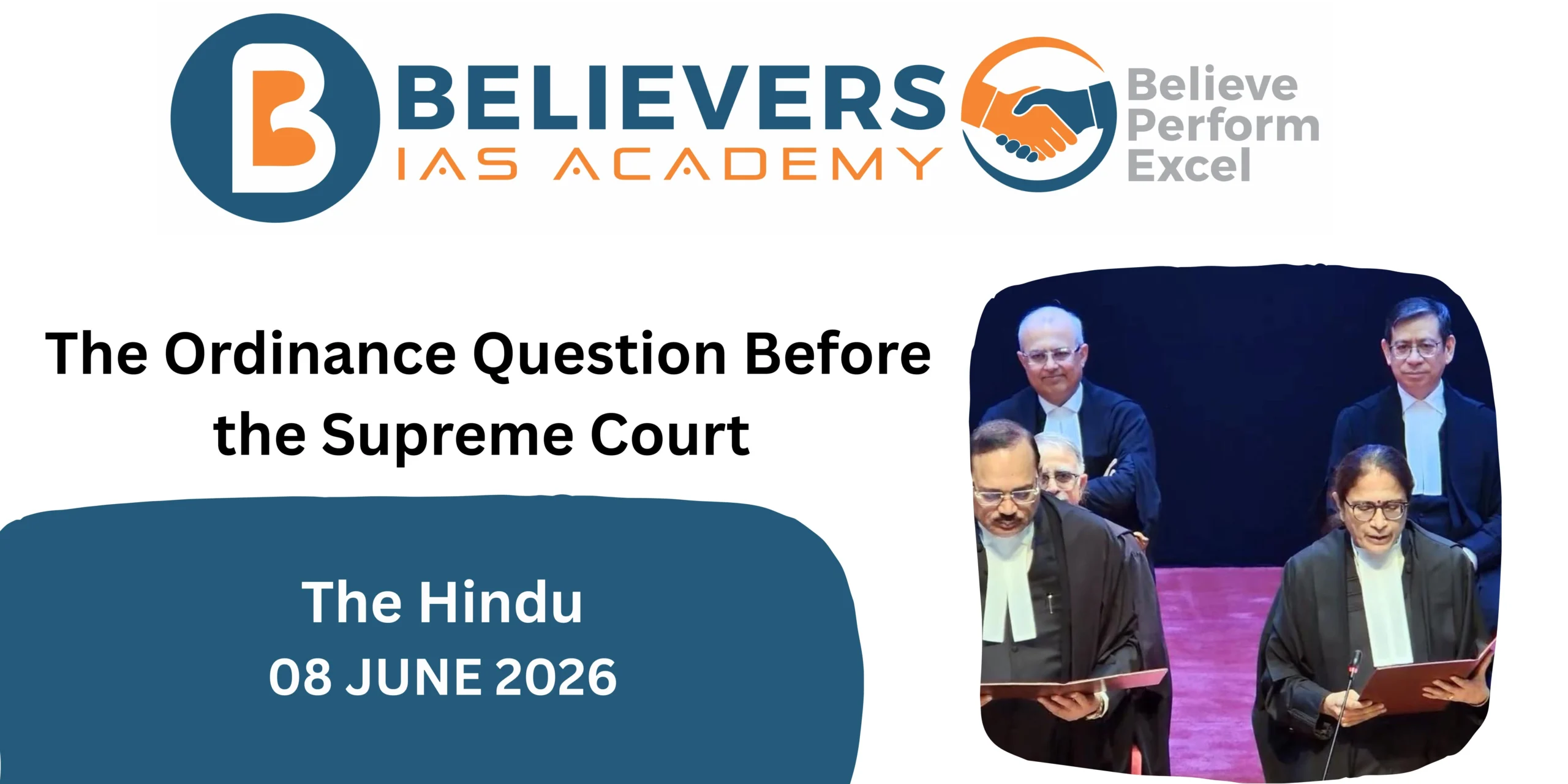
The Union Government increased the sanctioned strength of the Supreme Court from 34 to 38 judges through an Ordinance under Article 123. Acting on this, the Supreme Court Collegium recommended and the government appointed five new judges, three of whom occupy posts created solely by the Ordinance. This has sparked a debate on judicial independence, security of tenure, and the role of the Collegium in accepting appointments to Ordinance-created posts.
What is the Collegium System?
The Collegium System is the mechanism through which judges of the Supreme Court and High Courts are appointed and transferred.
Composition of the Supreme Court Collegium
- Chief Justice of India (CJI)
- Four senior-most judges of the Supreme Court
Constitutional Basis
- Not explicitly mentioned in the Constitution.
- Evolved through the:
- First Judges Case
- Second Judges Case
- Third Judges Case
Significance
- Ensures judicial primacy in appointments.
- Protects judicial independence from executive interference.
- Forms an important component of the independence of the judiciary.
Constitutional Provisions Involved
Article 124(1)
- Parliament determines the number of Supreme Court judges through law.
Article 123
- President can promulgate Ordinances when Parliament is not in session.
- Ordinances have the same force as an Act of Parliament.
- They cease to operate six weeks after Parliament reassembles unless approved.
Core Issue
The concern is not about the merit of the judges appointed but about:
- The Collegium accepting appointments to posts created through a temporary Ordinance.
- Whether such acceptance compromises the perception of judicial independence.
- Whether judges occupying such posts may appear dependent on executive and parliamentary approval.
Why is the Collegium Being Questioned?
1. Departure from Its Traditional Stand on Independence
The Collegium has historically defended judicial autonomy against executive influence.
In:
Supreme Court Advocates-on-Record Association v. Union of India
- The Supreme Court struck down the National Judicial Appointments Commission (NJAC).
- The Court held that judicial primacy in appointments is essential for judicial independence.
Critics argue that by accepting Ordinance-created posts, the Collegium has accepted a situation where some judicial positions depend on executive action.
2. Dependence on Parliamentary Approval
The additional posts continue only if Parliament converts the Ordinance into law.
Thus:
- The existence of these positions depends on future legislative approval.
- This creates an appearance that some judges hold office subject to executive and parliamentary goodwill.
3. Inconsistency with Earlier Judgments on Ordinances
D.C. Wadhwa v. State of Bihar
- Re-promulgation of Ordinances was termed a “fraud on the Constitution.”
Krishna Kumar Singh v. State of Bihar
- Ordinance-making power cannot be used as a substitute for legislation.
The criticism is that the Collegium accepted appointments based on a temporary legislative instrument that the Court itself has viewed cautiously.
Possible Justifications for the Collegium’s Decision
Addressing Vacancies and Pendency
- The Supreme Court faces a growing workload and rising pendency.
- Additional judges can improve disposal of cases.
Constitutional Validity of the Ordinance
- While in force, an Ordinance has the same legal status as an Act.
- Therefore, appointments made under it are legally valid.
Practical Considerations
- The government has sufficient parliamentary strength to pass the replacement legislation.
- The Collegium may have assumed that the Ordinance would soon be converted into a permanent law.
Broader Constitutional Concerns
Judicial Independence
A basic feature of the Constitution requiring freedom from actual or perceived executive influence.
Security of Tenure
Judges should not face uncertainty regarding the legal basis of their office.
Separation of Powers
Each organ must function without undue dependence on another.
Institutional Credibility
Public confidence depends not only on actual independence but also on the appearance of independence.
Conclusion
The controversy is as much about the Collegium’s institutional judgment as it is about the Ordinance itself. By recommending appointments to posts whose existence depends on subsequent parliamentary approval, the Collegium has invited scrutiny regarding the perception of judicial independence. Even if Parliament ultimately converts the Ordinance into law, the episode raises important questions about whether the judiciary should avoid arrangements that could create any appearance of dependence on the executive or legislature.
UPSC Mains Question
“The recent appointment of Supreme Court judges to posts created through an Ordinance has reopened the debate on judicial independence and the role of the Collegium system.” Critically examine. (15 Marks, 250 Words)


