
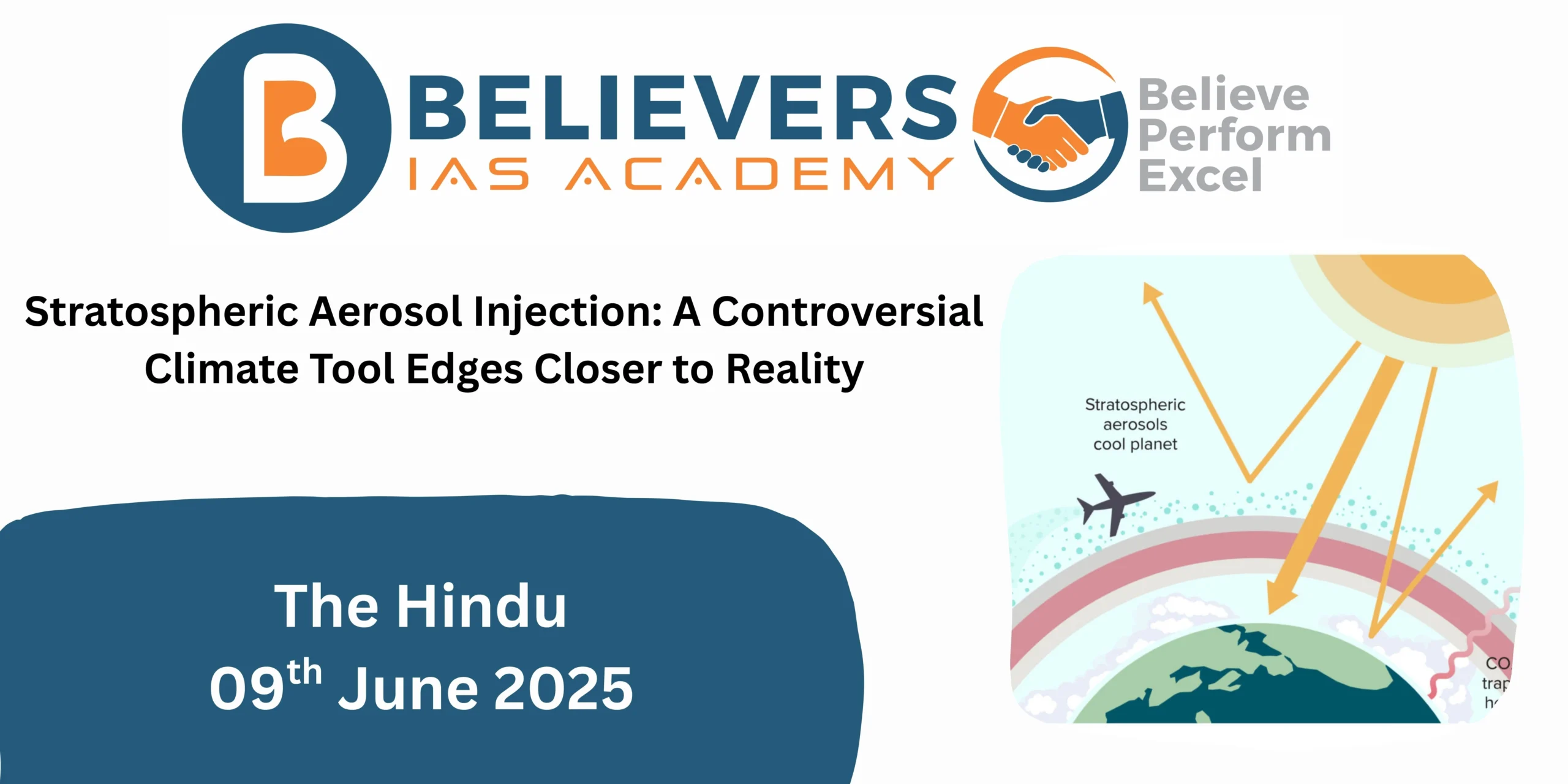
Stratospheric Aerosol Injection: A Controversial Climate Tool Edges Closer to Reality
Relevance : GS3 (Environment, Science & Technology)
Context
Climate change is one of the most pressing global challenges of our time. While the Paris Agreement and international efforts focus on reducing greenhouse gas emissions, progress has been slow and inconsistent. In this context, scientists have been exploring alternative or complementary technologies that might help mitigate global warming. One such emerging and controversial method is Stratospheric Aerosol Injection (SAI) — a form of solar geoengineering.
What is Stratospheric Aerosol Injection (SAI)?
Stratospheric Aerosol Injection involves injecting fine particles, such as sulphur dioxide, into the stratosphere (approximately 20 km above the Earth’s surface). These particles reflect a portion of the sun’s rays back into space, creating a cooling effect, similar to what happens naturally during large volcanic eruptions like Mount Pinatubo in 1991.
New Study Offers a Pragmatic Twist
A recent study published in Earth’s Future explores a more accessible and cost-effective approach to implementing SAI. Traditionally, the method has been studied at high altitudes (20 km or more), primarily over the equator, requiring specially designed aircraft — expensive and technologically challenging.
However, the new study, led by Alistair Duffey of University College London, proposes using existing commercial aircraft like the Boeing 777F to perform low-altitude injections (around 13 km), particularly in polar and extratropical regions where the stratosphere is closer to the Earth’s surface.
Key Findings
-
Injecting 12 million tonnes of sulphur dioxide annually at 13 km could reduce global temperatures by 0.6°C.
-
To achieve a 1°C cooling, around 21 million tonnes would be required — similar to the Mount Pinatubo effect.
-
Higher altitudes and subtropical injections remain more efficient: only 7.6 million tonnes needed for the same effect at 20 km.
-
Seasonal spraying during local spring and summer increases effectiveness.
-
This approach could be implemented more quickly and cheaply since it avoids the need for new aircraft.
Relevance to India and the World
India, as a climate-vulnerable country with high dependency on monsoons and agriculture, has a keen interest in global climate mitigation efforts. However, any unilateral deployment of SAI by other nations could affect regional weather patterns, potentially disrupting rainfall, agriculture, and even leading to geopolitical tensions.
The technique also has environmental risks:
-
Delayed ozone layer recovery
-
Acid rain
-
Unintended climate side effects
-
Unequal cooling effects, benefiting polar regions more than the tropics
Moreover, SAI might mask symptoms of climate change without addressing the root cause — greenhouse gas emissions — leading to complacency among policymakers.
Controversy and Ethical Dilemmas
SAI is inherently global in impact, making it a highly controversial approach. If one country initiates such a program, the effects would be felt worldwide, raising concerns about fairness, consent, and accountability. This has led many scientists and civil society groups to urge caution:
-
In 2021, the US National Academies recommended transparent research into solar geoengineering.
-
By 2022, several global scholars called for a moratorium on such R&D, warning it is currently ungovernable in a just and democratic way.
Conclusion
As the world struggles to meet climate targets, solar geoengineering — particularly Stratospheric Aerosol Injection — is gaining attention. While this new study offers a cheaper and more feasible pathway to implementation, the risks, ethics, and governance challenges remain unresolved.
Related Posts


Dissonance in RBI’s inflation messaging
Posted on
