

Strait of Hormuz: The Waterway Where America Stalled
Context
The Strait of Hormuz, connecting the Persian Gulf to the Arabian Sea through the Gulf of Oman, has emerged as the most critical geopolitical flashpoint in the ongoing U.S.-Israel-Iran conflict. Iran’s effective control over this strategic chokepoint has disrupted global energy supplies, increased shipping costs, and exposed the limits of military power in securing vital maritime routes.
Why is the Strait of Hormuz Important?
Geographical Significance
- The Strait of Hormuz is the only maritime gateway connecting the Persian Gulf to the Arabian Sea and the wider Indian Ocean.
- It is:
- About 50 km wide at its entrance and exit.
- Only 33 km wide at its narrowest point, lying between Iran and Oman.
- The narrow shipping corridor consists of:
- 2-nautical-mile inbound lane.
- 2-nautical-mile outbound lane.
- 2-nautical-mile buffer zone.
Iran’s Geographic Advantage
Iran enjoys a dominant position because:
- It controls 7 of the 8 major islands in the Strait.
- Key islands include:
- Qeshm Island
- Hormuz Island
- Larak Island
- Abu Musa
- These islands are located close to shipping lanes, enabling Iran to monitor and influence maritime traffic.
Strategic and Economic Importance
Global Energy Lifeline
- Around 25% of global seaborne oil trade passes through the Strait.
- Nearly 20% of global LNG trade moves via this route.
- Approximately 20 million barrels of oil per day transit through Hormuz.
- Nearly 3,000 ships per month used the route before the conflict.
Countries Dependent on Hormuz
The economies of:
- Saudi Arabia
- Qatar
- United Arab Emirates
- Kuwait
- Iraq
- Bahrain
- Iran
depend heavily on the strait for exports and imports.
Beyond Oil
The route is also critical for:
- LNG exports.
- Fertilizer shipments.
- Food imports.
- Medicines.
- Technology products.
How Iran Weaponised Geography
Historical Precedent
- During the Iran-Iraq War, both sides targeted oil tankers in the Persian Gulf.
- Iran has repeatedly threatened to close Hormuz if attacked.
Asymmetric Warfare Strategy
Despite suffering extensive damage to its conventional military infrastructure:
- Iran relied on:
- Fast attack boats.
- Naval mines.
- Drones.
- Anti-ship missiles.
- IRGC maritime operations.
- Instead of defeating superior U.S. naval forces directly, Tehran increased the cost of navigation through the strait.
Impact
- Ship traffic reportedly declined by over 90%.
- Insurance premiums surged.
- Freight and shipping rates increased sharply.
- Global fuel prices rose.
- Energy-importing countries, including India, faced economic pressure.
Why the U.S. Struggled
Limits of Conventional Military Power
The conflict demonstrated that:
- Military superiority does not guarantee control over maritime chokepoints.
- Geography can provide strategic leverage to smaller powers.
- Asymmetric tactics can impose disproportionate costs on stronger adversaries.
Diplomatic Deadlock
According to the article:
- The U.S. demanded reopening of the Strait.
- Iran linked the issue to broader political and security concerns.
- Tehran established the Persian Gulf Strait Authority (PGSA) to regulate maritime traffic.
- A permit-based system for vessels further institutionalized Iranian control.
Implications for India
Energy Security Concerns
India remains vulnerable because:
- A substantial portion of its crude oil imports originates in the Gulf.
- Higher oil prices worsen:
- Current Account Deficit (CAD).
- Inflation.
- Fiscal pressures.
Maritime and Strategic Concerns
- Reinforces the importance of diversifying energy sources.
- Highlights the need for strategic petroleum reserves.
- Strengthens India’s interest in secure sea lanes in the Indian Ocean Region.
Mapping the Strait of Hormuz
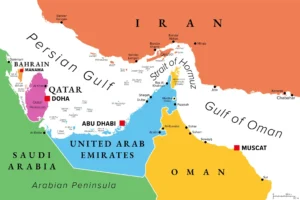
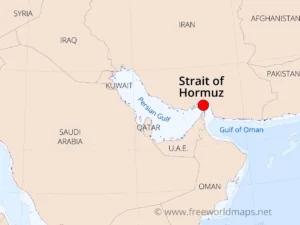
Countries and Regions to Locate on the Map
| Country/Region | Significance |
|---|---|
| Iran | Controls the northern coast of the strait and most strategic islands. |
| Oman | Controls the southern side through the Musandam Peninsula. |
| United Arab Emirates | Adjacent to the strait; involved in island disputes with Iran. |
| Saudi Arabia | Major oil exporter dependent on Hormuz. |
| Qatar | World’s leading LNG exporter; heavily reliant on the strait. |
| Kuwait | Oil exports pass through Hormuz. |
| Bahrain | Gulf state dependent on maritime access. |
| Iraq | Significant oil exports transit through the Gulf. |
| India | Major energy importer affected by disruptions. |
Important Water Bodies
- Persian Gulf
- Gulf of Oman
- Arabian Sea
- Caspian Sea
Strategic Islands to Mark
- Qeshm Island
- Hormuz Island
- Larak Island
- Abu Musa
- Greater Tunb
- Lesser Tunb
- Musandam Peninsula
UPSC Mains Question
“The Strait of Hormuz has once again demonstrated how geography can shape global geopolitics and energy security. Examine the strategic significance of the Strait of Hormuz and analyse its implications for India.” (15 Marks, 250 Words)


