
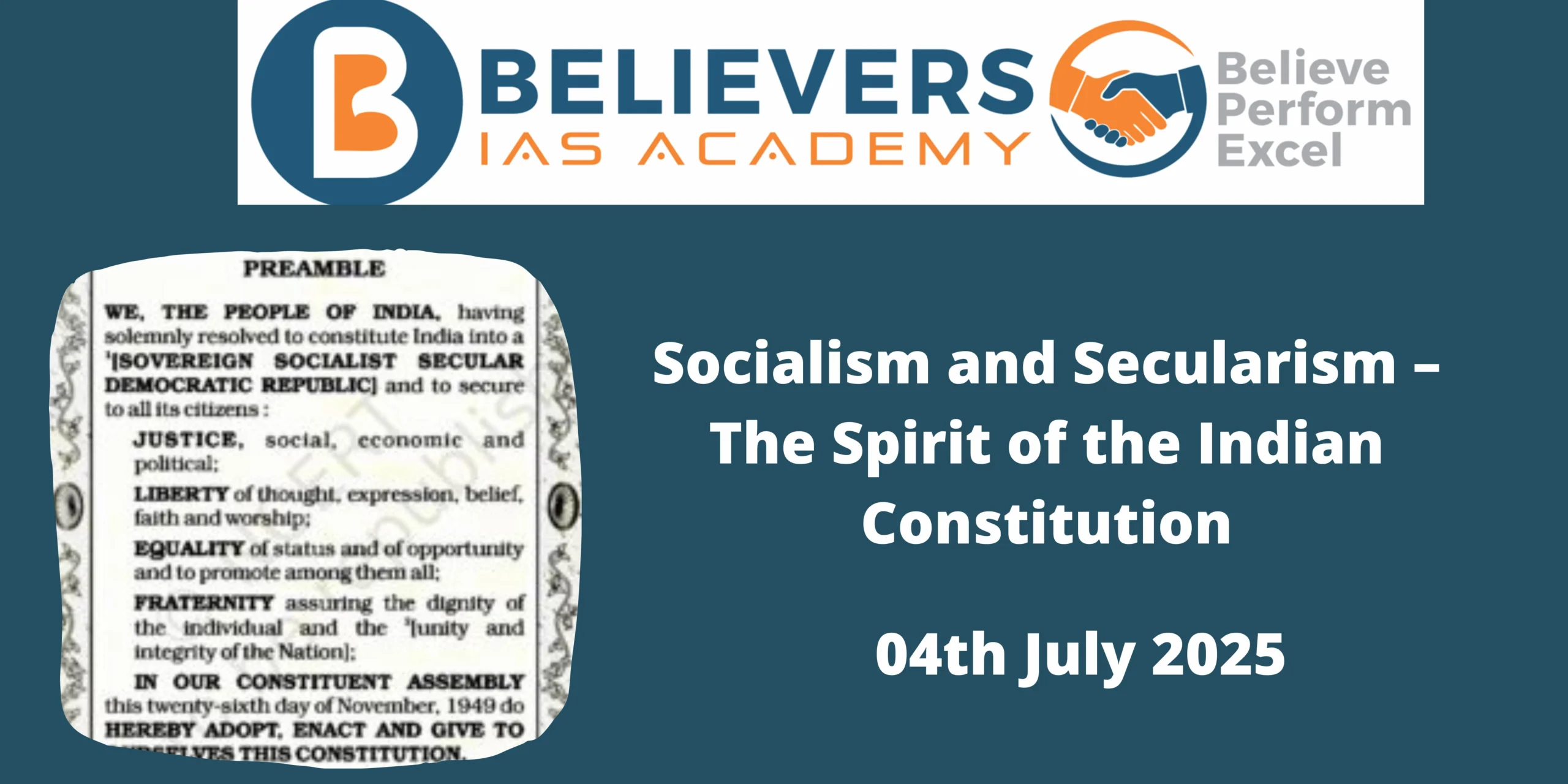
Socialism and Secularism – The Spirit of the Indian Constitution
(GS Paper II – Indian Constitution | Preamble | Basic Structure | Welfare Governance)
Context (2025 Current Affairs)
- Recent demands to remove ‘socialism’ and ‘secularism’ from the Preamble have sparked constitutional debate.
- Critics argue these principles reflect the foundational values of the Constitution and form part of its Basic Structure, which cannot be amended or erased.
- Socialism in the Indian Constitution
🔹 Meaning
- Indian socialism ≠ Marxist state control
- Instead: Democratic Socialism → aims at social & economic justice, welfare of all, and reduction of inequality.
🔹 Preamble Reference
- Originally absent, but spirit present (e.g., “Justice: social, economic and political”)
- 42nd Amendment Act, 1976: Inserted “Socialist” into the Preamble during the Emergency.
🔹 Fundamental Rights Enabling Socialism
- Article 14: Equality before law
- Article 15: No discrimination on religion, caste, sex, etc.
- Article 16: Equality in public employment
➡️ These uphold social equality and inclusion.
🔹 Directive Principles of State Policy (DPSP)
- Article 38: Social order to promote welfare of people
- Article 39: Equal pay, livelihood, equitable distribution of resources
- Articles 41–43: Right to work, education, public assistance
➡️ These are non-justiciable but act as guiding principles for welfare legislation.
- Secularism in the Indian Constitution
🔹 Meaning of Indian Secularism
- Positive secularism: Equal respect for all religions, not strict separation as in Western models.
- Protects religious freedoms while allowing the State to intervene for social reform.
🔹 Preamble Reference
- Added by 42nd Amendment (1976)
- Originally reflected in “Liberty of belief, faith and worship” and “Fraternity”
🔹 Constitutional Provisions
- Articles 25–28: Freedom of religion
- Articles 29–30: Minority cultural and educational rights
- Article 25(2)(a): Allows the State to regulate religious practices for social welfare (e.g., temple entry, triple talaq).
III. Judiciary on Socialism and Secularism
🔹 Kesavananda Bharati v. State of Kerala (1973)
- Introduced Basic Structure Doctrine
- Declared secularism as a part of the Basic Structure – cannot be amended by Parliament.
🔹 Minerva Mills v. Union of India (1980)
- Reaffirmed that socialism and social justice form part of the Basic Structure.
🔹 SR Bommai v. Union of India (1994)
- Secularism = constitutional morality
- Any political party or government that violates secular principles can be deemed unconstitutional.
- Historical Foundations
🔹 Objective Resolution (1946) – Jawaharlal Nehru
- Laid foundational principles of equality, liberty, and justice — precursors to secularism and socialism.
🔹 Dr. Ambedkar’s Vision (1949)
- Advocated economic equality (socialism) and religious freedom (secularism) as pillars of justice.
- Warned against social discrimination and religious majoritarianism.
Conclusion
The principles of socialism and secularism are not temporary or ideological impositions but essential to the spirit, structure, and functioning of the Indian Constitution. They reflect India’s diverse social fabric, uphold justice and equality, and act as safeguards against both economic exploitation and religious majoritarianism.
Attempts to remove them from the Preamble challenge not only symbolic commitments but also the substantive guarantees of the Constitution. As upheld by the Supreme Court, these principles are part of the Basic Structure and must remain inviolable in any constitutional democracy.
Mains Questions
GS Paper II – Polity and Governance
Q1. The ideals of socialism and secularism are not just words in the Preamble but core constitutional values. Critically examine in light of recent debates to remove them.
Q2. Discuss the relevance of the 42nd Constitutional Amendment in embedding socialism and secularism in the Preamble. Can these be amended or removed? Justify with reference to the Basic Structure Doctrine.


