
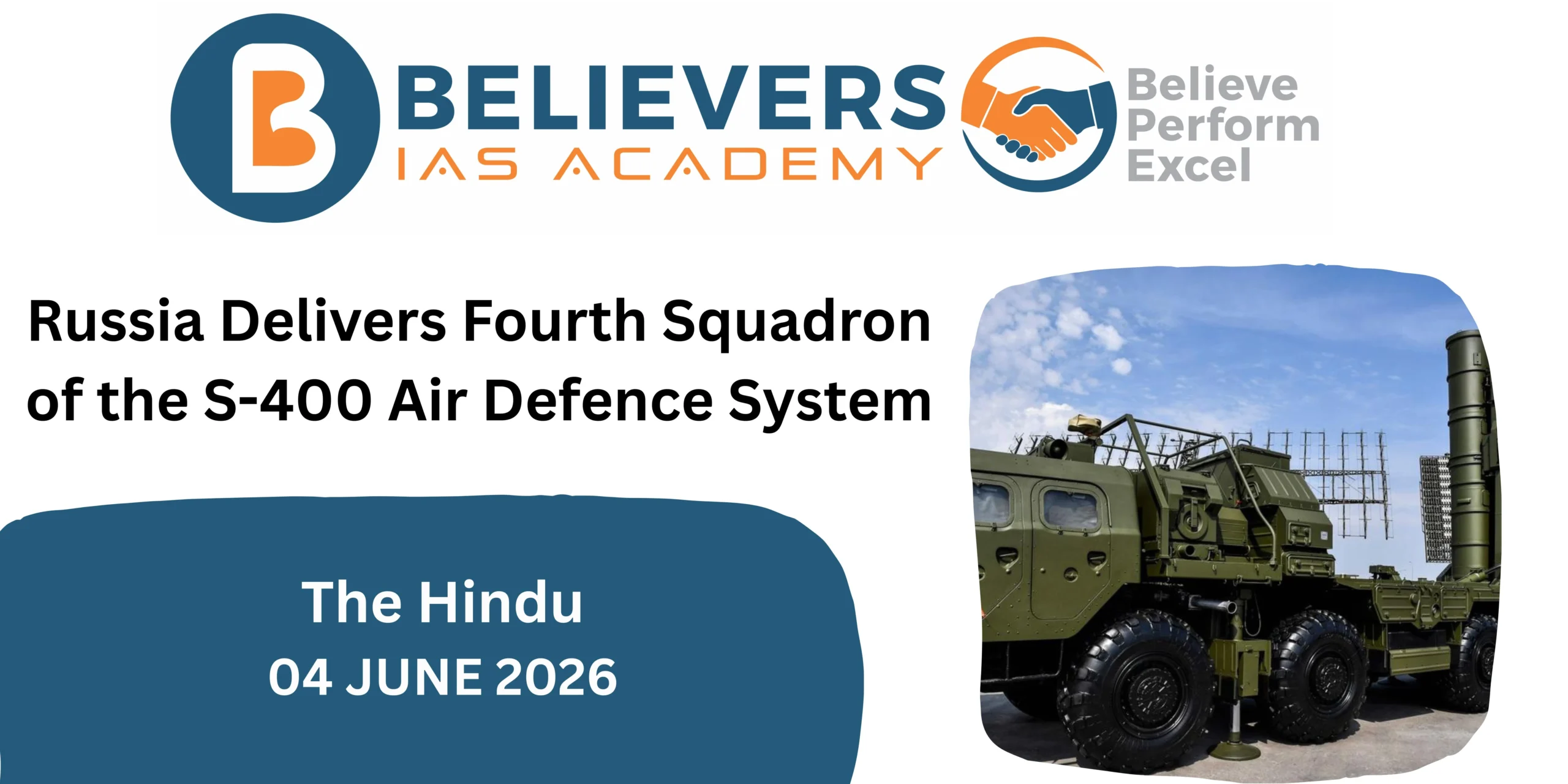
Russia Delivers Fourth Squadron of the S-400 Air Defence System
Why in News?
India has received the fourth squadron of the S-400 Triumf air defence system, a major boost to its long-range air defence capabilities.
- The delivery is part of the $5.43 billion India–Russia agreement signed in 2018.
- Three squadrons had already been inducted into service.
- The fourth squadron arrived after delays caused by the Russia–Ukraine conflict.
- The fifth and final squadron is expected to be delivered in 2027.
The induction further strengthens India’s multi-layered air defence architecture against modern aerial threats.
What is the S-400 “Sudarshan Chakra”?
The S-400 Triumf is a long-range, multi-layered Surface-to-Air Missile (SAM) system developed by the Russian defence company Almaz-Antey.
- NATO designation: SA-21 Growler
- Entered Russian service: 2007
- Indian designation: “Sudarshan Chakra”
The system is designed to detect, track, and destroy:
- Fighter aircraft
- Stealth aircraft
- Drones (UAVs)
- Cruise missiles
- Ballistic missiles
- Certain hypersonic threats
Key Features of the S-400
1. Long Detection and Engagement Range
- Detects targets up to 600 km away.
- Can engage threats at distances up to 400 km.
This enables early warning and long-range interception.
2. Multi-Layered Defence
The S-400 employs different missile types for different ranges, creating a layered shield against aerial threats.
| Missile Type | Approximate Range |
|---|---|
| 40N6 | 400 km |
| 48N6 | 250 km |
| 9M96E2 | 120 km |
| 9M96E | 40 km |
This allows interception of threats at multiple distances.
3. Multi-Target Engagement
- Can track nearly 80 aerial targets simultaneously.
- Can engage multiple targets at the same time.
This is particularly useful during saturation attacks involving drones, missiles, and aircraft.
4. Rapid Response Capability
- Tracking-to-launch cycle occurs within seconds.
- Uses advanced radar-guided missile technology.
- Effective against high-speed and maneuvering targets.
5. Integrated Components
Each S-400 squadron consists of:
- Command and control vehicle
- Long-range surveillance radar
- Engagement radar
- Missile launcher vehicles
- Support and communication systems
A squadron typically includes 16 or more vehicles.
AI Integration in the New Squadron
A significant development is the integration of Artificial Intelligence (AI)-enabled decision-support systems.
AI-Assisted Functions
- Threat detection
- Threat classification
- Target prioritisation
- Engagement recommendations
Human Control Maintained
The AI system will only assist operators.
Final firing authority remains with human operators, ensuring human oversight in combat decisions.
Strategic Importance for India
Strengthening Air Defence Network
The S-400 forms a critical layer in India’s integrated air defence system by complementing:
- Indigenous missile systems
- Radar networks
- Fighter aircraft
- Command-and-control infrastructure
Protection of Critical Assets
The system provides security cover for:
- Major cities
- Air bases
- Military installations
- Strategic infrastructure
- Nuclear assets
Deterrence Against Adversaries
The S-400 creates a powerful Anti-Access/Area Denial (A2/AD) capability by making hostile aerial operations highly risky.
This enhances India’s deterrence posture along both western and northern fronts.
Current Deployment in India
The S-400 systems are reportedly deployed in strategically important locations such as:
- Pathankot sector
- Siliguri Corridor
- Western Front
These deployments provide coverage against potential aerial threats from multiple directions.
Role in Operation Sindoor
According to defence reports, the S-400 system played a significant role during Operation Sindoor, reportedly intercepting more than 15 aerial threats and demonstrating the effectiveness of India’s layered air defence network.
Advantages of the S-400
Strengths
✔ Longest engagement range among operational SAM systems
✔ Simultaneous engagement of multiple targets
✔ Capability against aircraft, drones, cruise missiles, and ballistic missiles
✔ Mobility and rapid deployment
✔ Integration with network-centric warfare systems
✔ Strong deterrence value
Challenges and Limitations
Dependence on Foreign Technology
- Maintenance and spare parts depend on Russian support.
High Cost
- Procurement and lifecycle maintenance are expensive.
Evolving Threat Environment
- Future threats such as advanced hypersonic weapons may require further technological upgrades.
Related Posts

Neptune Cruise Missile
Posted on
Semiconductors in India
Posted on
