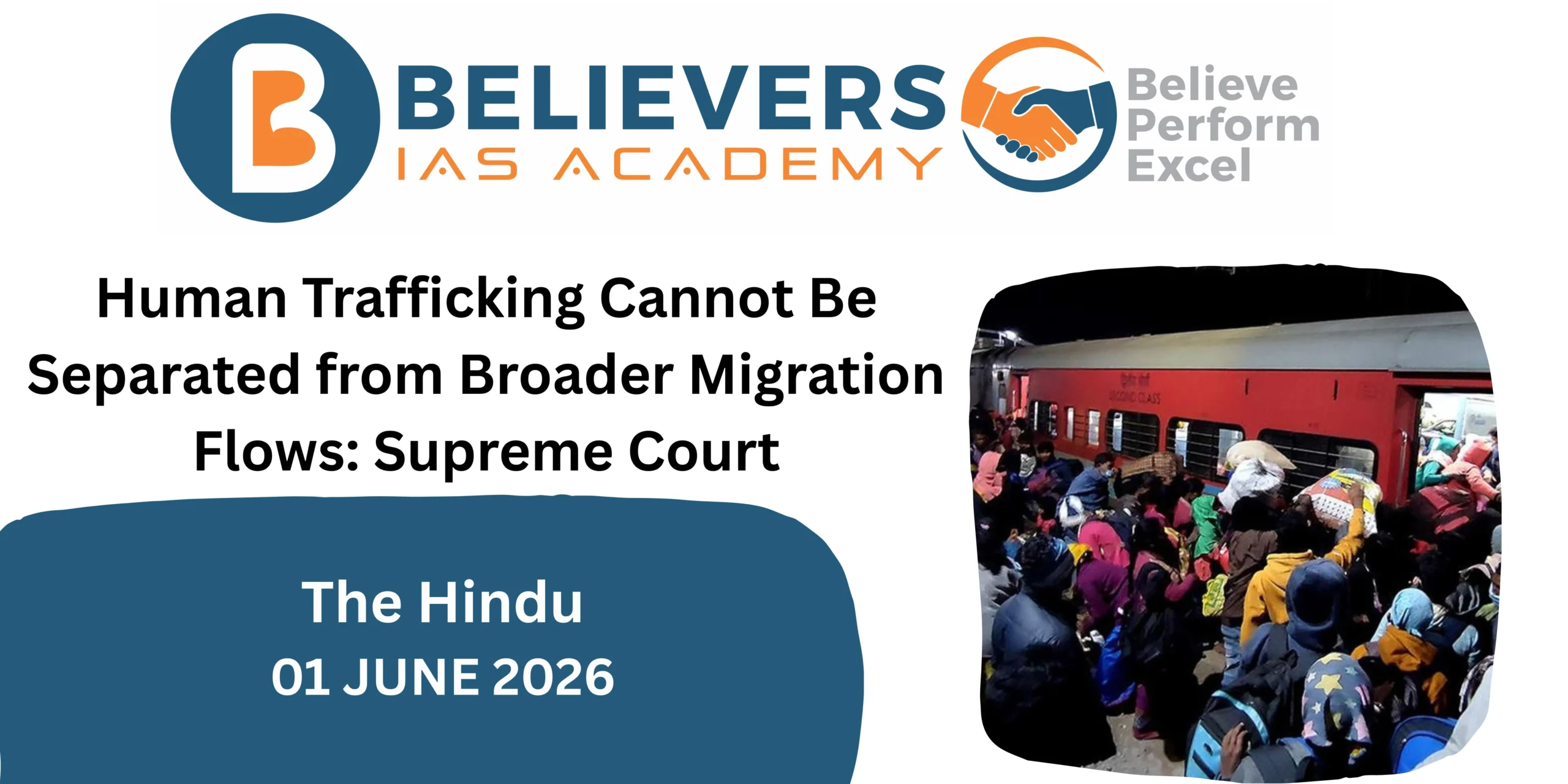
Human Trafficking Cannot Be Separated from Broader Migration Flows: Supreme Court
Context
The Supreme Court, in a landmark 297-page judgment, examined the interconnected issues of migration, human trafficking, and sex work. The Court observed that migration undertaken for livelihood often creates conditions that facilitate trafficking, particularly among women and children.
The judgment also reviewed the effectiveness of the Immoral Traffic (Prevention) Act, 1956 (ITPA) and highlighted the need to distinguish voluntary adult sex work from trafficking.
Key Observations of the Supreme Court
1. Human Trafficking and Migration are Interlinked
Human trafficking is one of the gravest forms of exploitation.
Migration, especially driven by poverty and lack of opportunities, can expose individuals to traffickers.
While all migration is not trafficking, trafficking frequently emerges from migration flows.
Structural inequalities, unemployment, gender discrimination, and economic vulnerability create conditions for exploitation.
Factors Facilitating Trafficking
Poverty and indebtedness
Lack of livelihood opportunities
Social and gender inequalities
Coercion and deception
Weak institutional protection mechanisms
Rights of Voluntary Adult Sex Workers
Supreme Court’s Position
The Court observed that the ITPA inadequately recognizes and protects the rights of voluntary adult sex workers.
Key Concerns
Social stigma leads to exclusion from legal and welfare protections.
Adult individuals engaged voluntarily in sex work often face harassment.
Existing laws sometimes treat all forms of prostitution as trafficking.
Important Observation- “Rights of sex workers can exist without there being a right to sex work.”
Implication
Recognition of basic human rights, dignity, health care, legal aid, and social security for sex workers.
Protection from violence, discrimination, and arbitrary state action.
Distinguishing Sex Work from Sex Trafficking
Court’s Criticism
The Court criticized the tendency of laws to conflate:
Voluntary adult sex work; and
Human trafficking for sexual exploitation.
Why Distinction is Necessary?
Voluntary Adult Sex Work
Sex Trafficking
Based on consent
Based on coercion/deception
Adult’s independent decision
Victim is exploited
No force or fraud
Involves force, abuse, fraud, or inducement
Rights-based approach needed
Criminal justice intervention needed
Court’s Recommendation
Revisit the legal framework.
Align domestic laws with international anti-trafficking standards.
Laws Discussed in the Judgment
1. Immoral Traffic (Prevention) Act (ITPA), 1956
Purpose
India’s primary legislation to combat trafficking for commercial sexual exploitation.
Supreme Court’s Concerns
a) Conflation of Sex Work and Trafficking
Treats prostitution involving third parties as trafficking even where:
No force,
No coercion,
No deception,
No inducement exists.
b) Harassment of Intended Beneficiaries
The law may inadvertently target and harass the very persons it seeks to protect.
c) Ambiguity Regarding Children
Does not explicitly exclude children from its ambit.
Creates interpretational and implementation challenges.
Need for Reform
Clear distinction between consensual adult sex work and trafficking.
Greater focus on victim protection and rehabilitation.
2. Section 143 of the Bharatiya Nyaya Sanhita (BNS), 2023
Definition of Human Trafficking
The Court noted that Section 143 follows the internationally accepted Act–Means–Purpose framework.
A. Act
Recruitment
Transportation
Transfer
Harbouring
Receipt of persons
B. Means
Force
Coercion
Abduction
Fraud
Deception
Abuse of power
Inducement
C. Purpose
Sexual exploitation
Forced labour
Slavery or slavery-like practices
Servitude
Organ removal
Supreme Court’s Interpretation
For trafficking to be established:
Act + Means + Purpose = Trafficking
All three elements must generally be present.
Significance
Mere involvement in prostitution does not automatically amount to trafficking.
Presence of coercive or deceptive means is essential.
3. Palermo Protocol (2000)
Full Name
Protocol to Prevent, Suppress and Punish Trafficking in Persons, Especially Women and Children
Background
Supplementary protocol to the United Nations Convention against Transnational Organized Crime.
Adopted in 2000.
India’s Status
Signed in 2002.
Ratified in 2011.
Core Framework
The protocol defines trafficking through:
Act + Means + Purpose
Importance
Global benchmark for anti-trafficking laws.
Victim-centric and rights-based approach.
Emphasizes prevention, prosecution, and protection.
Court’s Observation
Section 143 of BNS is broadly aligned with Palermo Protocol standards.
Significance of the Judgment
Governance Perspective
Recognizes trafficking as a socio-economic issue, not merely a criminal law issue.
Protection against exploitation (Articles 23 & 24)
Challenges in Combating Human Trafficking in India
Poverty and unemployment
Informal migration channels
Gender-based discrimination
Weak rehabilitation mechanisms
Cross-border trafficking networks
Lack of awareness among vulnerable populations
Social stigma attached to victims and sex workers
Way Forward
Reform ITPA to clearly distinguish trafficking from consensual adult sex work.
Strengthen safe migration frameworks and labour protections.
Improve victim rehabilitation and reintegration.
Enhance interstate and international cooperation.
Promote rights-based and victim-centric approaches.
Expand social protection and livelihood opportunities for vulnerable groups.
Improve implementation of anti-trafficking laws and victim support services.
UPSC Mains Question
“Human trafficking is often rooted in structural inequalities and migration vulnerabilities rather than merely criminal intent.” Examine in the light of the recent Supreme Court judgment. Also discuss the need to distinguish voluntary adult sex work from human trafficking. (15 Marks, 250 Words)
🕒 Weekend Batch Details
Class: Saturday & Sunday
Time: 10:00 AM – 05:00 PM
Test : Every Sunday
For more details, contact us 9611451616 [email protected]
Evening Batch
🕒Evening Batch Details
Class: Monday to Friday
Time: 05:00 PM – 08:00 PM
Test : Every Sunday
For more details, contact us 9611451616 [email protected]
Regular Batch
🕒 Regular Batch Details
Class: Monday to Friday
Time: 07.00 AM to 10:00 AM and 11.00 AM to 02.00 PM
Class: Saturday & Sunday
Time: 10.00 AM to 05.00 PM
🕒 Morning Batch Details Class: Monday to Friday Time: 07:00 AM – 10:00 AM Test : Every Sunday For more details, contact us 9611451616 [email protected]