
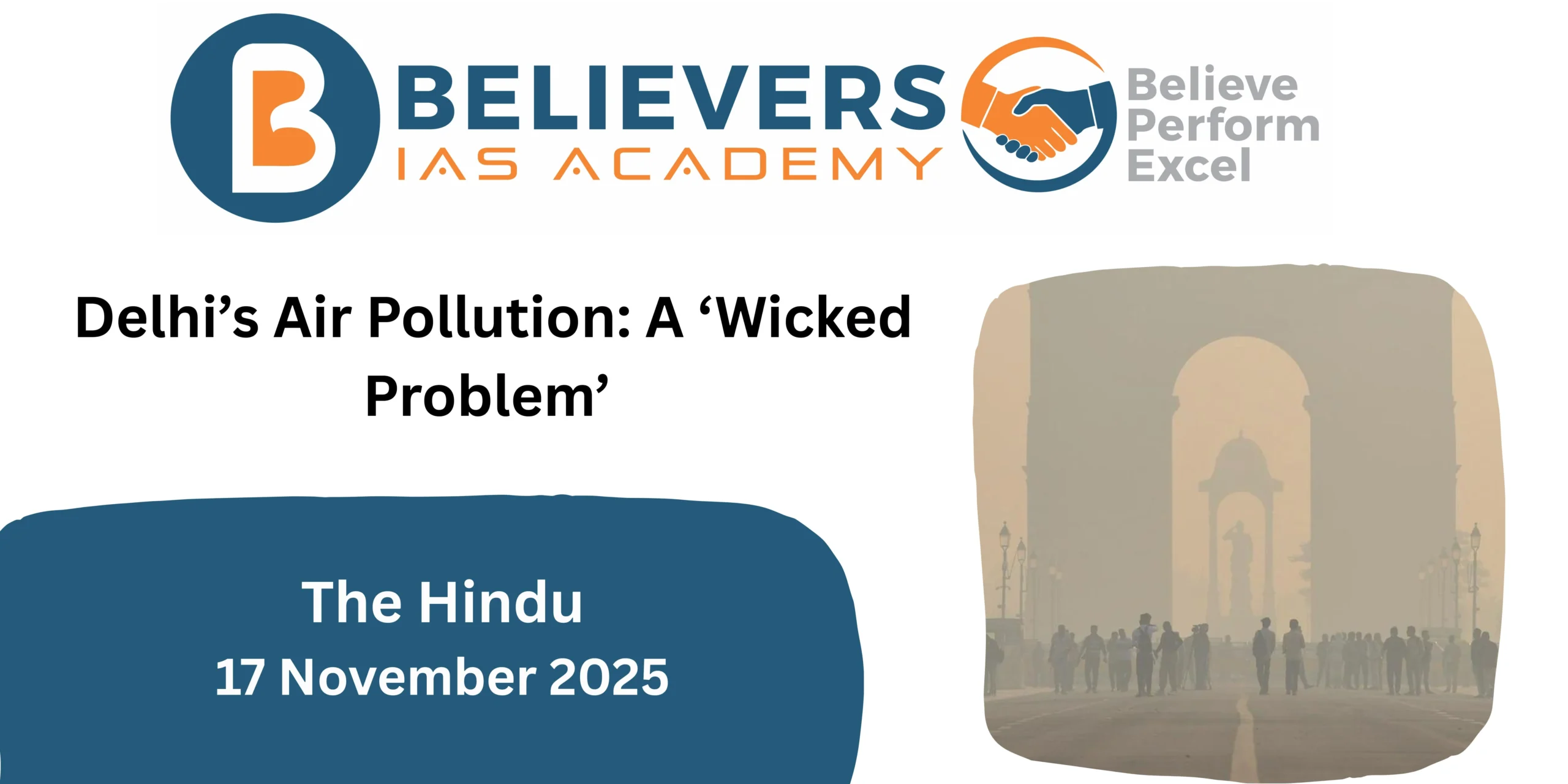
Delhi’s Air Pollution: A ‘Wicked Problem’
Context
Delhi faces a recurring severe air pollution crisis each winter, with AQI frequently breaching 400+ (Severe category), forcing school closures, flight delays, and emergency health advisories. Shashi Tharoor highlights this as a chronic public health emergency, not a seasonal issue.
Why it is a Wicked Problem
A “wicked problem” is one that is:
-
Complex and multi-causal
-
Cross-jurisdictional
-
Politically sensitive
-
Lacks a single solution
-
Consequences are unevenly distributed
Delhi’s air pollution fits this definition due to interlinked geographical, meteorological, and anthropogenic drivers.
Impact & Consequences
Health Impacts
-
May reduce life expectancy by up to 10 years
-
Increase in:
-
Asthma, bronchitis, COPD
-
Heart attacks, hypertension, strokes (PM2.5 enters bloodstream)
-
Cognitive decline, depression & anxiety (esp. children & elderly)
-
Auto-immune disorders: rheumatoid arthritis, lupus, multiple sclerosis
-
People are relocating from NCR at the cost of career opportunities due to health risks.
Economic Impacts
-
1.36% of India’s GDP (~$36.8 billion) lost annually due to:
-
Healthcare burden
-
Productivity loss
-
Premature deaths
-
-
Damages tourism, investment, and overall economic image
Causes – Multi-layered
Geography & Meteorology
| Factor | Impact |
|---|---|
| Basin-like topography, flanked by Aravallis | Restricts air flow |
| Temperature inversion (Oct–Jan) | Traps pollutants near ground |
| Low wind speed | Poor dispersion |
Similar to Los Angeles, which overcame it through policy & technology.
Vehicular Emissions
-
NCR has 3.3 crore+ registered vehicles
-
Diesel trucks, old buses, 2-wheelers → NOx & PM2.5
-
BS-VI compliance poorly enforced
Construction & Dust
-
~27% of PM2.5 load
-
Dust-control norms routinely violated
Industrial & Energy Sources
-
Outdated factories in NCR states emitting SO₂ and toxins
-
Some still coal-based or lacking emission filters
Agricultural Stubble Burning
-
Punjab & Haryana crop residue burning
-
Economic and machinery constraints despite subsidies
Episodic Pollution Additions
-
Diwali firecrackers (green crackers ineffective at scale)
-
Open waste burning
Global Models to Emulate
| City | Successful Interventions |
|---|---|
| London | ULEZ charging polluting vehicles + EV push + retrofitted energy-efficient buildings |
| Los Angeles | Strict vehicle emission norms + clean fuel + regional coordination |
| Beijing | Multi-year plan: shift industries, ban coal in cities, real-time monitoring → 35% PM2.5 reduction in 5 years |
Proposed Solutions / Policy Recommendations
Governance Reform
-
Unified Airshed Management Plan treating NCR as one pollution zone
-
Inter-state coordination: Delhi, Haryana, Uttar Pradesh, Rajasthan
-
Real-time public air quality dashboards to ensure transparency
Transport & Mobility
-
Accelerate EV adoption
-
Electrify public buses, expand metro network
-
Penalize high-emission vehicles; consider ULEZ-like zones
Construction & Waste
-
Strict dust-control enforcement
-
Ban and penalize open waste burning
Agriculture
-
Scale up:
-
Happy Seeder
-
Bio-decomposers
-
MSP-linked incentives for clean stubble management
-
Citizen Behavioural Change
-
School & community awareness
-
Shared responsibility approach
-
Reduce cracker use, private car dependency


