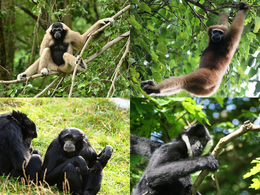
At a recent international conference on gibbons held in China, the conservation status of India’s sole ape raised questions.
What do we know about hoolock gibbon?
There are two types of Hoolock Gibbon which are seen in parts of North Eastern India and Parts of China
Eastern Hoolock Gibbon (Hoolock leuconedys):
Eastern Hoolock Gibbons are mostly found in Myanmar and southwest Yunnan, China, east of the Chindwin River.
The colour of the fur is mostly black.
Genetic study shows a split from a Western Hoolock Gibbon common ancestor around 1.42 million years ago.
distinct white eyebrows that are separated slightly more widely than those of a Western Hoolock gibbon.
Western Hoolock Gibbon: Hoolock hoolock, also known as the Western Hoolock Gibbon, is mostly found in Myanmar west of the Chindwin River.
Light brown or reddish brown is the colour of the fur.
Genetic research suggests that the Eastern Hoolock Gibbon and humans diverged from one another roughly 1.42 million years ago.
distinctive white eyebrows that are more closely spaced than those of an Eastern Hoolock gibbon.
What are the threats faced by the Hoolock gibbons (both species)?
Habitat encroachment: Human activities including farming, building infrastructure, and towns that invade gibbon habitats.
Fragmentation of the forest restricts the movement and availability of gibbons by dividing their habitats into smaller, isolated sections.
Gibbons are hunted for their meat, which is used as bushmeat, and for their various body parts, which are utilised in traditional medicine.
Pet trade: Gibbons are frequently taken in violation of the law and marketed as exotic pets.
What is the strength of these species and their conservative status?
In the last few decades, there has been a sharp drop in the population of the Eastern Hoolock Gibbon.
It was one of the top 25 most endangered primates in the world in 2009.
The likelihood of the Western Hoolock Gibbon surviving is decreasing as a result of habitat loss.
The International Union for Conservation of Nature (IUCN) Red List classifies it as Endangered.
Both species are recognized in India under Schedule 1 of the Indian (Wildlife) Protection Act of 1972.
The largest remaining population of Hoolock Gibbons is determined to be in Myanmar, according to a national Hoolock Gibbon status evaluation done in Myanmar between 2007 and 2011.
Hunting and logging were shown to be two major threats to both species.
The two main challenges to their survival were identified as habitat degradation and fragmentation.
🕒 Weekend Batch Details
Class: Saturday & Sunday
Time: 10:00 AM – 05:00 PM
Test : Every Sunday
For more details, contact us 9611451616 [email protected]
Evening Batch
🕒Evening Batch Details
Class: Monday to Friday
Time: 05:00 PM – 08:00 PM
Test : Every Sunday
For more details, contact us 9611451616 [email protected]
Regular Batch
🕒 Regular Batch Details
Class: Monday to Friday
Time: 07.00 AM to 10:00 AM and 11.00 AM to 02.00 PM
Class: Saturday & Sunday
Time: 10.00 AM to 05.00 PM
🕒 Morning Batch Details Class: Monday to Friday Time: 07:00 AM – 10:00 AM Test : Every Sunday For more details, contact us 9611451616 [email protected]