
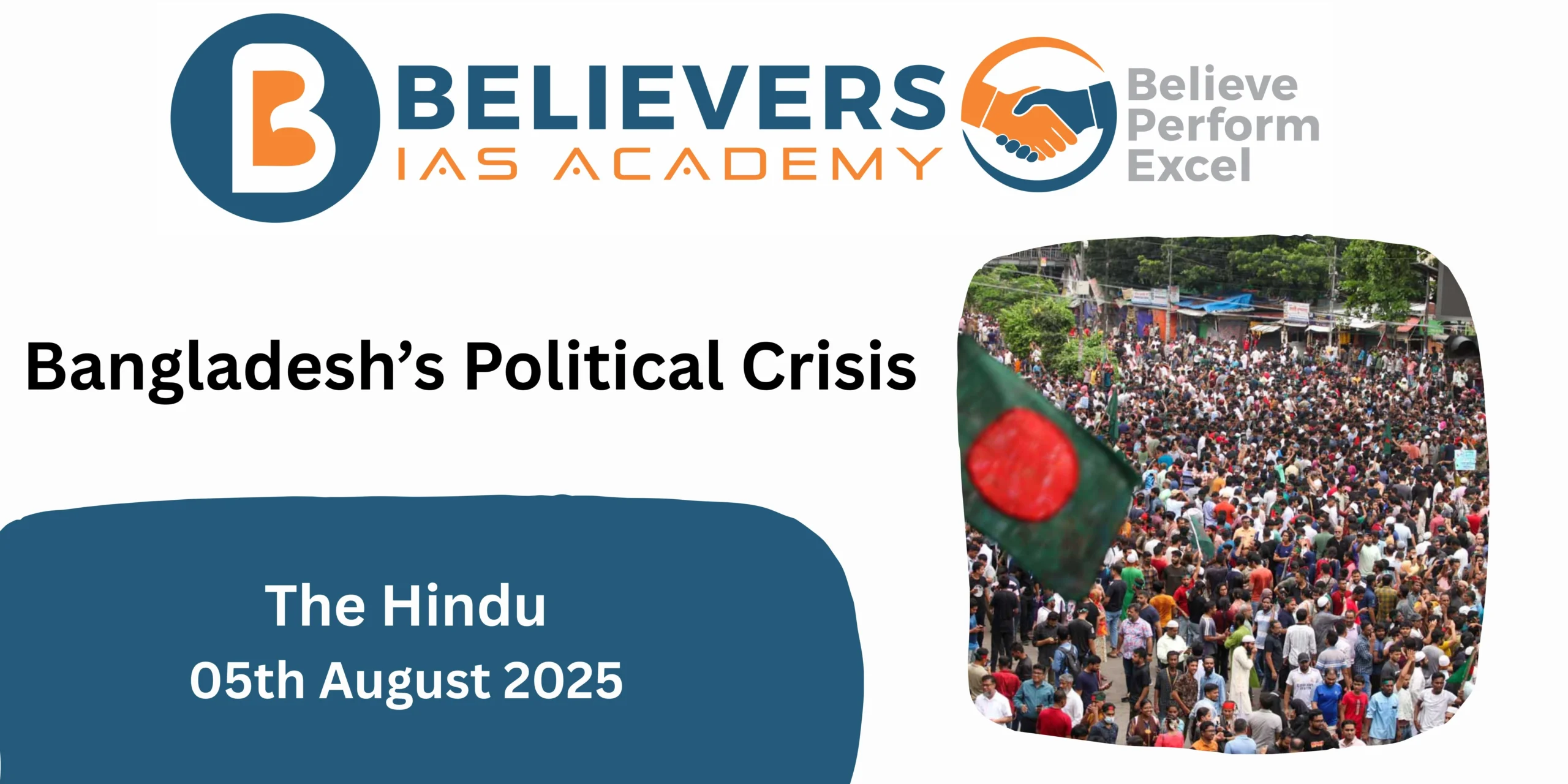
Bangladesh’s Political Crisis: One Year After Sheikh Hasina’s Ouster
Context:
Since the ousting of Sheikh Hasina in August 2024, Bangladesh has witnessed a steep descent into political instability, violence, religious extremism, institutional decay, and economic distress. The Interim Government led by Prof. Muhammad Yunus is widely regarded as unconstitutional, with Jamaat-e-Islami (JeI) exercising de facto control.
Key Myths and Realities Uncovered
1. Myth of a Spontaneous Uprising
- The student-led uprising that led to Hasina’s ouster was in fact a well-orchestrated regime change, backed by JeI, with support from Pakistan, China, and elements within the U.S..
- JeI, which opposed the creation of Bangladesh in 1971, now controls the levers of power behind the scenes.
2. Illegitimacy of the Interim Government
- The Constitution of Bangladesh has no provision for an interim regime.
- The Yunus-led administration fails to meet the neutrality criteria of a caretaker government.
- Key advisers include members of extremist Islamist outfits (Hizb-ut Tahrir, Islami Andolan Bangladesh, Hefazat-e-Islam).
- One adviser openly advocated for a Sharia-based caliphate and civil war, showing the regime’s ideological radicalism.
3. Election Postponement Strategy
- The regime has delayed elections by setting up unconstitutional reform commissions.
- Reforms are being used to increase JeI’s political legitimacy and vote share.
- Major political parties and the Army demand elections by December 2025.
Worsening Political Violence and Repression
- Non-Muslim minorities (Hindus, Buddhists, Christians) and Muslim sectarian minorities (Sufis, Ahmadiyyas) face systemic violence.
- Awami League members are being jailed, killed; party activities were banned in May 2025.
- Liberation War heritage is being erased; over 400 police stations looted, hundreds of officers killed using stolen weapons.
- The interim regime has indemnified participants of the 2024 violence, shielding them from legal action.
Rise of the National Citizen Party (NCP)
- Formed in Feb 2025, the NCP is seen as the “King’s Party” of Yunus.
- Comprised of former Islami Chhatra Shibir members, it has no significant student base.
- On July 16, 2025, attempted desecration of Sheikh Mujibur Rahman’s mausoleum led to civilian deaths in Gopalgunj, allegedly due to Army firing.
- A UN complaint has termed it a genocidal attack.
Institutional Breakdown and Media Clampdown
- Judiciary and Bangladesh Bank officials were forced to resign under mob pressure.
- Media freedom has been suppressed; journalists jailed on false charges.
- State-backed propaganda dominates national narrative.
Economic Decline Post-Hasina
- Growth dropped from 6%+ to below 3%, factory closures, job losses, and hyperinflation prevail.
- Bangladesh Bank highlighted macroeconomic instability due to political uncertainty and inflation (July 2025).
Foreign Policy Shift and India-Bangladesh Ties
Anti-India Turn
- JeI-backed regime fostered anti-India propaganda, blaming India for domestic unrest.
- Trade and investment links with India were portrayed as one-sided and exploitative.
India’s Patience and Outreach
- Despite provocations, India reiterated support for a democratic, stable, inclusive Bangladesh.
- PM Modi met Prof. Yunus in April 2025, but diplomatic outreach was rebuffed.
- A China–Pakistan–Bangladesh axis is being explored by the interim regime.
Way Forward: India’s Stand
- India calls for early, free, fair, and inclusive elections under a constitutionally valid caretaker regime.
- India remains hopeful that a people-mandated government will restore cordial bilateral ties, safeguard regional stability, and counter extremist influences.


