
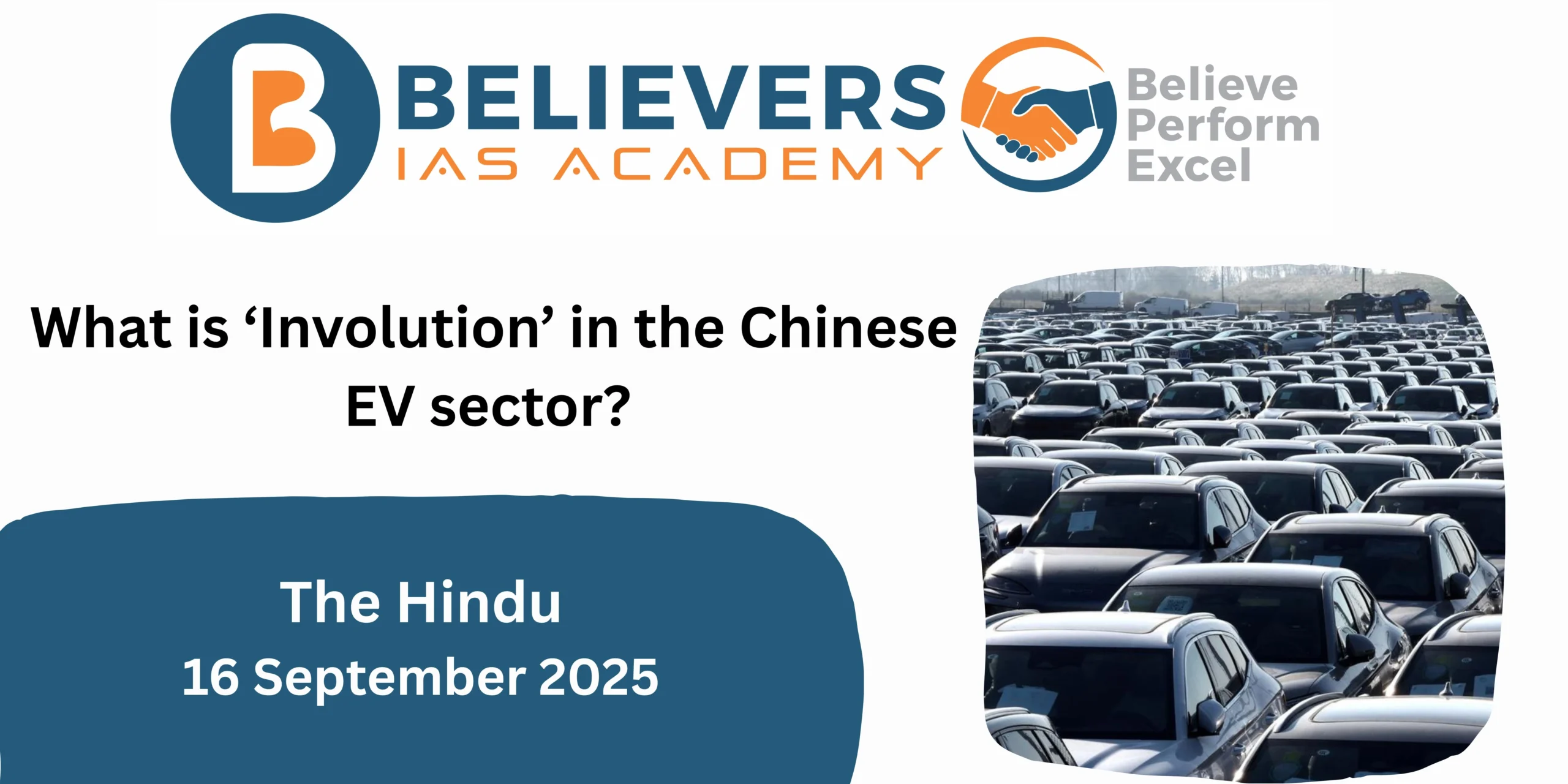
What is ‘Involution’ in the Chinese EV sector?
Definition:
Involution (nèijuǎn, 内卷) describes a situation where firms in a crowded market compete so intensely (mainly through price cuts) that everyone works harder but achieves diminishing or even negative returns.
In EVs:
-
- 120–130 Chinese EV makers are locked in a cut-throat price war.
- Prices have been slashed so much that vehicles are sold below production cost.
- Firms struggle to cover R&D and operational expenses → leading to losses, bankruptcies, or forced exits.
Impact: Like Clifford Geertz’s rice farming analogy, more effort (competition, innovation, subsidies) is being poured in, but margins and profitability shrink.
Why has involution worsened in EVs?
- Overcapacity in China – Massive state support + industrial policy led to oversupply.
- Trade barriers abroad:
- S. → 100% tariffs (effectively a ban on Chinese EVs).
- EU → Countervailing duties (17%–35% on top of 10% import duty).
- Türkiye (40%) and Mexico (50%) followed suit.
- These moves restricted China’s export outlets, forcing intensified competition at home.
- Consumer slowdown – Domestic demand is growing but not fast enough to absorb all supply.
How is China tackling involution and EV price wars?
1. Policy Interventions
- MIIT (May 2025): Pledged to rein in price wars.
- Politburo (June 2025): Framed Xi’s stance as a “war on price wars”.
- Draft Pricing Law (July 2025): Prohibits:
- Below-cost selling.
- Algorithmic pricing abuses by platforms.
- Xi Jinping (Sept 2025, Qiushi article):
- Curb “disorderly competition”.
- Push for an “orderly exit” of outdated capacity.
- Prioritize quality over quantity.
2. Industry Restructuring
- Encouraging consolidation → smaller, weaker EV makers to exit or merge.
- SOEs and top players (BYD, Geely, SAIC) expected to survive and dominate.
3. Global Diversification
- Chinese OEMs investing in local production abroad (e.g., BYD in Hungary, Türkiye).
- Targeting emerging markets (Africa, SE Asia, Latin America) → where tariffs are lower and EV penetration is still growing.
Broader Implications
- For China: Short-term pain (bankruptcies, layoffs), but medium-term industry stabilisation with fewer, stronger players.
- For Europe & U.S.: Tariffs may only delay, not prevent, Chinese EV dominance—especially as Chinese firms localise production.
For Emerging Markets: China remains the biggest EV supplier, shaping the global clean mobility transition


