
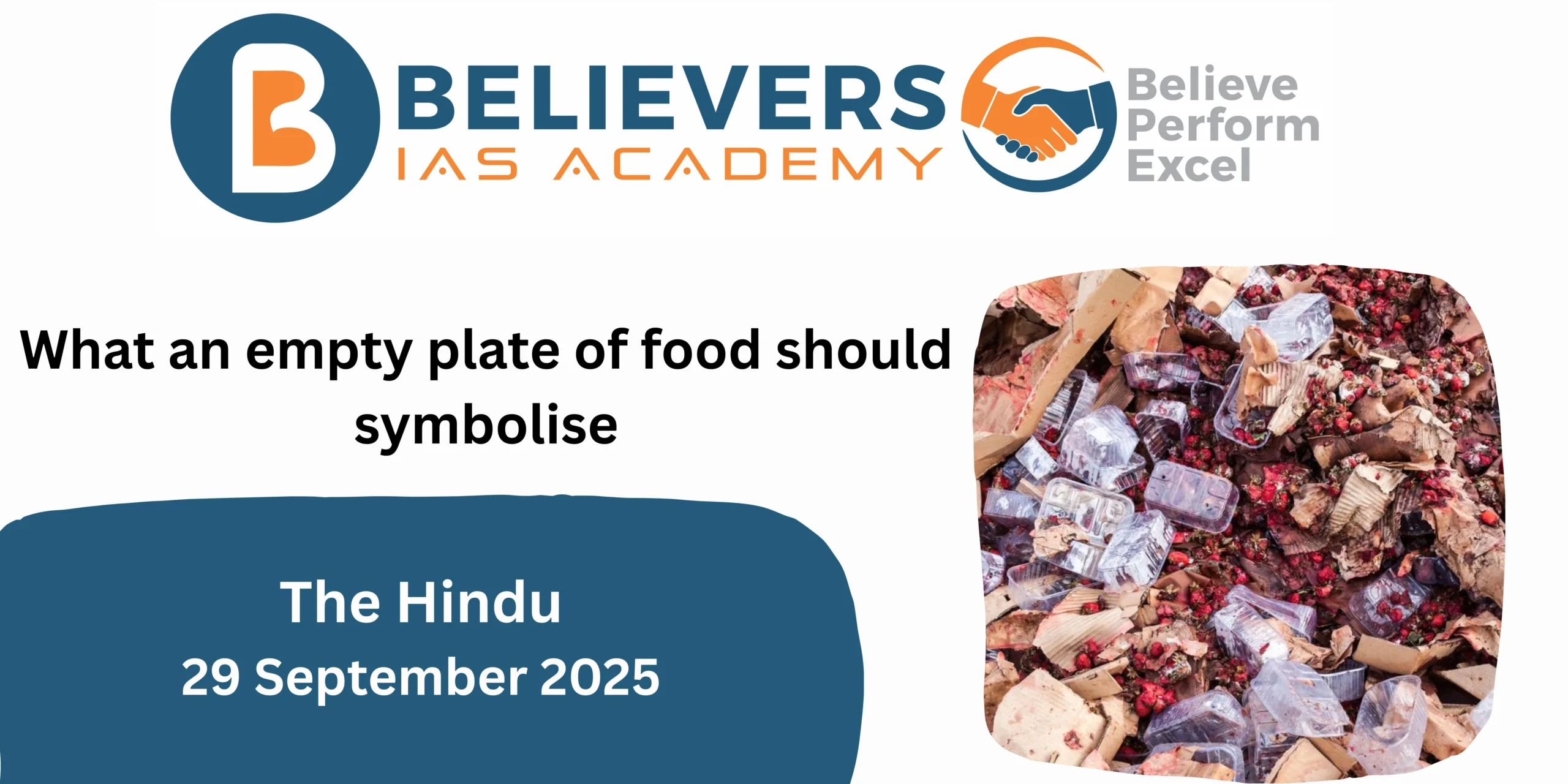
What an Empty Plate of Food Should Symbolise
Context
- Occasion: International Day of Awareness of Food Loss and Waste (IDAFLW) — September 29.
- Global issue: Nearly one-third of all food produced worldwide is lost or wasted.
- India’s challenge: As a major food producer, India suffers high post-harvest losses across crops, leading to economic, nutritional, and climate impacts.
The Scale of the Problem in India
- Economic toll: Post-harvest losses cost nearly ₹1.5 trillion annually (~3.7% of agricultural GDP).
- High-loss categories:
- Fruits & Vegetables → 10–15% losses.
- Staples → Paddy (4.8%), Wheat (4.2%).
- Impact:
- Farmers lose income.
- Households lose nutrition.
- Resources (water, energy, labour) are wasted.
- Climate burden worsens.
The Climate Link
- Post-harvest losses = hidden GHG emissions.
- FAO–NIFTEM–GCF study:
- Even small cereal losses → large CO₂-equivalent emissions (paddy alone → >10 million tonnes annually due to methane).
- Livestock losses → heavy footprint.
- Total (30 commodities) → >33 million tonnes of CO₂-equivalent emissions annually.
- India-specific trend: Losses mostly occur early in supply chains (handling, processing, distribution) unlike high-income countries where waste is consumer-driven.
Solutions: Multi-Pronged Approach
- Infrastructure & Technology
- Strengthen cold chains (pre-cooling, refrigerated transport, modern storage).
- Leverage PMKSY (Pradhan Mantri Kisan SAMPADA Yojana) for logistics modernisation.
- Promote affordable solutions: solar cold storage, low-cost cooling chambers, crates for perishables, moisture-proof silos.
- Digital Innovations
- IoT & AI tools for forecasting and reducing bottlenecks.
- FAO’s Food Loss App (FLAPP) → launched 2023, used in 30+ countries to track losses.
- Circular Economy Models
- Redirect surplus food → food banks & community kitchens.
- Convert unavoidable waste → compost, animal feed, bioenergy.
- Incentives needed: subsidies, credit guarantees, low-interest loans.
Shared Responsibility
- Government: Integrate food loss reduction into climate strategy, invest in infrastructure.
- Businesses: Adopt circular models, innovate in logistics.
- Civil society & Academia: Awareness, research, grassroots solutions.
- Consumers: Practice mindful consumption, support redistribution.
Key Message
- An empty plate should symbolise a meal consumed with gratitude, not resources wasted through inefficiency.
- Tackling food loss saves:
- Nutrition for millions.
- Climate resources (water, energy, soil).
- Farmer incomes and livelihoods.
Takeaway
Food loss is not only a food security issue, but also an economic and climate challenge. Solutions lie in technology, infrastructure, circular economy, and behavioural change, with responsibility shared across the supply chain.
Related Posts

India’s Q3 GDP Growth Trends
Posted on
PIB Analysis 03-02-23 – Part 1
Posted on
