
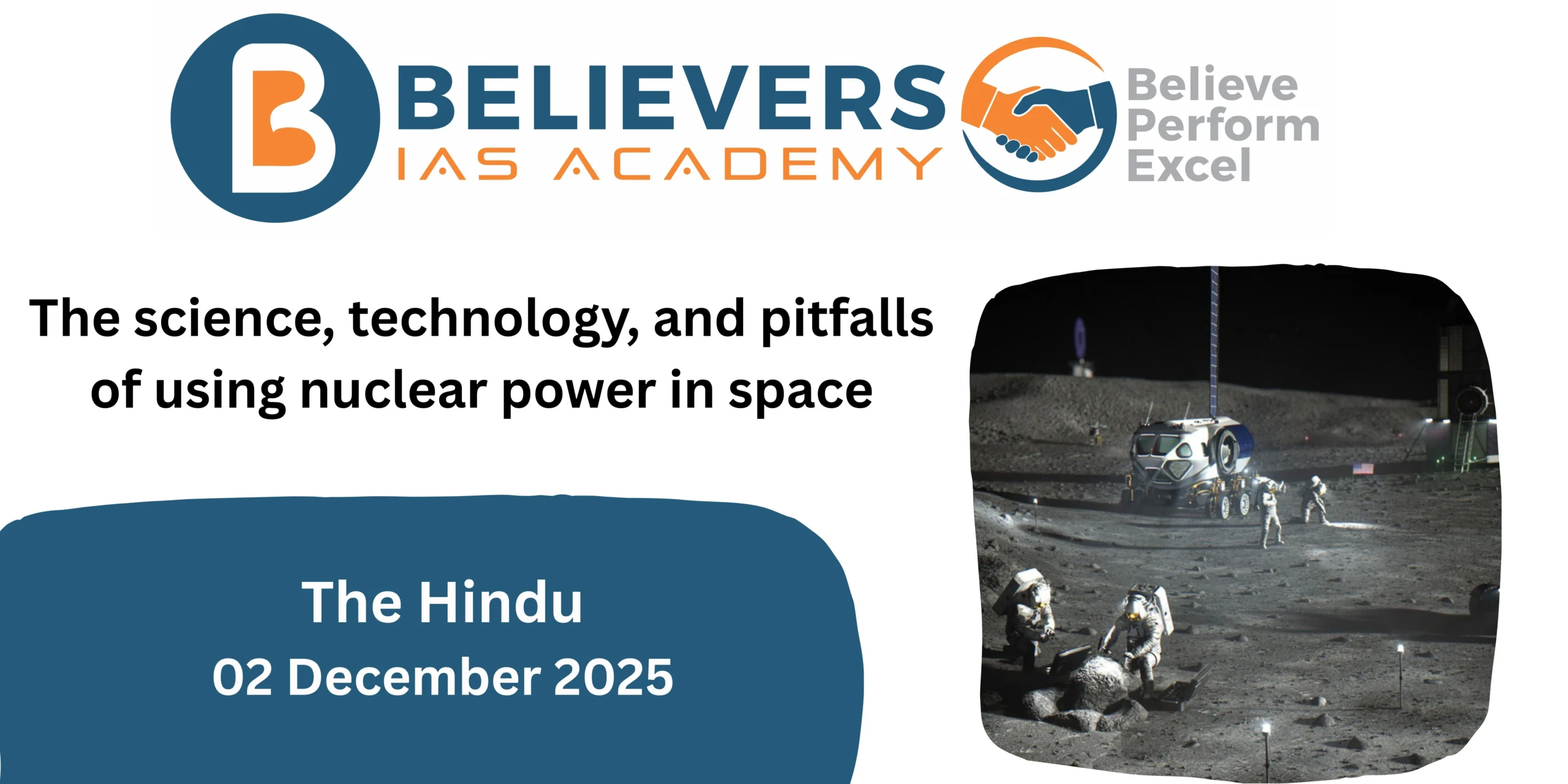
The science, technology, and pitfalls of using nuclear power in space
Context
-
The U.S. plans to deploy a small fission reactor on the Moon by early 2030s under the Lunar Fission Surface Power Project.
-
Marks a shift from solar to compact nuclear reactors for sustained presence on Moon/Mars.
-
Raises questions of technology, safety, global governance, and legal gaps in international space law.
Why Nuclear Power in Space?
Limitations of Solar Power
-
Lunar nights last ~14 days → no sunlight.
-
Polar regions receive very low sunlight.
-
Dust storms on Mars can block sunlight for months.
Energy Needs for Future Space Missions
-
Human habitats, life support systems.
-
Laboratories, manufacturing, ISRU (in-situ resource utilisation).
-
Large-scale operations need hundreds of kW to MW-level continuous power → solar insufficient.
Existing Nuclear Technologies for Space
1. Radioisotope Thermoelectric Generators (RTGs)
-
Use plutonium-238 decay heat → electricity.
-
Power Voyager, Cassini, Perseverance rover.
-
Pros: reliable, dust-proof, sunlight-independent.
-
Limitations: low power output (few hundred watts).
2. Compact Fission Reactors
-
Size of a shipping container.
-
Output: tens to hundreds of kW.
-
Potential uses:
-
Human bases on Moon/Mars
-
ISRU (water extraction, fuel production)
-
Industrial operations
-
-
Reactors can be buried under regolith for natural radiation shielding.
3. Nuclear Thermal Propulsion (NTP)
-
Nuclear reactor heats propellant → thrust.
-
U.S. DRACO mission to test NTP by 2026.
-
Cuts travel time to Mars → reduces exposure to cosmic radiation.
4. Nuclear Electric Propulsion (NEP)
-
Reactor generates electricity → ionises propellant.
-
Enables years-long deep-space missions with high efficiency.
Why Nuclear Power is Attractive
-
High energy density, compactness.
-
Reliable and continuous power regardless of environment.
-
Essential for Mars missions, lunar bases, mining operations.
-
Reduces mission time → enhances crew safety.
Risks and Pitfalls
1. Accidents & Radioactive Release
-
Launch explosions → radioactive dispersal.
-
Re-entry mishaps could contaminate the Earth.
2. Extraterrestrial Environmental Damage
-
Potential contamination of pristine celestial environments.
-
Risks irreversible changes before scientific study.
3. Safety Zones vs Space Freedom
-
Nuclear reactors require “safety zones”.
-
But safety zones must not →
national appropriation or violation of “freedom of space” under the Outer Space Treaty.
4. Militarisation & Strategic Concerns
-
Nuclear propulsion could bring dual-use concerns.
-
Risks of weaponisation or geopolitical competition.
Existing International Legal Framework (and Gaps)
A. 1992 UN Principles on Nuclear Power Sources in Outer Space
-
Principles 3, 4, & 7:
-
Design to prevent release of radioactive materials.
-
Mandatory safety analysis pre-launch.
-
Emergency notification to affected states.
-
Limitations:
-
Non-binding (UNGA resolution).
-
Cover only RTGs and fission reactors for electricity —
not propulsion reactors (NTP/NEP). -
No standards for:
-
Reactor design
-
Safety benchmarks
-
Waste disposal / end-of-life protocols
-
B. Outer Space Treaty (1967)
-
Bans nuclear weapons in orbit — NOT peaceful nuclear reactors.
-
Silent on nuclear propulsion.
C. Liability Convention (1972)
-
Addresses damage by space objects.
-
But unclear on:
-
Nuclear accidents beyond Earth orbit
-
Reactors jettisoned in space
-
D. Nuclear Non-Proliferation Treaty (NPT)
-
Pertains mainly to weaponisation, not reactors in space.
Governance Vacuum
-
No clear rules for:
-
Nuclear reactors on Moon/Mars
-
“Safety zones” around installations
-
Preventing radioactive contamination
-
End-of-life disposal in space
-
-
Without reforms, nuclear activity in space may:
-
Trigger accidents
-
Fuel geopolitical competition
-
Cause a “nuclear Cold War in space”
-
What Needs to Be Done?
A. Updating UN Principles (1992)
-
Explicitly include:
-
NTP/NEP propulsion reactors
-
Technical safety standards
-
Disposal protocols for reactors
-
B. Binding Environmental Protocols
Through UN COPUOS:
-
Governing safe launches
-
Preventing contamination of celestial bodies
-
Reactor burial/disposal requirements
C. Multilateral Oversight Mechanism
-
An IAEA-like global body for space nuclear reactors:
-
Certify reactor design
-
Ensure transparency
-
Monitor compliance
-
D. Space Traffic & Nuclear Safety Coordination
-
Protocols for:
-
Collision avoidance involving nuclear-powered spacecraft
-
Cis-lunar space accident response.
-
India’s Opportunity
Why India Matters
-
India has:
-
Advances in nuclear technology (DAE)
-
Strong space capability (ISRO)
-
-
A joint ISRO–DAE programme can:
-
Build indigenous space nuclear reactors
-
Power lunar bases, Mars ISRU facilities
-
Position India as a leader in deep-space innovation
-
Role India Can Play
-
Champion global norms for safe nuclear space operations.
-
Lead multilateral efforts like it did with:
-
Non-Aligned Movement
-
Disarmament diplomacy
-
-
Use G20, BRICS, Quad, and UN platforms to push for:
-
Ethical nuclear practices
-
Transparency in space governance
-
Conclusion
Nuclear power will be central to the future of human presence on the Moon, Mars, and beyond. But without a robust legal and ethical framework, nuclear technology in space risks accidents, militarisation, and geopolitical tensions. India is well-positioned to guide global governance by combining technological capability with norm-setting diplomacy, shaping a safe and sustainable space future.


