
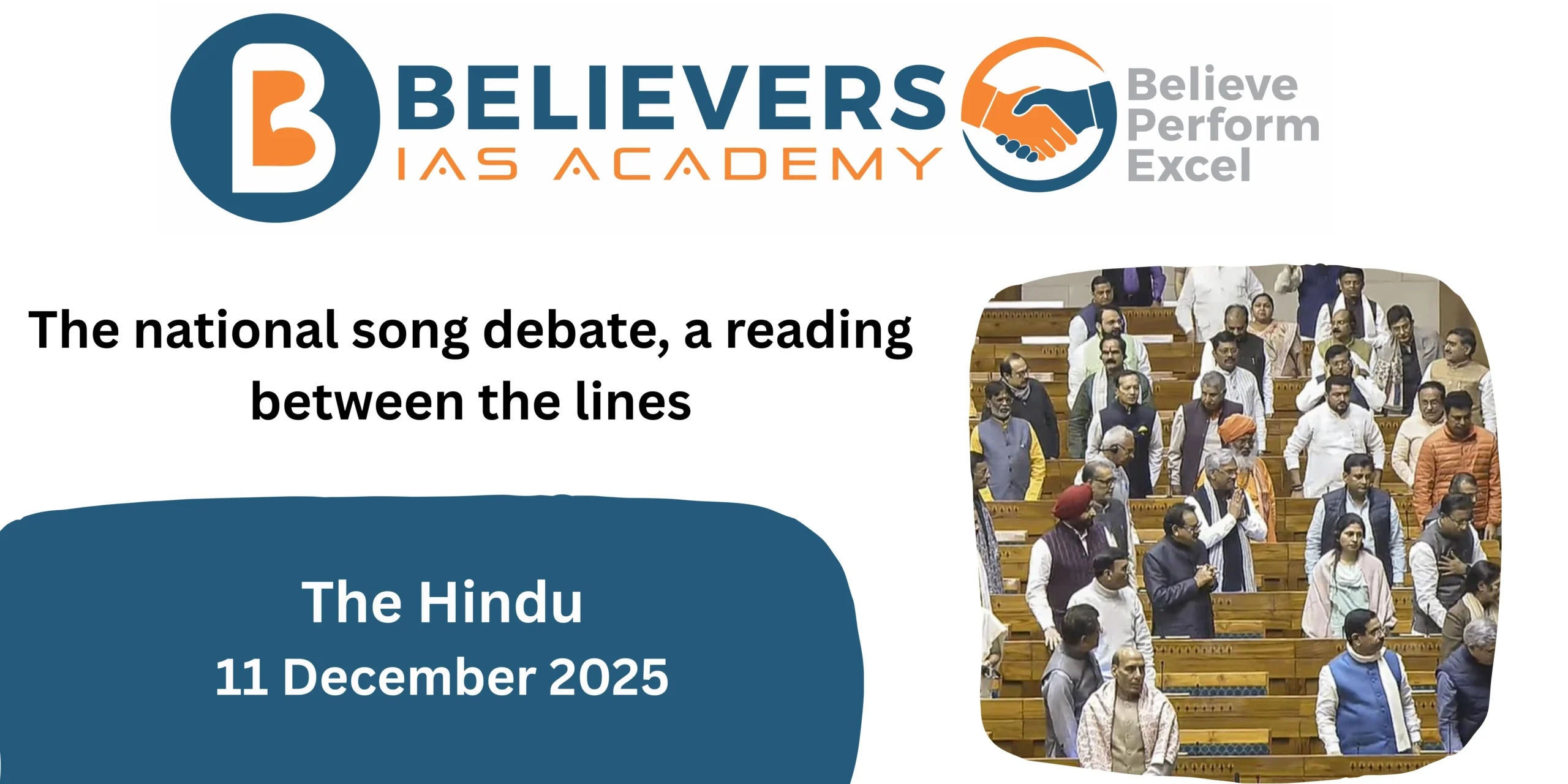
The national song debate, a reading between the lines
Context
-
A renewed political and parliamentary debate has emerged over Vande Mataram, with allegations that Congress “muted” parts of the original song in 1937 to appease minorities.
-
PM Narendra Modi indirectly targeted the Congress Working Committee (CWC) decision of 1937 that restricted the officially sung version to the first two stanzas.
-
The debate resurfaces even though the matter was settled by the Constituent Assembly in 1950.
Historical Evolution of Vande Mataram
1 Origins
-
Written by Bankim Chandra Chattopadhyay, published in Bangadarshan (1875).
-
Sung for the first time at the 1896 INC Session by Rabindranath Tagore.
-
Evoked strong patriotic sentiment during the freedom struggle, including among Muslim revolutionaries.
2 1937: Congress Working Committee (CWC) Resolution
-
CWC meeting chaired by Jawaharlal Nehru at Calcutta; attended by Patel, Rajendra Prasad, Azad, Bose, JB Kripalani, Rajaji, JP Narayan, Pattabhi Sitaramayya, etc.
-
Gandhi participated as an invitee and helped finalise the resolution.
Key decision:
-
Only the first two stanzas to be sung publicly, because:
-
They were non-objectionable to Muslim members.
-
They contained the “essence” of the song.
-
They helped maintain communal harmony.
-
-
Rabindranath Tagore’s musical version to be used.
Purpose: To ensure pan-India acceptance at government functions after INC came to power in provinces (1937 Act elections).
Constituent Assembly Debates (1947–50)
1 Composition and Context
-
Constituent Assembly had 389 members initially; dropped to 299 after Partition.
-
Despite being Hindu majority, the Assembly took a secular approach.
2 Songs under consideration
Members heard:
-
Vande Mataram
-
Sare Jahan Se Achha
-
Jana Gana Mana
-
Sare Jahan Se Achha was rejected because Iqbal later supported Pakistan.
3 Final Decision
-
Jana Gana Mana adopted as National Anthem.
-
Vande Mataram acknowledged as National Song, but not included as a constitutional provision.
-
No article in Constitution mentions “National Song”.
Constitutional & Legal Position
1 Fundamental Duties (42nd Amendment, 1976)
-
Article 51A requires respect for the Constitution, National Flag, National Anthem.
-
National Song is not mentioned.
2 Prevention of Insults to National Honour Act, 1971
-
Penalises disrespect to the National Anthem.
-
No penal provision for the National Song → Legal distinction maintained by GoI in court.
3. Key Judgments
-
Bijoe Emmanuel v. State of Kerala (1986)
-
Upholds freedom of religion & expression; students cannot be compelled to sing the anthem if no disrespect shown.
-
4 High Court Interventions
-
Madras High Court (2017) – directed weekly singing in schools and monthly in offices.
-
Delhi High Court – suggested treating National Song on par with Anthem.
-
Modi Government’s Response –
-
Both have “sanctity”, but not legally equal.
-
A writ cannot create a legal status equivalent to the anthem.
-
Contemporary Political Debate
Why is the Issue Revived?
Possible motivations:
-
Political polarisation using historical narratives.
-
Projecting Congress resolution as appeasement of minorities.
-
Push for a new fundamental duty requiring respect for Vande Mataram at par with the Anthem.
-
Possible attempt to:
-
Change the national anthem,
-
Or elevate Vande Mataram without constitutional amendment (as done with Article 370).
-
2 Author’s Concern
-
A “non-issue” is being amplified for political mileage.
-
Could be a precursor to altering national symbols through simple Parliamentary resolutions.
Ethical Dimensions
1. Spirit of Tolerance
-
Respecting diverse faiths was foundational to freedom movement.
-
Imposing cultural symbols undermines values of empathy & accommodation.
2 Responsible Leadership
-
Leaders must avoid weaponising national symbols for political gain.
Conclusion
The debate on Vande Mataram is historically settled, legally clear, and constitutionally unambiguous.
Revival of controversy appears politically motivated, aiming to reshape national identity symbols outside constitutional mechanisms.
Related Posts

Deepfakes
Posted on

