The 8th Central Pay Commission (CPC) — A Chance to Reform Pay Commissions
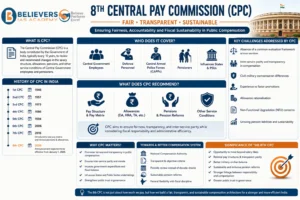
What is the Central Pay Commission (CPC)?
The Central Pay Commission (CPC) is a body constituted by the Government of India, typically every 10 years, to review and recommend changes in the salary structure, allowances, pensions, and other service conditions of Central Government employees and pensioners.
The 1st CPC was constituted in 1946.
The 7th CPC, implemented in 2016, introduced a new pay matrix and revised pensions and allowances.
The 8th CPC has been announced and is expected to recommend changes effective from January 1, 2026.
The recommendations of the CPC affect:
Central Government employees
Defence personnel
Central Armed Police Forces (CAPFs)
Pensioners
Often influence pay revisions in State Governments and Public Sector Undertakings (PSUs)
Why the 8th CPC Matters Beyond Salary Hikes
As India moves toward the 8th Central Pay Commission (CPC), public debate has largely focused on fitment factors, pay hikes, and arrears. However, the larger issue is whether India’s public compensation system remains fair, transparent, efficient, and fiscally sustainable.
Pay Commissions today are no longer mere wage-revision exercises. Their recommendations influence:
Inter-service parity
Government expenditure
Pension liabilities
Administrative efficiency
Public trust in governance
Challenges in the Existing CPC Framework
1. Absence of a Common Evaluation Framework
Different services operate under vastly different conditions, yet there is no universally accepted mechanism to assess:
Responsibility
Risk
Technical expertise
Career progression
Hardship faced
As a result, demands for parity often arise without clearly defined criteria.
2. Issues of Inter-Service Parity
Officers from different services with varying responsibilities and career trajectories may receive similar compensation.
The challenge is not competition among services but ensuring:
Transparency
Consistency
Objective justification
for compensation decisions.
3. Civil-Military Compensation Concerns
The Armed Forces and Civil Services differ significantly:
Armed Forces
Civil Services
Early retirement
Longer careers
Steep pyramidal promotion structure
Broader promotion avenues
High operational risk
Generally lower physical risk
Compensation frameworks often struggle to account adequately for these structural differences.
4. Experience vs Faster Promotions
Recent trends indicate reduced years of service required for senior administrative positions.
Experience remains critical for effective policymaking.
5. Allowance Rationalisation
Allowances are intended to compensate for:
Hardship
Remote postings
Operational risks
However, the absence of a transparent and uniform assessment framework often creates disparities.
6. Non-Functional Upgradation (NFU)
NFU allows certain civil servants to receive higher pay without corresponding promotions.
Critics argue that NFU:
Weakens the link between responsibility and compensation.
Creates concerns regarding equity and accountability.
The Growing Pension Challenge
India currently operates multiple pension systems:
Old Pension Scheme (OPS)
National Pension System (NPS)
Unified Pension Scheme (UPS)
Separate pension arrangements for legislators and constitutional authorities
This creates concerns regarding:
Fiscal sustainability
Rising pension liabilities
Inter-generational equity
A substantial portion of government expenditure is already devoted to:
Salaries
Pensions
Interest payments
reducing fiscal space for developmental spending.
Need for a New Compensation Architecture
Many countries have shifted from decadal pay revisions to continuous review mechanisms through independent bodies.
Possible Reforms
National Compensation Authority A permanent institution could:
Continuously review compensation structures.
Develop objective evaluation benchmarks.
Ensure consistency across services.
Transparent Compensation Principles Standardised criteria may be developed for:
Responsibility
Experience
Skill requirements
Hardship
Risk exposure
Periodic Review Instead of Decadal Shocks Smaller periodic revisions could:
Reduce fiscal shocks.
Improve predictability.
Ensure timely corrections.
Federal Flexibility States should retain autonomy while adhering to:
Transparency
Fiscal discipline
Comparable standards
Significance of the 8th CPC
The 8th CPC offers an opportunity to move beyond traditional salary revision and address deeper structural issues:
✔ Rational pay structures ✔ Transparent parity mechanisms ✔ Better military-civilian balance ✔ Sustainable pension reforms ✔ Stronger linkage between responsibility and compensation ✔ Greater public trust in governance
Conclusion
The 8th Central Pay Commission should not merely determine how much government employees are paid. It should address how public compensation is structured, ensuring fairness, accountability, transparency, and long-term fiscal sustainability. A modern compensation architecture can strengthen both institutional effectiveness and public confidence in governance.
🕒 Weekend Batch Details
Class: Saturday & Sunday
Time: 10:00 AM – 05:00 PM
Test : Every Sunday
For more details, contact us 9611451616 [email protected]
Evening Batch
🕒Evening Batch Details
Class: Monday to Friday
Time: 05:00 PM – 08:00 PM
Test : Every Sunday
For more details, contact us 9611451616 [email protected]
Regular Batch
🕒 Regular Batch Details
Class: Monday to Friday
Time: 07.00 AM to 10:00 AM and 11.00 AM to 02.00 PM
Class: Saturday & Sunday
Time: 10.00 AM to 05.00 PM
🕒 Morning Batch Details Class: Monday to Friday Time: 07:00 AM – 10:00 AM Test : Every Sunday For more details, contact us 9611451616 [email protected]