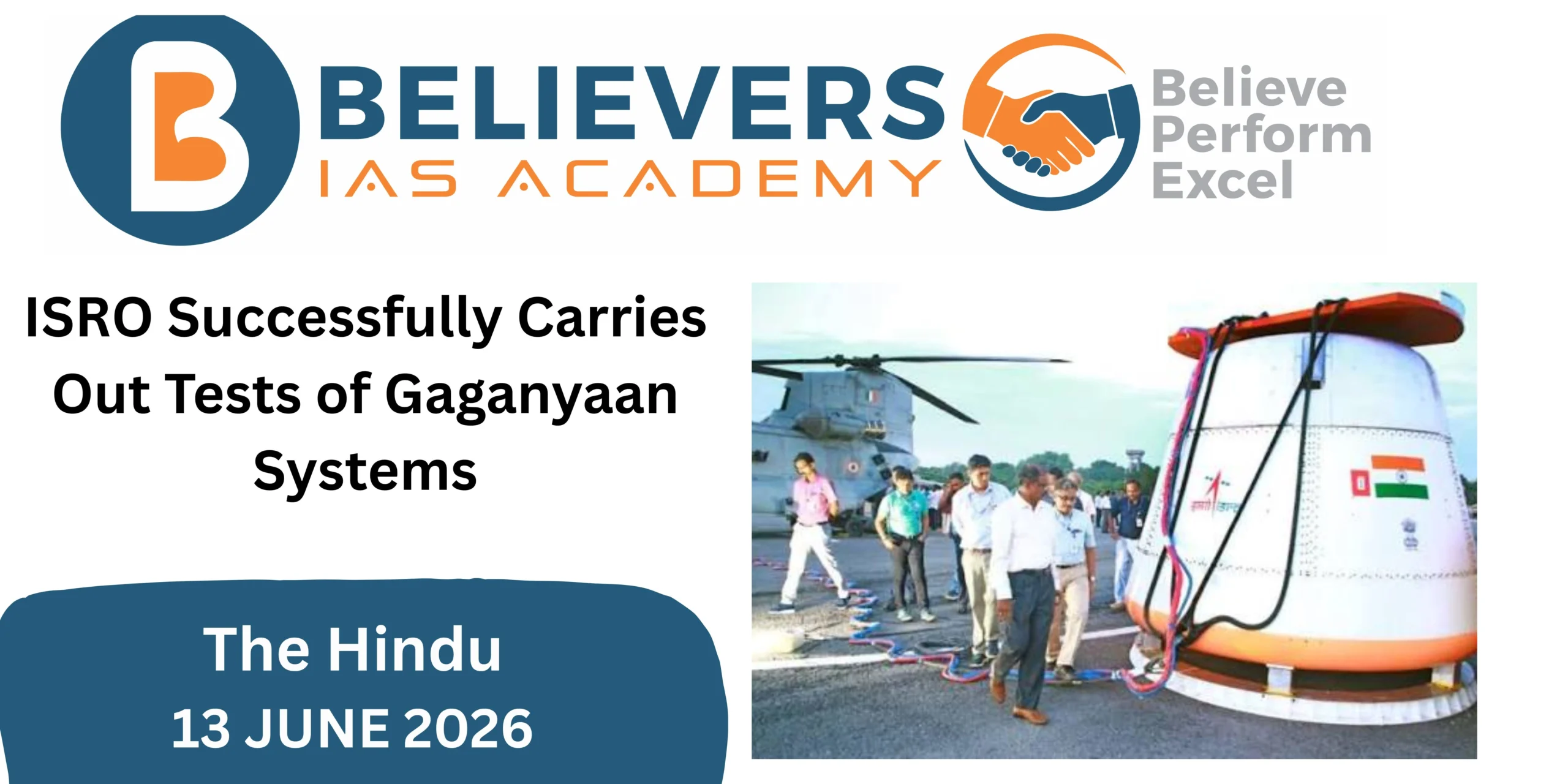
ISRO Successfully Carries Out Tests of Gaganyaan Systems
SUBJECT: Science & Technology (GS Paper III – Space Technology)
Why in News?
The Indian Space Research Organisation (ISRO) has successfully completed three major qualification tests of critical Gaganyaan Crew Module systems, marking another milestone towards India’s first human spaceflight mission.
These tests validated key systems related to:
Crew safety
Module separation
Structural integrity
Safe re-entry and recovery
About Gaganyaan Mission
Gaganyaan is India’s first indigenous human spaceflight mission.
Objectives
Send Indian astronauts (Gaganyatris) into Low Earth Orbit (LEO).
Keep the crew in orbit for about 3 days.
Safely recover the crew after splashdown in the sea.
Demonstrate India’s indigenous human spaceflight capability.
Three Major Tests Conducted by ISRO
1. Crew Module Uprighting System (CMUS) Test
Purpose
To ensure that the Crew Module remains upright after splashdown in the ocean.
Why is it Important?
After re-entry, the crew capsule lands in the sea.
If the capsule overturns:
Astronaut safety is compromised.
Rescue operations become difficult.
How Does CMUS Work?
ISRO has developed a stored cold-gas-based uprighting system.
During testing:
High-pressure gas cylinders released stored gas.
The gas inflated flotation bags.
The flotation system successfully restored and maintained the capsule in an upright position.
Significance
Enhances astronaut safety.
Facilitates faster recovery operations.
Ensures post-splashdown stability.
2. Umbilical Separation Mechanism Test
Purpose
To validate the safe separation of the Crew Module from the Service Module.
Components
Crew Module
Contains:
Astronauts
Life-support systems
Re-entry systems
Service Module
Provides:
Power
Propulsion
Mission support systems
The modules remain connected through an Umbilical Separation Unit (CSU).
CSU-1 is attached to the Crew Module.
CSU-2 is attached to the Service Module.
During Re-entry
Service Module separates from the Crew Module.
CSU-1 disconnects first.
CSU-2 separates immediately before atmospheric re-entry.
Test Outcome
ISRO successfully demonstrated:
Clean separation of CSU-2.
Structural stability of the Crew Module.
Integrity of all interfaces during separation.
Significance
Prevents structural damage.
Ensures safe atmospheric re-entry.
Improves mission reliability.
3. Apex Cover Separation Test
Purpose
To verify the Crew Module’s structural integrity during Apex Cover separation.
What is the Apex Cover?
The Apex Cover protects:
Parachutes
Recovery systems
Associated subsystems
during launch and spaceflight.
Before Landing
The Apex Cover separates.
This exposes the parachutes, which:
Deploy successfully.
Slow down the Crew Module.
Enable a safe splashdown in the sea.
Test Outcome
The test confirmed:
Successful Apex Cover separation.
Structural stability of the Crew Module.
Readiness for parachute deployment.
Significance of These Tests
The successful qualification tests strengthen:
Crew safety systems.
Re-entry reliability.
Structural robustness.
Splashdown recovery capability.
Overall mission readiness.
These are critical milestones before India’s first crewed Gaganyaan mission.
Importance of Gaganyaan
Makes India the fourth country to independently send humans into space after:
Russia (USSR)
United States
China
Strengthens India’s space technology ecosystem.
Promotes indigenous aerospace capabilities under Atmanirbhar Bharat.
Generates technological spin-offs in robotics, materials, medicine, navigation, and communication.
Enhances India’s strategic and scientific capabilities.
Key Components of Gaganyaan
Component
Function
Crew Module
Carries astronauts and returns safely to Earth
Service Module
Provides propulsion, power and mission support
Crew Escape System
Protects astronauts during launch emergencies
Crew Module Uprighting System (CMUS)
Keeps capsule upright after splashdown
Umbilical Separation Unit (CSU)
Disconnects Crew and Service Modules safely
Apex Cover
Protects parachutes until deployment
Parachute System
Slows descent before splashdown
UPSC Mains Question (10 Marks)
“Discuss the technological significance of the Gaganyaan Mission. Explain how recent qualification tests of the Crew Module systems strengthen India’s human spaceflight capabilities.”
🕒 Weekend Batch Details
Class: Saturday & Sunday
Time: 10:00 AM – 05:00 PM
Test : Every Sunday
For more details, contact us 9611451616 [email protected]
Evening Batch
🕒Evening Batch Details
Class: Monday to Friday
Time: 05:00 PM – 08:00 PM
Test : Every Sunday
For more details, contact us 9611451616 [email protected]
Regular Batch
🕒 Regular Batch Details
Class: Monday to Friday
Time: 07.00 AM to 10:00 AM and 11.00 AM to 02.00 PM
Class: Saturday & Sunday
Time: 10.00 AM to 05.00 PM
🕒 Morning Batch Details Class: Monday to Friday Time: 07:00 AM – 10:00 AM Test : Every Sunday For more details, contact us 9611451616 [email protected]