
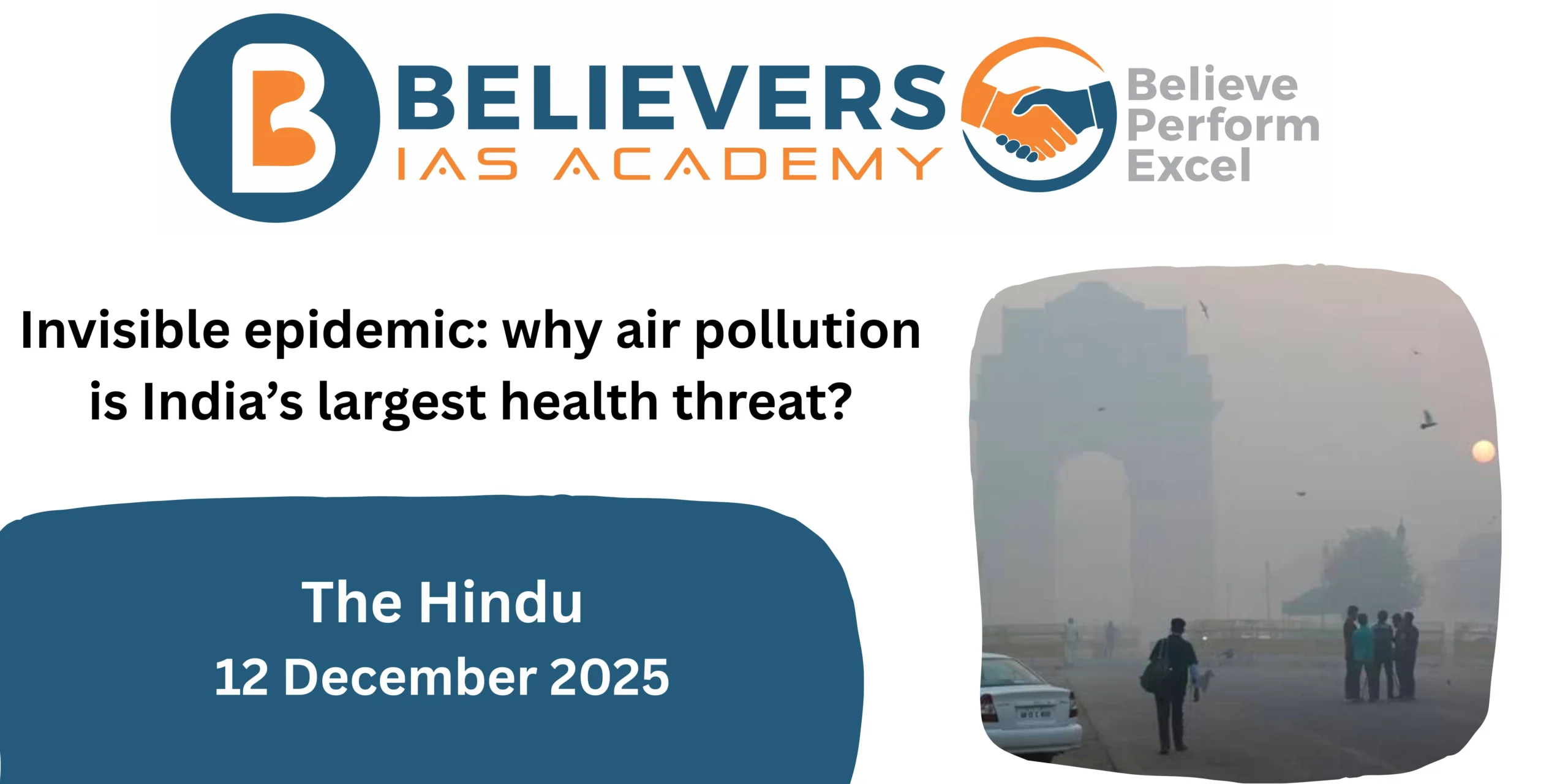
Invisible epidemic: why air pollution is India’s largest health threat?
Context
-
Air pollution has become India’s largest health threat and a persistent, nationwide emergency.
-
Not confined to the Indo-Gangetic plains or winter months; now affects every demographic group, every organ system, and every season.
-
India must treat clean air as a fundamental right and a national development priority.
Scale of the Crisis
Widespread & Chronic
-
In 2025, 150 of 256 monitored cities exceeded national PM2.5 limits (CREA report).
-
Indo-Gangetic plain remains the worst affected.
-
Delhi PM2.5 levels: 107–130 µg/m³ (vs. India’s limit 60 µg/m³, WHO guideline 15 µg/m³).
AQI Problems
-
India’s AQI caps values at 500, outdated and unrealistic.
-
Actual pollution often >600–1000 (shown by global monitors like IQAir).
-
Categorises all severe values into one bracket → masks true risk.
-
Experts argue for updated thresholds, removal of upper cap, modernised monitoring.
Health Burden & Life Expectancy
Life Expectancy Loss
-
46% of Indians live in regions with severe pollution-linked reduction in life expectancy (AQLI).
-
Delhi: PM2.5 exposure reduces >8 years of life (vs WHO levels).
-
Northern India: 3.5–7 years loss.
Mortality
-
~2 million deaths in 2023 attributed to air pollution (State of Global Air Report, 2025).
-
Pollution-linked mortality up 43% since 2000.
How PM2.5 Damages the Body (System-wise)
A. Cardiovascular System
-
PM2.5 enters bloodstream → systemic inflammation.
-
8% rise in annual mortality per 10 µg/m³ rise.
-
Linked to:
-
Hypertension
-
Atherosclerosis
-
Heart attacks
-
Arrhythmias
-
Strokes
-
B. Respiratory System
-
6% of children suffer from asthma.
-
AIIMS data: 10 µg/m³ rise causes 20–40% spike in paediatric ER visits.
-
Children show 10–15% reduced lung capacity.
-
Increasing adult cases of COPD, bronchitis, recurrent infections.
C. Neurological System
-
PM2.5 crosses the blood–brain barrier → neuroinflammation.
-
Linked to:
-
Impaired memory
-
Lower academic performance
-
Slower cognitive development
-
-
International evidence: 35–49% higher dementia risk per 10 µg/m³ rise.
D. Maternal & Neonatal Health
-
Higher risks of:
-
Preterm births
-
Low birth weight
-
Stillbirths
-
Neonatal mortality
-
-
Long-term generational inequities.
Social Inequalities & Environmental Justice
-
Poorer communities live near roads, industrial clusters, landfills, construction sites.
-
Greater outdoor exposure, poor housing, reliance on biomass fuel.
-
Hence, largest burden falls on the most vulnerable → deepening inequality.
True Structural Causes of PM2.5
Not seasonal events like stubble burning or fireworks, which only worsen spikes.
Main year-round contributors:
-
Vehicular emissions
-
Industrial processes
-
Construction/demolition dust
-
Informal waste burning
-
Biomass use for cooking
-
Diesel freight and generator emissions
Institutional Response: National Clean Air Programme (NCAP)
Progress
-
Monitoring expansion
-
City-level clean air plans
Challenges
-
Targets modest and not legally binding
-
Weak enforcement
-
Limited accountability
-
Poor inter-State coordination
What India Must Do — A Multi-Sectoral Strategy
A. Transport Reforms
-
Mass electrification of buses, autos, 2-wheelers.
-
Shift freight from diesel trucks to rail/electric fleets.
-
Introduce:
-
Low-emission zones
-
Congestion pricing
-
Real-world emissions monitoring
-
B. Industrial Emissions
-
Strict compliance with pollution-control tech.
-
Phased transition away from coal-based processes.
C. Construction & Dust Control
-
Mandatory dust suppression, site enclosures, mechanised road sweeping.
D. Waste Management
-
Segregation at source
-
Decentralised processing
-
Biomethanation
-
Scientific landfill remediation
-
Ban on open burning
E. Health System Integration
-
AQI-based health advisories
-
Lung function testing in schools
-
Screening for COPD, cardiovascular disease, cognitive decline
-
Air-quality data embedded into public health planning
Clean Air as a Fundamental Right
-
Essential to health, productivity, equity and development.
-
Supported by Supreme Court expanding Article 21 to include environmental rights.
-
Clean air must become non-negotiable national priority — science-driven, health-focused, executed urgently.
Related Posts

PIB Analysis – 06th September, 2022
Posted on

