
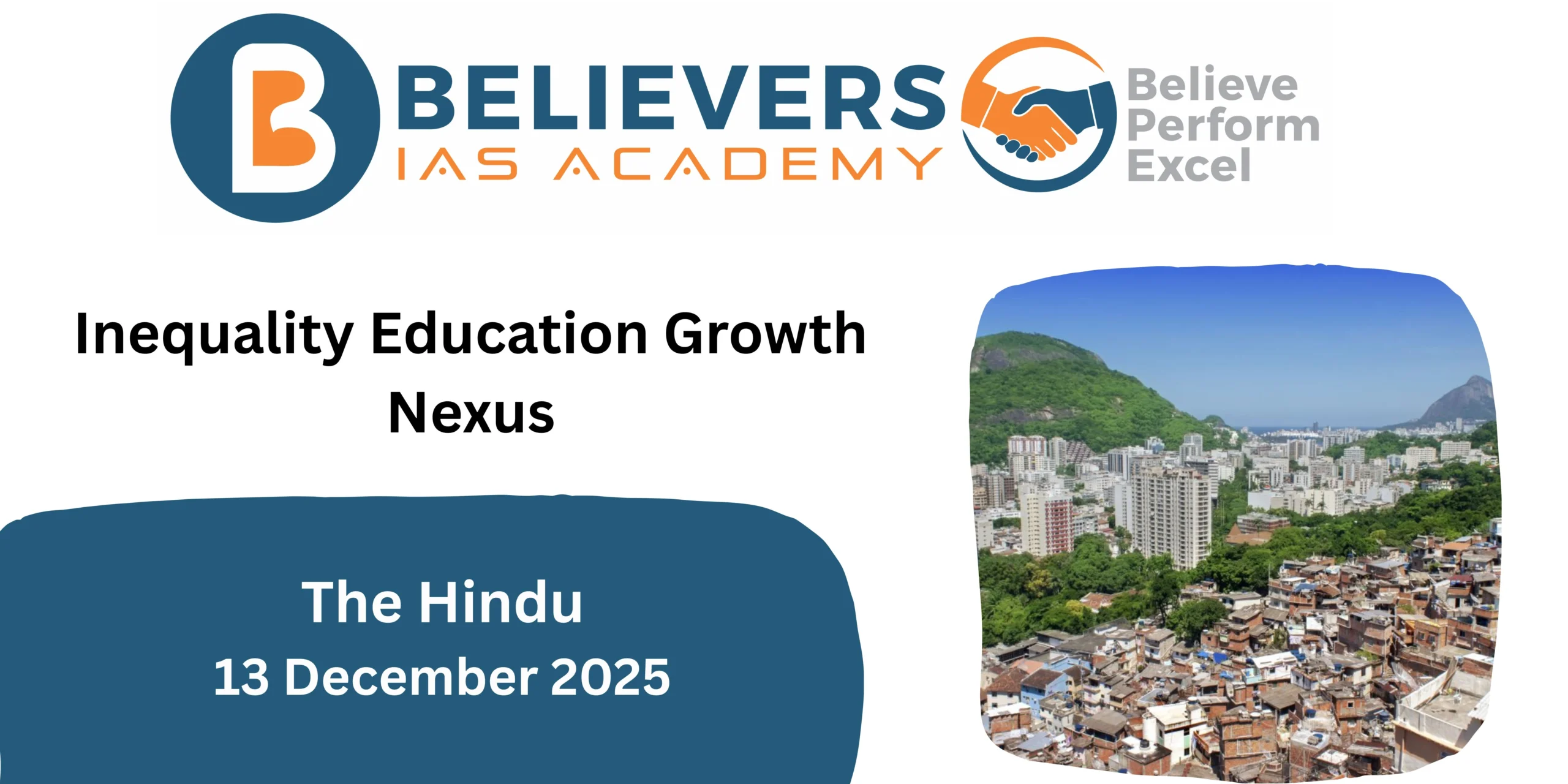
Inequality Education Growth Nexus
Context
- World Inequality Report 2026 highlights sharply widening global income and wealth disparities.
- Brings focus to the role of public investment in education and health as the most effective equaliser.
Key Findings: Global Inequality Snapshot
Income Inequality
- Top 10% earn more than the remaining 90% combined.
- Bottom 50% earn less than 10% of global income.
Wealth Inequality (More Extreme)
- Top 10% own ~75% of global wealth.
- Bottom 50% own only ~2%.
➡️ Indicates structural concentration of assets and intergenerational inequality.
Deep Regional Income Divides
Global Income Tiers
- High-income regions: North America & Oceania, Europe
- Middle-income regions: Russia & Central Asia, East Asia, Middle East & North Africa
- Low-income, populous regions: Latin America, South & Southeast Asia (including India), Sub‑Saharan Africa
Stark Income Gaps (PPP-adjusted)
- Average income in North America & Oceania is:
- 13× higher than Sub‑Saharan Africa
- 3× the global average
- Daily average income:
- ~€125 in North America & Oceania
- ~€10 in Sub‑Saharan Africa (many earn far less)
➡️ Global averages hide extreme lived inequalities.
Misplaced Inequality Debate
- Public discourse often focuses on:
- Whether inequality exists
- How large it is
- This diverts attention from the real policy question:
- Which interventions can actually reduce inequality?
➡️ Leads to policy paralysis rather than reform.
Public Investment as the Strongest Equaliser
Report’s Core Argument
- Public investment in education and health is the most effective tool to reduce inequality.
Why It Works
- Free, high-quality:
- Schools
- Healthcare
- Childcare
- Nutrition programmes
- Helps:
- Reduce early-life disadvantages
- Promote lifelong learning
- Ensure equality of opportunity
➡️ Shifts outcomes from birth-based privilege to merit-based mobility.
Education Spending Gap: A Structural Inequality
Public Education Expenditure (2025)
- Per school-age individual (0–24 years):
- Sub‑Saharan Africa: €220
- North America & Oceania: €9,025
- Gap: Nearly 1:41
➡️ Unequal public spending reproduces global inequality across generations.
The Inequality–Education–Growth Nexus
Vicious Cycle of Inequality
- High inequality →
- Credit constraints for poor families
- Limited access to quality education
- Educational inequality
- Misallocation of human capital
- Lower productivity & innovation
- Slower long-term economic growth
Virtuous Cycle through Educational Equity
- Equitable education →
- Broader skill base
- Higher productivity
- Inclusive economic growth
- Gradual reduction in inequality
➡️ Education acts as both economic input and social equaliser.
Education as a Tool to Reduce Inequality
- Education reduces:
- Economic inequality
- Social exclusion
- Environmental vulnerability
- Reflected in SDG 4 – Quality Education (“Leave No One Behind”)
Current Challenge
- Expansion of education access has:
- Mostly benefited the least marginalised
- Failed to close deep structural gaps
Systemic Issues
- Unequal funding
- Weak data systems
- Exclusionary institutional practices
➡️ Education systems often reinforce existing inequalities instead of correcting them.
Implications for India
- India lies in a low-income but populous region.
- Unequal education financing risks:
- Demographic dividend turning into demographic liability
- Persistent intergenerational poverty
- Reinforces need for:
- Higher public spending on education
- Focus on quality, not just access
- Targeted support for marginalised groups
Conclusion
- Inequality is not just about income and wealth, but about access to quality public services.
- Without substantial, equitable public investment, especially in education:
- Inequality will widen
- Growth will slow
- Social cohesion will weaken
Related Posts

India’s Retail Inflation Drops
Posted on

