
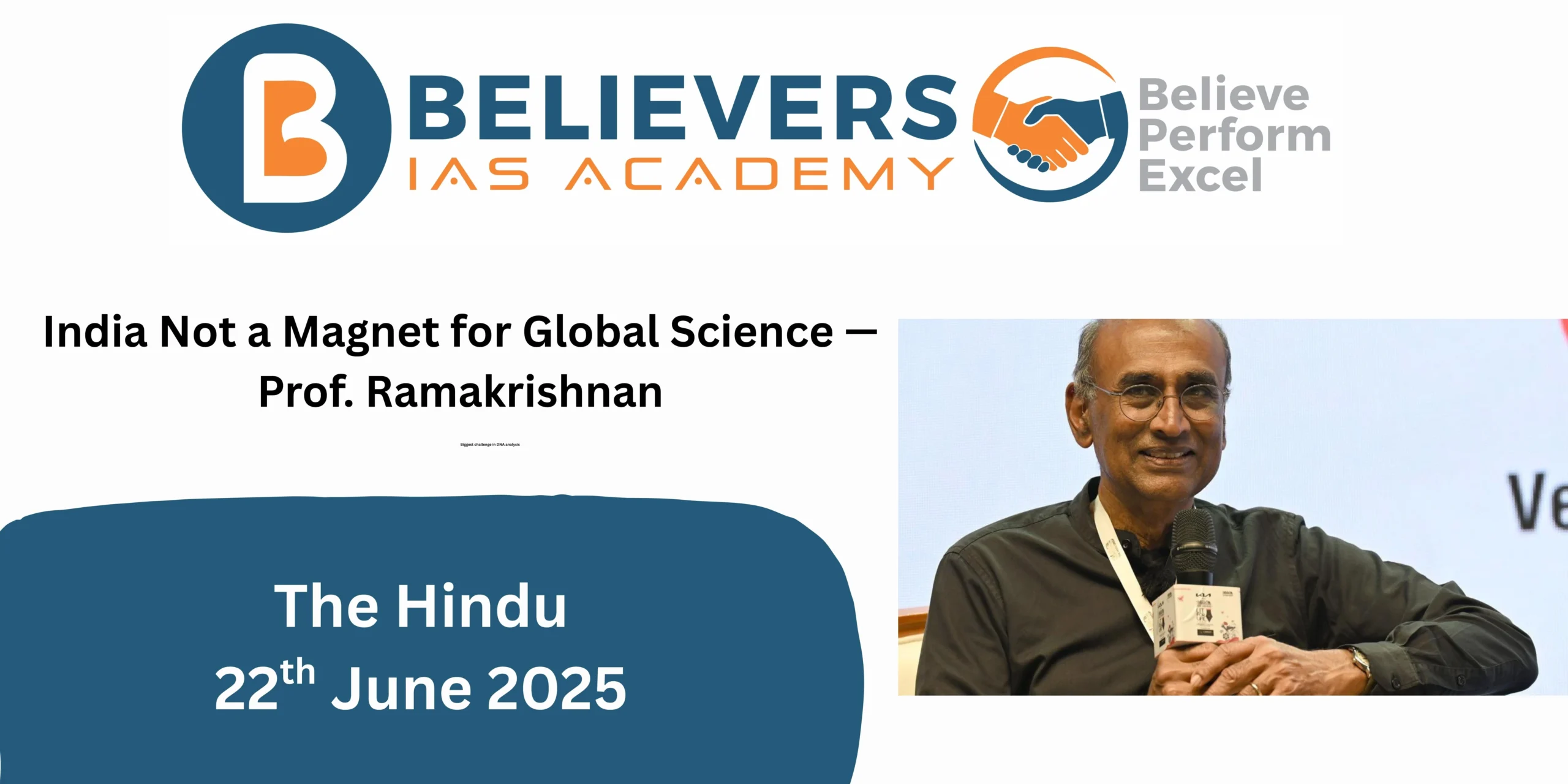
India Not a Magnet for Global Science — Prof. Ramakrishnan
Context
- The U.S. is undergoing massive science funding cuts (NIH, NSF, NASA), leading many American scientists to seek jobs abroad.
- European countries have launched special funding schemes to attract these scientists.
- India, despite its growing economy, fails to attract global scientific talent at scale.
- Nobel Laureate Venkatraman Ramakrishnan, MRC Lab, Cambridge, critiques India’s scientific ecosystem.
Relevance
- GS Paper 2: policy, governance challenges
- GS Paper 3: R&D ecosystem, innovation, demographic dividend
Key Points
- India’s Science Ecosystem: Limited Appeal
- Only a few institutions (IISc, NCBS, TIFR, IISERs, IITs) are world-class — and only in specific research areas.
- India is not a general magnet for international scientists.
- Scientific infrastructure and environment do not compare well with developed countries or even some Asian nations like China and Singapore.
- Funding Challenges
- India’s gross R&D expenditure is 0.6–0.7% of GDP, which is:
- Much less than China (~2.4%)
- Far below South Korea and developed countries (>2%)
- Government funding dominates; private sector contribution is minimal (opposite of developed countries).
- The Anusandhan National Research Foundation (NRF) was announced with ₹50,000 crore, but only ₹14,000 crore is committed by government, rest to be sourced from private/donors — showing funding uncertainty.
- Operational & Policy Issues
- Chronic delays in fund release every year.
- Research scholars often face scholarship delays up to a year.
- Science policies change whimsically without adequate consultation with scientists.
- Programs like the Ramalingaswami re-entry fellowship suffer from abrupt policy changes.
- No coherent national policy to attract senior scientists from abroad.
- Social & Environmental Factors
- Poor urban living conditions: pollution, unclean streets, lack of navigable sidewalks.
- Quality of life, safety, education, and healthcare infrastructure not attractive to international talent.
- Comparison with Singapore, which attracts scientists due to high salaries, low taxes, and excellent infrastructure.
Global Science Talent Migration
| Region | Situation |
| USA | Funding cuts; 75% of scientists keen to leave |
| Europe | Special funds to attract U.S. scientists, but limited |
| China | Aggressive incentives & stable funding attracting talent |
| India | Insufficient funding, infrastructure, incentives; poor urban living conditions |
Consequences if India Fails to Act
- Risk of losing demographic dividend due to lack of scientific opportunities.
- Falling behind Asian peers (China, South Korea, Singapore).
- India may fail to become a global scientific powerhouse.
Recommendations by Prof. Ramakrishnan
| Area | Suggestion |
| Funding | Increase R&D to at least 2% of GDP; ensure stable, long-term funding |
| Infrastructure | Upgrade labs, technology, and institutional facilities |
| Governance | Insulate science from politics; reduce bureaucratic delays |
| Policies | Create clear, attractive schemes to bring back Indian diaspora and foreign scientists |
| Social Environment | Improve urban living: clean cities, safe neighborhoods, good schools and healthcare |
Conclusion
India has made significant strides in science and technology, but Nobel Laureate Venkatraman Ramakrishnan’s observations highlight persistent structural and systemic challenges. Despite a youthful talent pool and pockets of excellence like IISc and IITs, India struggles to attract and retain top international researchers due to underfunding, bureaucratic inefficiencies, policy unpredictability, and poor infrastructure.
To transform into a global science hub, India must:
-
Substantially increase R&D investment, especially from the private sector,
-
Ensure timely disbursement of funds and scholarships,
-
Stabilize and depoliticize science policies through consultative processes,
-
Improve social infrastructure to make India a livable destination for global talent.
Only by addressing both the scientific and societal barriers can India fully leverage its demographic dividend and aspire to global leadership in research and innovation
Related Posts

UPSC Current Affairs Quiz, 14 May 2023
Posted on

