
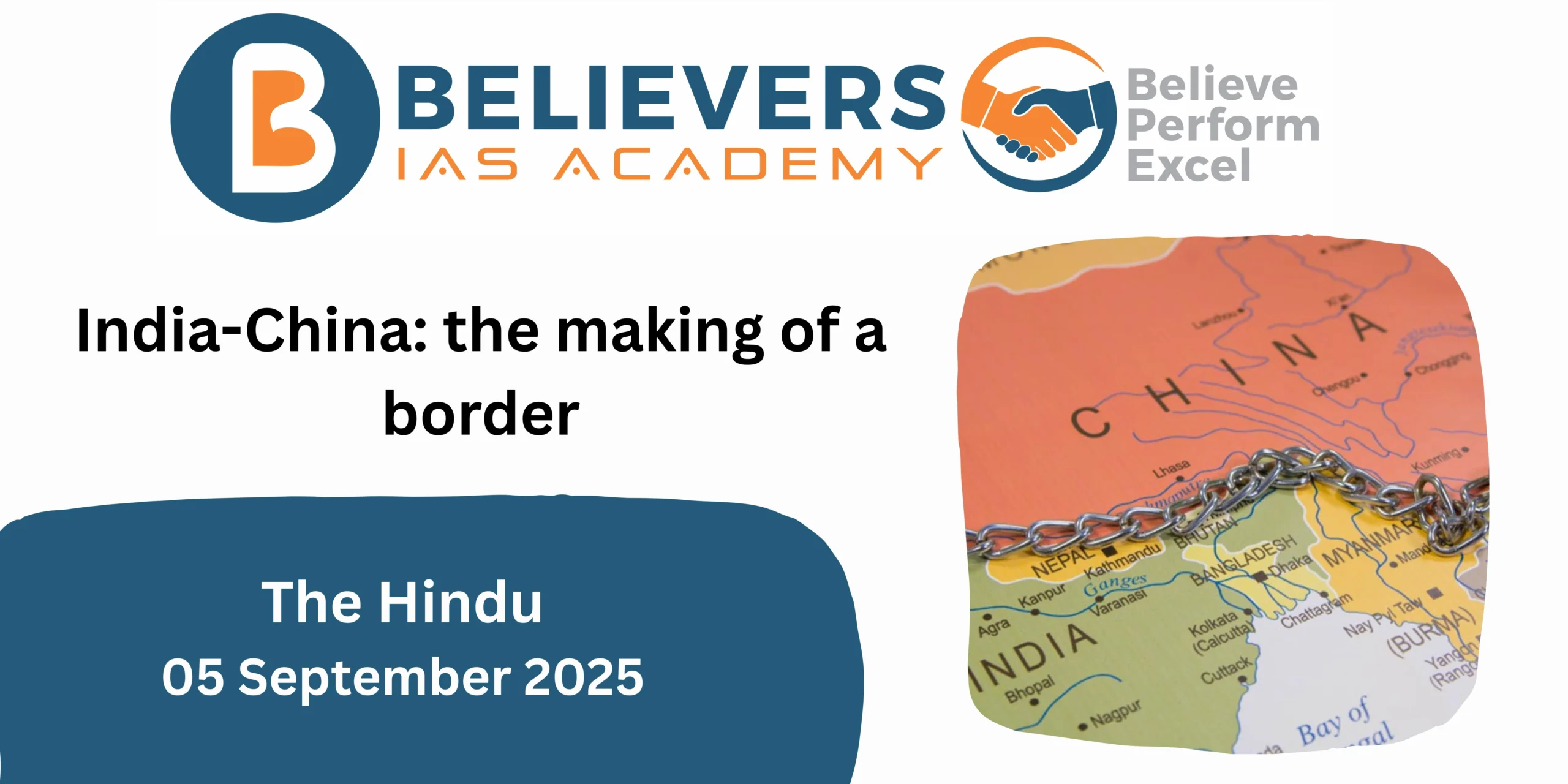
India-China: the making of a border
Context and Significance
-
India and China share a 3,488-km long disputed border, largely undefined and historically shaped by imperial legacies — British and Manchu.
-
The India-China boundary dispute is central to regional security, bilateral ties, and India’s foreign policy strategy.
Historical Background
1. Imperial Legacy
-
The border was a product of British India and Qing China, mostly undefined and running through uninhabited Himalayan regions.
-
After independence, India asserted inherited British-era maps without ground verification or mutual agreement.
2. Aksai Chin and McMahon Line
-
Aksai Chin: Claimed by India (Ladakh), occupied by China to link Xinjiang and Tibet.
-
Eastern sector: India’s control over Tawang (Arunachal Pradesh) based on the 1914 McMahon Line signed with an autonomous Tibet.
Conflict and the 1962 War
-
China proposed (1959): Mutual troop withdrawal, and accepting a Line of Actual Control (LAC).
-
Zhou Enlai’s 1960 proposal: Territorial swap — India keep Arunachal, China keep Aksai Chin.
-
India rejected the proposal; attempted to assert physical control over Aksai Chin.
-
1962 Sino-Indian War: China retained western gains (Ladakh); withdrew from eastern advances (north of McMahon Line).
Post-War Developments (1962–1979)
-
Border remained inactive for over a decade.
-
China Study Group (1975): Mapped the border, established patrolling points, regular surveillance initiated.
-
Nathu La & Cho La clashes (1967): Armed skirmishes in Sikkim; India responded strongly.
Attempts at Normalisation (1979–1988)
1. Vajpayee’s Visit (1979)
-
Aimed to restore normalcy with China.
-
Cut short due to Chinese invasion of Vietnam but initiated dialogue.
2. Deng Xiaoping’s 1980 Offer
-
Reiterated Zhou’s 1960 package deal: Recognition of McMahon Line in exchange for Indian acceptance of Aksai Chin status quo.
-
India rejected the “LAC Plus” proposal (1983), as it included permanent Chinese control over 1962 war gains in Ladakh.
3. Border Talks Begin (1981 onwards)
-
China insisted on comprehensive package, India preferred sector-by-sector approach.
-
1985–86 Tawang Crisis: China demanded Tawang; India undertook Operation Falcon to counter incursion in Wangdung.
Diplomatic Breakthrough (1988 Onwards)
1. Rajiv Gandhi’s Visit to China (1988)
-
Reopened high-level engagement after 28 years.
-
Deng Xiaoping: “Let us forget the past.”
-
Agreed to restore and develop overall bilateral ties, while keeping boundary issue on a separate track.
2. Joint Working Group (JWG) Formation
-
Created for peaceful resolution of the boundary dispute.
-
Marked paradigm shift: Normalisation of ties no longer contingent on immediate border resolution.
Key Issues in the Border Dispute
| Sector | Area | India’s Claim | China’s Claim |
|---|---|---|---|
| Western | Aksai Chin | Part of Ladakh | Vital corridor between Tibet & Xinjiang |
| Eastern | Arunachal Pradesh | Indian State | South Tibet, especially Tawang |
| Central | Uttarakhand, Himachal | Defined by British-era maps | Ambiguous |


