
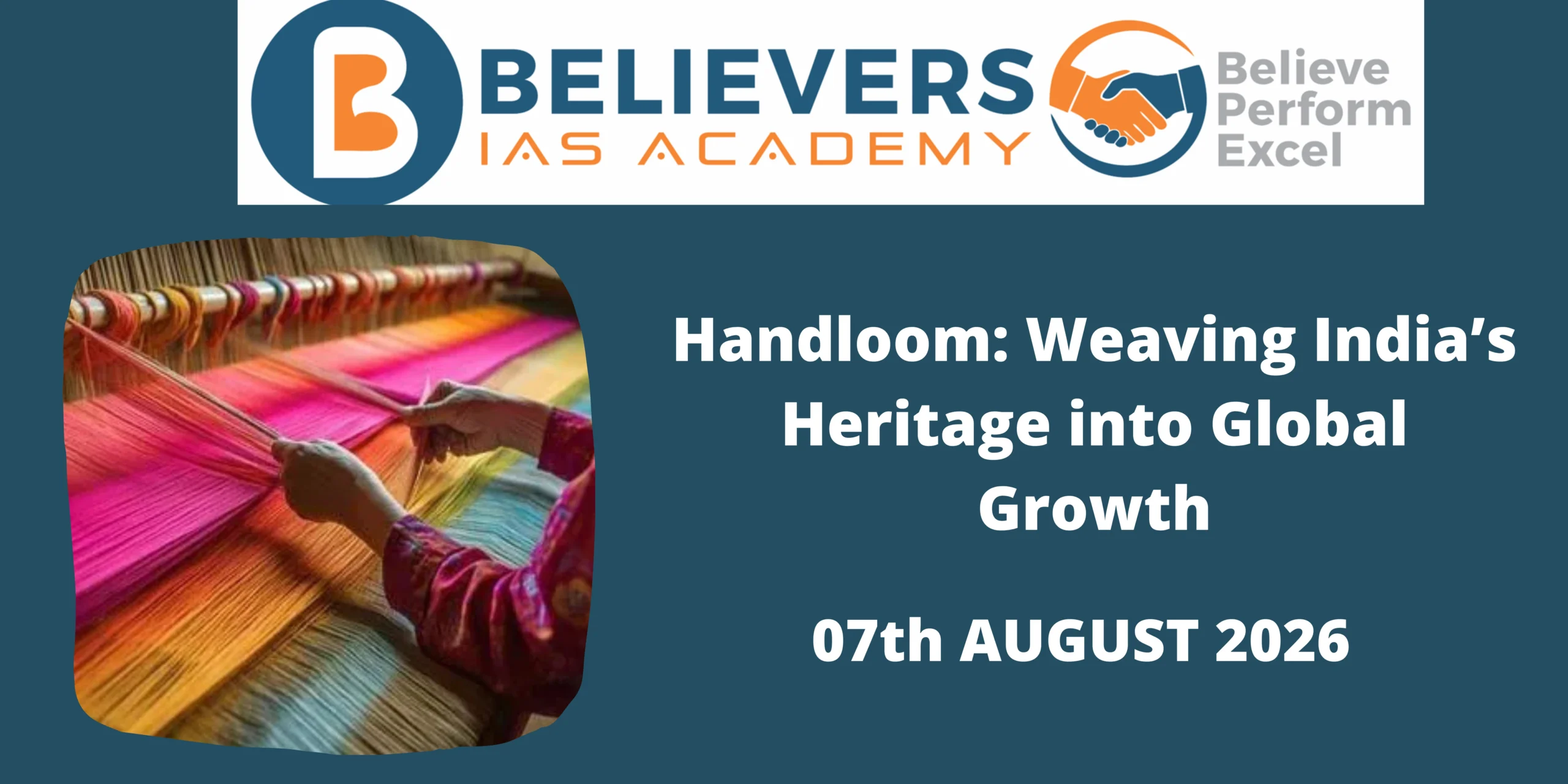
Handloom: Weaving India’s Heritage into Global Growth
Subject: Art & Culture ; Economy
Context
As one of India’s most ancient civilisational markers, the handloom sector represents a unique intersection of cultural heritage, sustainable craftsmanship, and grassroots economic empowerment. With a strategic thrust toward technology integration, structured institutional support, and global brand positioning, handlooms are increasingly viewed as a vital growth engine for inclusive rural development and export competitiveness.
Historical Roots and Civilisational Significance
-
Deep Civilisational Ties: India’s tryst with textiles dates back to the Indus Valley Civilisation, which witnessed some of the earliest recorded instances of cotton cultivation and weaving.
-
Global Pre-eminence: During the 18th century, indigenous Indian handcrafted textiles heavily dominated global trade networks.
-
Core Philosophy: Handlooms embody a long-standing tradition of sustainable, eco-friendly, and authentic craftsmanship that resonates with contemporary global demands for ethical fashion.
Socio-Economic Importance
-
Employment Potential: The handloom sector operates as India’s largest cottage industry, supporting the livelihoods of over 3.5 lakh weavers and allied workers.
-
Women-Led Growth: With nearly 72% of the workforce comprising women, it functions as a formidable vehicle for women’s economic empowerment.
-
Macroeconomic Catalysts: The sector drives rural livelihoods, fosters inclusive growth, aligns with Atmanirbhar Bharat (self-reliance), and strengthens India’s global export competitiveness.
Institutional Framework and Support Systems
The government has established a robust support network to streamline production, quality control, and market access:
-
Weavers’ Service Centres (WSCs): 29 dedicated centres across India providing training, skill upgrading, design development, raw material support, and direct market linkages.
-
Indian Institutes of Handloom Technology (IIHTs): 11 institutes focused on advanced technical education, skill enhancement, and the creation of niche, high-value handloom products.
-
Certification & Quality Assurance: Schemes like the Handloom Mark and India Handmade Certification authenticate genuine products for both domestic and international markets, protecting consumers and producers against powerloom counterfeits.
-
Infrastructure & Design Access: Development of 797 Handloom Clusters, Urban Haats for direct marketing, and Design Resource Centres (DRCs) to aid product diversification and trend adaptation.
Technological Evolution: From Tradition to Industry 4.0
Innovation in the handloom sector spans historical milestones to cutting-edge digital interventions:
-
Historical Innovations: The Ambar Charkha, inspired by Mahatma Gandhi, revolutionized spinning speed and efficiency, symbolizing rural self-reliance.
-
Modern Ergonomic Improvements: Regional innovations such as Assam’s Maina Loom and the Chitranjan Handloom (from Sivasagar, Assam) enhance ease of weaving, correct ergonomic posture, and boost productivity.
-
Centre of Excellence for Handloom Technology (CoEHT): Established alongside the IITs to design lightweight, robust, and disability-friendly looms aimed at reducing physical fatigue and improving occupational safety.
-
Handloom 4.0 and VisioNXT:
-
The Handloom 4.0 pilot utilizes Artificial Intelligence (AI) and digital tech for real-time productivity monitoring, quality checks, and predictive maintenance.
-
VisioNXT forecasts market demand, decodes design trends, authenticates genuine products, and connects weavers directly to global markets through data-driven production planning.
-
Policy Forward: Upcoming Programmes and Targets
-
National Handloom and Handicraft Programme: Designed to scale operations across 1,800 clusters spanning 500+ districts, targeting support for 65 lakh weavers and artisans with the core objective of establishing “Handmade in India” as a globally recognized, high-value brand.
-
Income Vision: The long-term policy vision looks beyond mere survival, aiming to secure a dignified and aspirational income benchmark of ₹50,000 per month for every weaver.
Related Posts

Mehrgarh
Posted on
Daily Static Quiz – 19th January, 2023
Posted on
