
Fiscal Federalism: Efficiency vs. Equity Under the 16th Finance Commission
Subject: Economy
Context
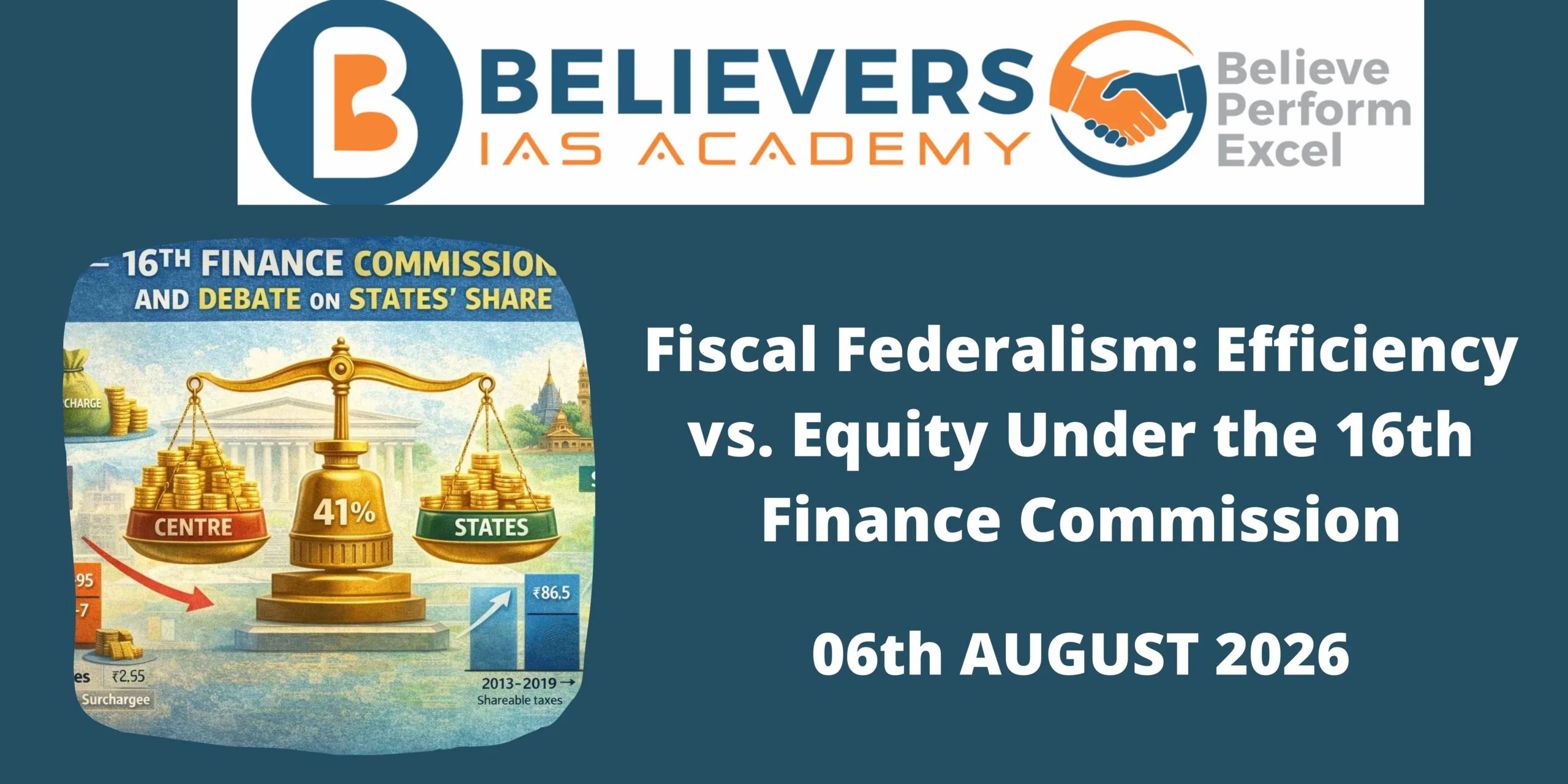
The recommendations of the 16th Finance Commission (FC-16) for the award period 2026–31 have ignited intense national debates on Indian fiscal federalism. By retaining vertical tax devolution at 41% while dramatically overhauling and downsizing grants-in-aid, the Commission has signalled a decisive pivot from need-based equalisation to performance-based efficiency.
Constitutional Mandate of the Finance Commission
Established under Article 280 of the Constitution, the Finance Commission serves as the foundational pillar of India’s fiscal federal architecture. Its primary mandate is to arbitrate resource allocation between the Union and the States, with core objectives that include:
-
Correcting vertical fiscal imbalances (the revenue-expenditure mismatch between the Centre and States).
-
Minimizing horizontal fiscal inequalities across diverse states.
-
Preserving the federal compact while fostering balanced regional growth.
Key Recommendations of the 16th Finance Commission (2026–31)
-
Vertical Devolution: The States’ share in the divisible pool of central taxes has been retained at 41%, defying the collective demand of 18 States for an elevation to 50%.
-
Contraction of Grants-in-Aid: Total recommended grants plummeted from ₹10.1 lakh crore (FC-15) to ₹9.47 lakh crore (FC-16), causing the share of grants in total FC transfers to nosedive from 19.4% to 8.3%.
-
Restructuring and Discontinuation: Grants are now heavily restricted to Local Bodies and Disaster Management. FC-16 has discontinued:
-
Revenue Deficit Grants (RDGs): Article 275 grants previously given to bridge post-devolution revenue gaps.
-
Sector-Specific Grants: Targeted funds for health, education, agriculture, judiciary, and infrastructure.
-
State-Specific Grants: Tailored allocations addressing distinct geographic, ecological, or socio-economic hurdles (e.g., higher administrative costs in hilly/North-Eastern regions, or social investments in Kerala and Punjab).
-
-
Formula Adjustments and New Metrics:
-
The weight assigned to Income Distance (the gauge measuring per capita income gaps from the richest state to promote equity) was trimmed from 45% to 42.5%.
-
A new criterion introducing a 10% weight for GDP contribution was established, tilting rewards toward economically advanced states.
-
Cesses and surcharges remain outside the divisible pool, with the Commission proposing a conditional “grand bargain” rather than a binding rollback.
-
The Rationale and Critique of FC-16
The Case for Efficiency (The Commission’s Stand)
-
Combating Moral Hazard: FC-16 argued that open-ended RDGs breed fiscal indiscipline, diminish state-level revenue mobilisation drives, and encourage reckless spending built on expectations of central bailouts.
-
Incentivizing Performance: The heavy reliance on performance-tied grants (e.g., tied to water/sanitation milestones, timely audits, and revenue enhancement) aims to enforce administrative accountability and outcome-oriented governance at grassroot tiers.
Core Criticisms and Concerns
-
Exacerbating Regional Disparities: A framework that rewards economic muscle (via GDP contribution weights) while slashing structural support (RDGs) risks penalizing fiscally stressed and poorer states.
-
Differential Capacities: Aggregate macro-indicators mask deep micro-level developmental strains across several states, particularly in the North-East and parts of eastern India.
-
Compromised State Autonomy: Heavy conditionality attached to performance-linked grants undermines local fiscal flexibility and erodes the spirit of cooperative federalism.
The Central Debate: Efficiency vs. Equity
The 16th Finance Commission report encapsulates a fundamental friction point in modern Indian governance:
| Dimension | The Efficiency Paradigm (FC-16 Preference) | The Equity Paradigm (Critic’s Demand) |
| Primary Goal | Fiscal discipline, revenue optimisation, and outcome delivery. | Equalisation, historical compensation, and fairness across regions. |
| Transfer Mechanism | Performance-linked, conditional, and output-based grants. | Need-based transfers, revenue-gap filling, and weighted devolution. |
| Federal Philosophy | Competitive federalism driven by economic productivity. | Cooperative federalism prioritizing balanced national development. |
Way Forward
-
Harmonizing Discipline with Empathy: Future iterations of fiscal architecture must establish safety nets for structurally disadvantaged states that cannot instantly compete with industrialized powerhouses.
-
Rationalizing Cesses: A concrete, time-bound roadmap to share cesses and surcharges with states is vital to restore trust in the divisible pool.
-
Balanced Grant Architecture: Re-introducing targeted windows for critical sectors (like public health and human capital development) without diluting the push for local fiscal accountability.


