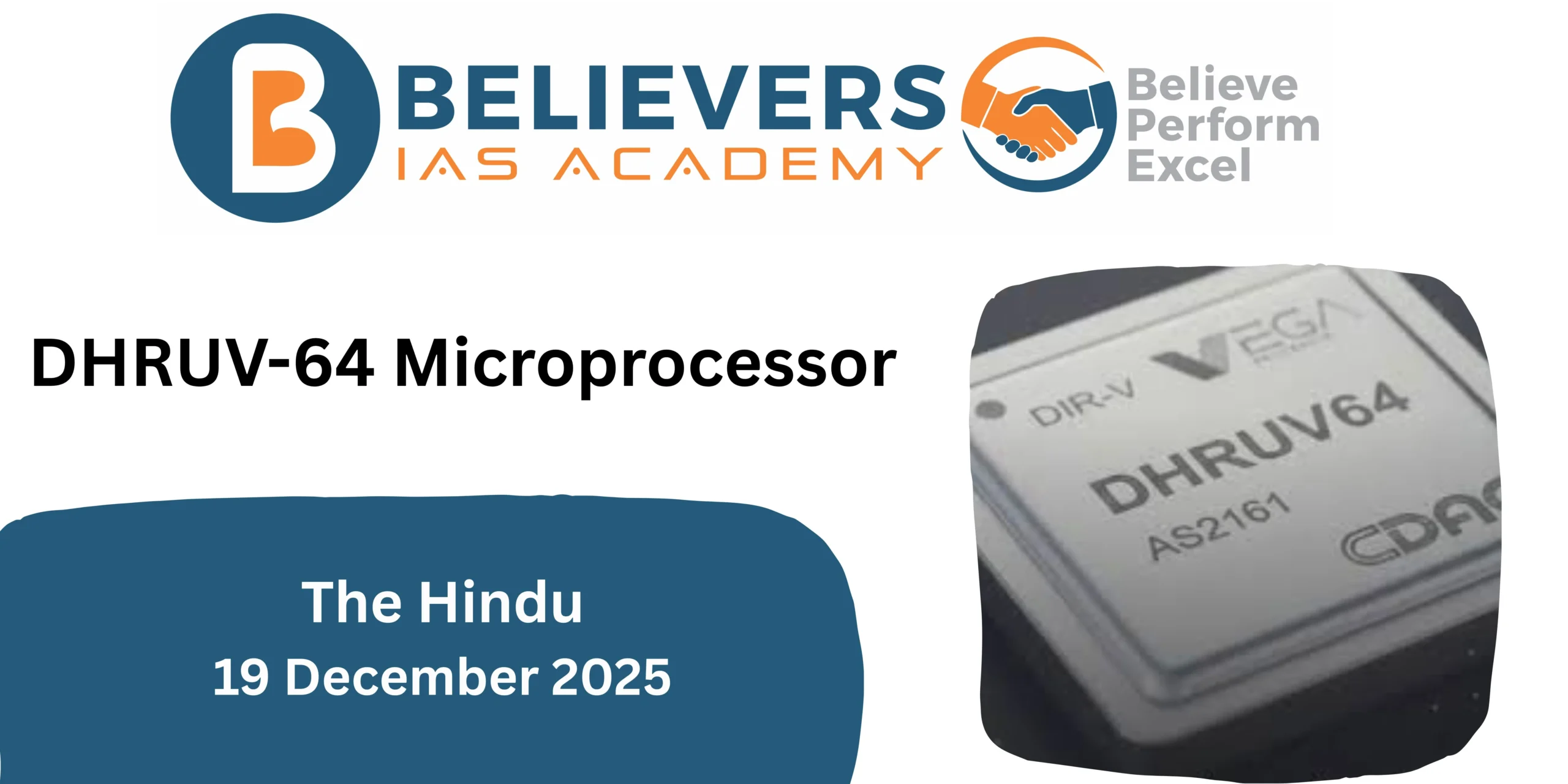
DHRUV64 Microprocessor
Context
-
On 15 December, the Ministry of Electronics and Information Technology (MeitY) announced DHRUV64, an indigenous microprocessor.
-
Part of India’s push for strategic autonomy in semiconductor design under the Microprocessor Development Programme (MDP).
What is DHRUV64?
-
Developer: Centre for Development of Advanced Computing (C-DAC) under MeitY.
-
Type: General-purpose 64-bit, dual-core microprocessor.
-
Clock Speed: 1 GHz.
-
Architecture: RISC-V based, under the Digital India RISC-V (DIR-V) programme.
-
Intended Applications:
-
Industrial automation
-
Telecom infrastructure
-
Embedded systems
-
Control systems
-
Why is it Significant?
-
India is a large consumer but not a designer of processors.
-
Indigenous processors enhance:
-
Strategic autonomy
-
Cybersecurity & supply chain resilience
-
Control over updates, toolchains, and IP
-
-
Useful for sectors where reliability > peak performance.
DHRUV64: What the Specs Mean
-
64-bit design → supports modern operating systems.
-
Performance is modest compared to consumer CPUs (no GPUs/AI accelerators).
-
Suitable for:
-
Telecom base stations
-
Routers
-
Industrial controllers
-
Automotive electronics
-
India’s Processor Ecosystem
| Processor | Institution |
|---|---|
| SHAKTI | IIT Madras |
| AJIT | IIT Bombay |
| VIKRAM | ISRO – SCL |
| THEJAS32/64 | C-DAC |
| DHRUV64 | C-DAC |
DHRUV64 is pitched as a platform for startups and academia to prototype systems without foreign dependence.
What is RISC-V / DIR-V?
-
RISC-V:
-
Open-source instruction set
-
No licensing fees
-
Modular and customizable
-
-
DIR-V (Digital India RISC-V):
-
National programme to build a portfolio of Indian RISC-V processors
-
Earlier chips: THEJAS32 (Malaysia fab), THEJAS64 (SCL Mohali)
-
What MeitY Has NOT Revealed
-
No performance benchmarks (cache, memory, power efficiency).
-
Fabrication details missing (foundry, node, yield, reliability).
-
Ambiguity in claim of “fully indigenous” (design vs fabrication vs IP).
-
No OEM clarity:
-
Developer boards
-
OS support
-
Security & audit features
-
Government anchor usage
-
-
Unclear roadmap beyond announcements.
Future Roadmap (C-DAC)
-
DHANUSH:
-
Quad-core, 1.2 GHz, 28 nm
-
-
DHANUSH+:
-
Quad-core, 2 GHz, 14/16 nm (reported)
-
Government Schemes Supporting Indigenous Chips
-
Chips to Startup (C2S) – ₹250 crore (5 years)
-
Design Linked Incentive (DLI) Scheme
-
INUP-i2i – access to nano-fabrication & training
-
India Semiconductor Mission (ISM):
-
10 projects
-
₹1.6 lakh crore investment
-
Across 6 States
-
Way Forward
-
Build system-on-chip families
-
Strong software & developer ecosystem
-
Transparent manufacturing & testing
-
Government as anchor buyer
-
Goal: Indian chips adopted without high cost or risk