
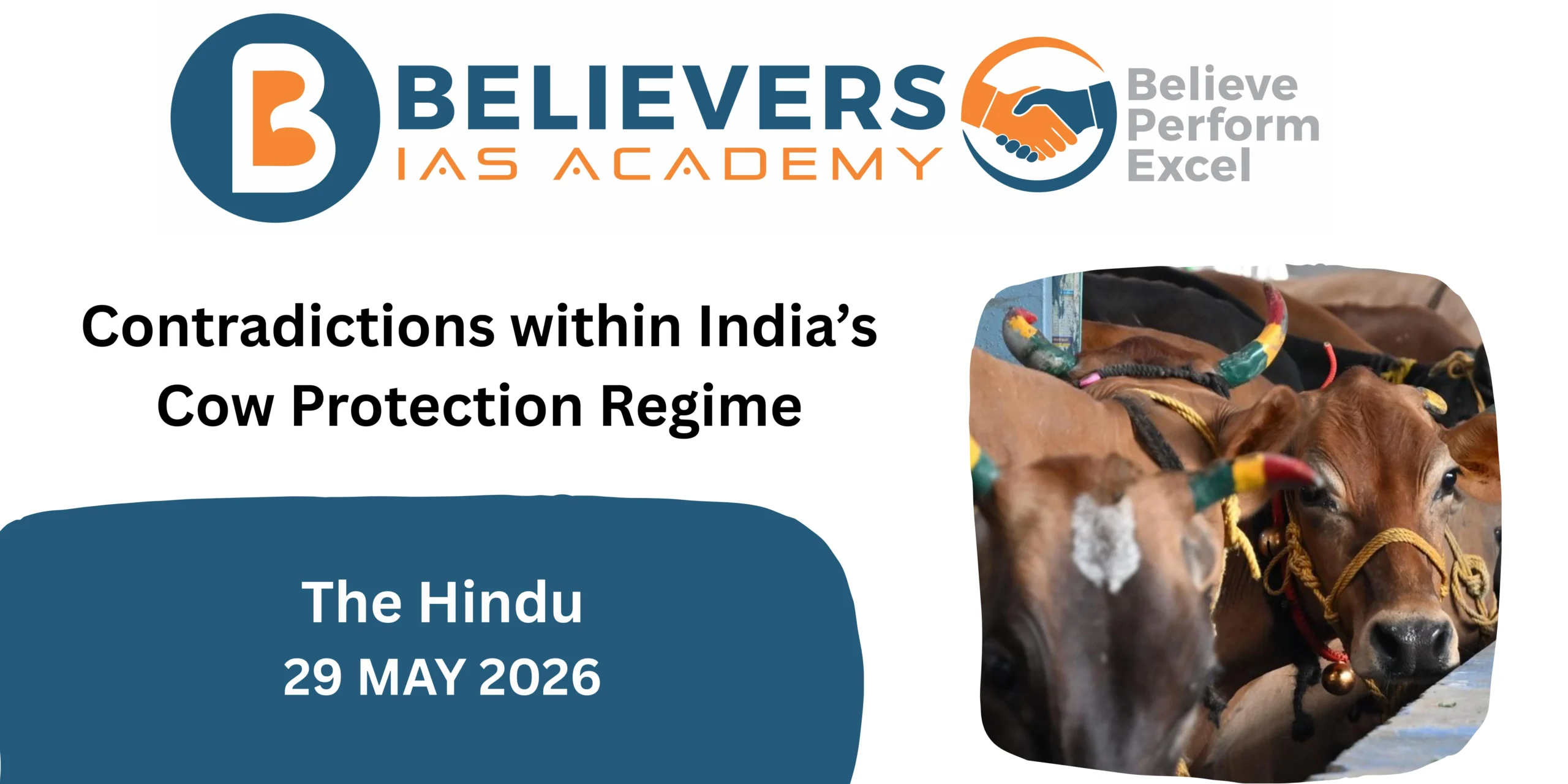
Contradictions within India’s Cow Protection Regime
Context
Recent incidents such as:
- Discovery of hundreds of cow carcasses in Jaisalmer, Rajasthan
- Reports of starvation deaths of cows in Chhattisgarh
have reignited debate on the effectiveness and contradictions within India’s cow-protection framework.
Simultaneously, West Bengal introduced stricter certification requirements for cattle slaughter under the West Bengal Animal Slaughter Control Act, 1950, while allowing slaughter of cows above 14 years under prescribed conditions.
Historical Evolution of Cow Protection in India
1. Colonial Period
Cow protection emerged as a major socio-political issue during British rule.
Key Features
- Cow protection movements were used for political mobilisation.
- Cow symbolism became associated with identity politics and nationalism.
- Viceroy Lord Lansdowne reportedly observed that the movement strengthened the political mobilisation capacity of the Indian National Congress.
- Cow and calf symbols were historically associated with Congress politics.
Religious Accommodation by Earlier Rulers
Several Muslim rulers imposed restrictions on cow slaughter to respect local sentiments:
- Babur
- Jahangir
This indicates that cow protection historically also functioned as a tool of social accommodation.
2. Post-Independence Constitutional Position
Constituent Assembly Debates
- Debates in 1948 witnessed support for cow protection even from some Muslim members.
- The issue was linked to:
- Agriculture
- Rural economy
- Animal husbandry
Article 48 – Directive Principles of State Policy
Article 48: Prohibit slaughter of cows, calves, and other milch and draught cattle\text{Article 48: Prohibit slaughter of cows, calves, and other milch and draught cattle}
Article 48 directs the State to:
- Organise agriculture and animal husbandry on modern and scientific lines
- Preserve and improve breeds
- Prohibit slaughter of cows, calves, and milch/draught cattle
Role of B. R. Ambedkar
Dr. Ambedkar placed cow protection under DPSPs instead of Fundamental Rights, balancing:
- Economic concerns
- Religious sensitivities
- Federal flexibility
Judicial Position on Cow Slaughter
Mohd. Hanif Quareshi v. State of Bihar (1958)
Mohd. Hanif Quareshi v. State of Bihar
Supreme Court Held:
- Cow slaughter on Bakr-Eid is not an essential Islamic practice.
- States can impose reasonable restrictions on slaughter.
This judgment constitutionally validated many State-level prohibition laws.
What Does the Cattle Census Reveal?
Contradiction in Outcomes
Despite stricter laws in many States, cattle populations have not proportionately increased.
Census Trends
Since 1951:
- Cow population increased only about 49.6%
- Buffalo population increased around 153.8%
- Female buffalo population rose around 161.9%
State-wise Trends
States with stringent laws such as:
- Gujarat
- Uttar Pradesh
- Maharashtra
have witnessed:
- Decline in male cattle populations
- Shift toward buffalo rearing
Whereas:
- West Bengal with relatively less restrictive laws recorded comparatively better cattle growth.
Economic Contradictions in Cow Protection
Burden on Farmers
Farmers traditionally depend on selling unproductive cattle for:
- Education expenses
- Healthcare
- Marriages
- Farm investments
Problems Created by Restrictions
- Increased maintenance cost of aged cattle
- Reduced economic flexibility
- Stray cattle problem
- Crop damage by abandoned cattle
Informal and Illegal Markets
Stringent bans may unintentionally:
- Encourage illegal cattle trade
- Increase role of middlemen
- Reduce farmers’ income realization
Rural Economy Dimension
Livestock is central to India’s:
- Agro-economy
- Dairy sector
- Mixed farming systems
- Rural livelihoods
Thus, cattle policies directly affect:
- Small farmers
- Landless households
- Dairy economy
- Rural credit cycles
Rights-Based Debate
Article 21 and Food Choice
Article 21 includes privacy, dignity, and personal autonomy\text{Article 21 includes privacy, dignity, and personal autonomy}
In K. S. Puttaswamy v. Union of India:
Justice J. Chelameswar
Observed that:
- The State should not excessively regulate personal choices such as food, dress, or associations.
Justice D. Y. Chandrachud
Held that:
- Food choices form part of privacy and dignity under Article 21.
This creates a constitutional debate between:
- Directive Principles (Article 48)
vs.
- Fundamental Rights (Article 21)
Key Contradictions in India’s Cow Protection Regime
| Objective | Ground Reality |
|---|---|
| Protect cattle population | Cow numbers not rising significantly |
| Promote animal welfare | Reports of starvation and abandonment |
| Preserve agrarian economy | Farmers face financial burden |
| Maintain social harmony | Laws often generate social tensions |
| Scientific animal husbandry | Policy outcomes encourage buffalo substitution |
| Ethical protection | Stray cattle crisis worsening |
Challenges
Administrative
- Poor gaushala infrastructure
- Inadequate funding
- Weak veterinary support
Economic
- Rising cost of maintaining unproductive cattle
- Lack of compensation mechanisms
Social
- Vigilantism and social conflict
- Communal polarization
Legal
- Variation in State laws
- Tension between DPSPs and Fundamental Rights
Way Forward
Balanced Policy Approach
- Shift from symbolic politics to scientific cattle management
Strengthen Gaushalas
- Better funding and monitoring
- Public-private partnerships
Farmer-Centric Policies
- Compensation for maintaining aged cattle
- Insurance support
- Incentives for indigenous breeds
Scientific Livestock Management
- Breed improvement
- Dairy productivity enhancement
- Sustainable fodder systems
Constitutional Balance
- Harmonise:
- Animal welfare
- Farmers’ livelihood
- Individual freedoms
- Social harmony
Conclusion
India’s cow protection regime reflects a complex intersection of:
- Religion
- Constitutional values
- Agrarian economy
- Animal welfare
- Personal liberty
The evidence suggests that legal prohibition alone cannot ensure effective cattle preservation. Sustainable outcomes require a humane, economically viable, and scientifically informed livestock policy that balances constitutional morality with rural realities.


