
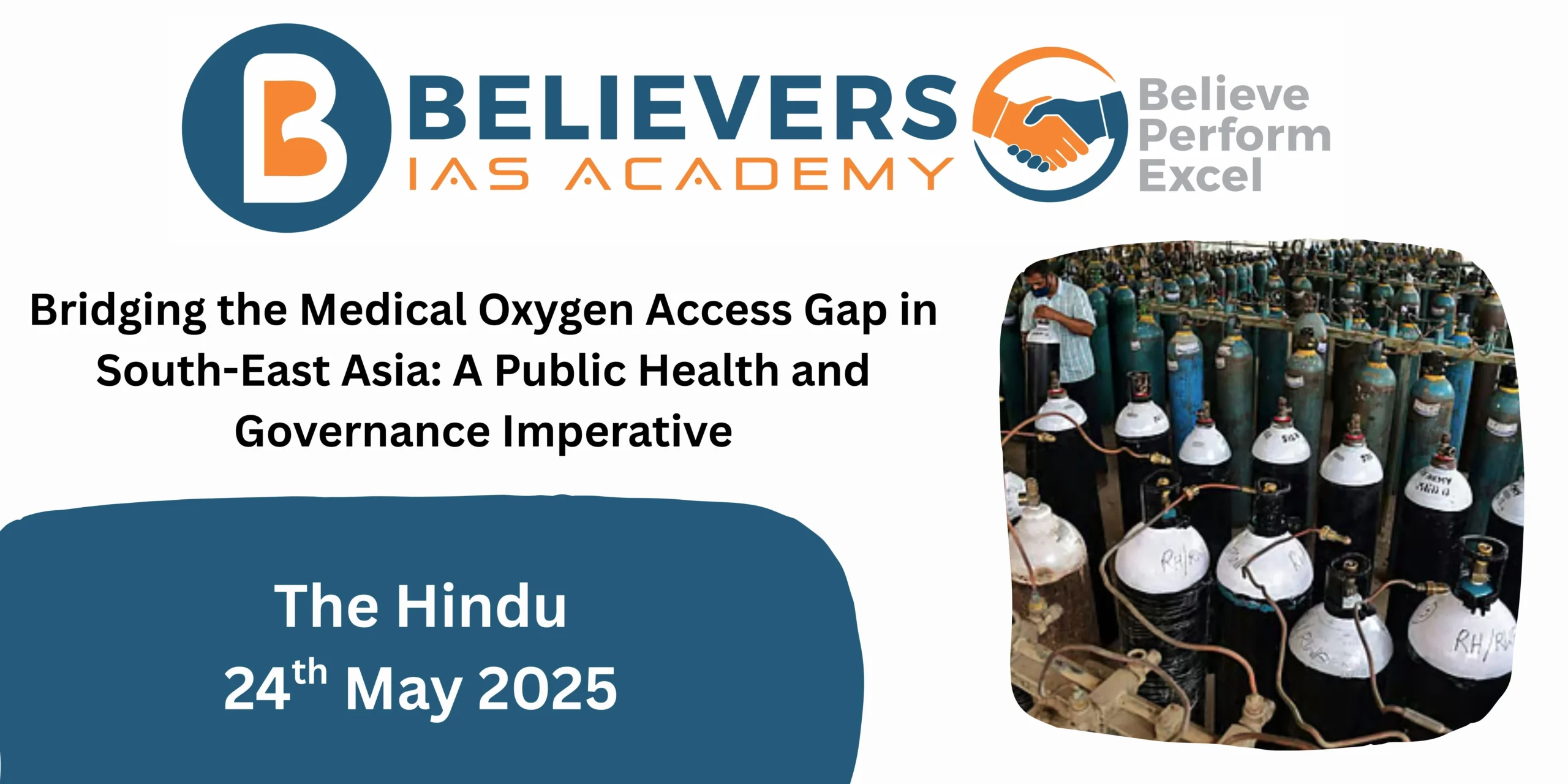
Bridging the Medical Oxygen Access Gap in South-East Asia: A Public Health and Governance Imperative
Context
Medical oxygen is an essential component of modern healthcare, critical for treating conditions like pneumonia, neonatal disorders, trauma, and COVID-19. Yet, despite its importance, access to safe, affordable, and reliable medical oxygen remains severely limited, especially in South Asia and East Asia-Pacific regions, which face service coverage gaps of 78% and 74% respectively. The COVID-19 pandemic further highlighted these deficiencies, exposing systemic weaknesses in oxygen infrastructure across low- and middle-income countries (LMICs), including India.
Relevance
-
GS Paper II: Governance, Health Sector Reforms
-
Role of the government and WHO in public health infrastructure.
-
International collaboration and capacity building in healthcare delivery.
-
-
GS Paper III: Science & Tech, Disaster Management
-
Role of innovation (solar-powered oxygen systems, PSA plants).
-
Managing public health emergencies through resilient infrastructure.
-
-
Essay Paper / Ethics
-
Ethical dimensions of equitable healthcare.
-
Human rights and dignity in access to essential medicines.
-
Multi-Dimensional Analysis of the Oxygen Access Gap
1. Health Infrastructure Challenges in Medical Oxygen Access
-
Limited Equipment Penetration: Only 54% of LMIC hospitals have pulse oximeters and 58% have access to medical oxygen. This leads to delayed diagnosis, inadequate treatment, and preventable deaths.
-
High Financial Cost: An estimated $6.8 billion is required globally to bridge the oxygen gap; South Asia alone needs $2.6 billion.
-
Shortage of Skilled Workforce: Lack of trained biomedical engineers and technicians hampers the maintenance and operation of oxygen equipment.
2. Policy and Governance Bottlenecks
-
Short-term Emergency Responses: COVID-19 induced a reactive, rather than sustainable, approach.
-
Lack of Long-Term Planning: Many countries lack integrated scale-up plans for oxygen access within Universal Health Coverage (UHC).
-
Weak Regulatory Frameworks: There is a need for standardised safety protocols for storage, production, and delivery.
3. Regional Cooperation and WHO Interventions
-
WHO’s Role: Developed a 2022 report highlighting best practices and initiated regional collaboration (e.g., Nepal training Bhutanese engineers).
-
Oxygen Resolution: WHO’s global call for periodic progress reviews (2026, 2028, 2030).
-
Scorecard and Monitoring Tools: WHO Access to Medical Oxygen Scorecard promotes data-driven accountability.
4. Innovations and Technological Solutions
-
PSA Oxygen Plants: Pressure Swing Adsorption (PSA) plants offer decentralized oxygen production.
-
Solar-Powered Oxygen Systems: Adopted in Ethiopia and Nigeria, these ensure uninterrupted oxygen supply in low-power zones—ideal for South-East Asia.
-
Booster Pumps & Portable Concentrators: Improve last-mile oxygen delivery.
5. Private Sector and Civil Society Involvement
-
Private Investment: Encouraged in local manufacturing to cut import costs and address supply-demand gaps.
-
NGOs and Donors: Must shift from crisis-mode aid to long-term operational support and infrastructure funding.
-
Academia and Research: Need to develop affordable, scalable, low-maintenance oxygen technologies tailored to LMICs.
6. Strategic Policy Actions Needed
-
Integrated Oxygen Ecosystems: National governments must draft and execute oxygen scale-up strategies.
-
Training and Capacity Building: Continuous training for biomedical personnel and plant operators is crucial.
-
Decentralised Manufacturing: Reduces transport cost and improves rural reach.
-
Emergency Preparedness Integration: Oxygen access should be a core part of disaster and health emergency planning.
Conclusion
The oxygen access crisis is not just a public health issue—it is a matter of equity, justice, and human rights. Oxygen, a life-saving medicine with no alternative, should never be a luxury. The pandemic has provided both a warning and a window of opportunity. If we fail to act now, history may repeat itself.
A multi-stakeholder, coordinated, and sustained effort—involving governments, WHO, private players, civil society, and academia—is the only way to ensure equitable oxygen access. South-East Asia, with its high demand and demonstrated capacity for regional collaboration, must lead the way in bridging this gap.
Related Posts

We Are Making Believers More Attractive
Posted on
OECD’s Insights for Global Action
Posted on
