
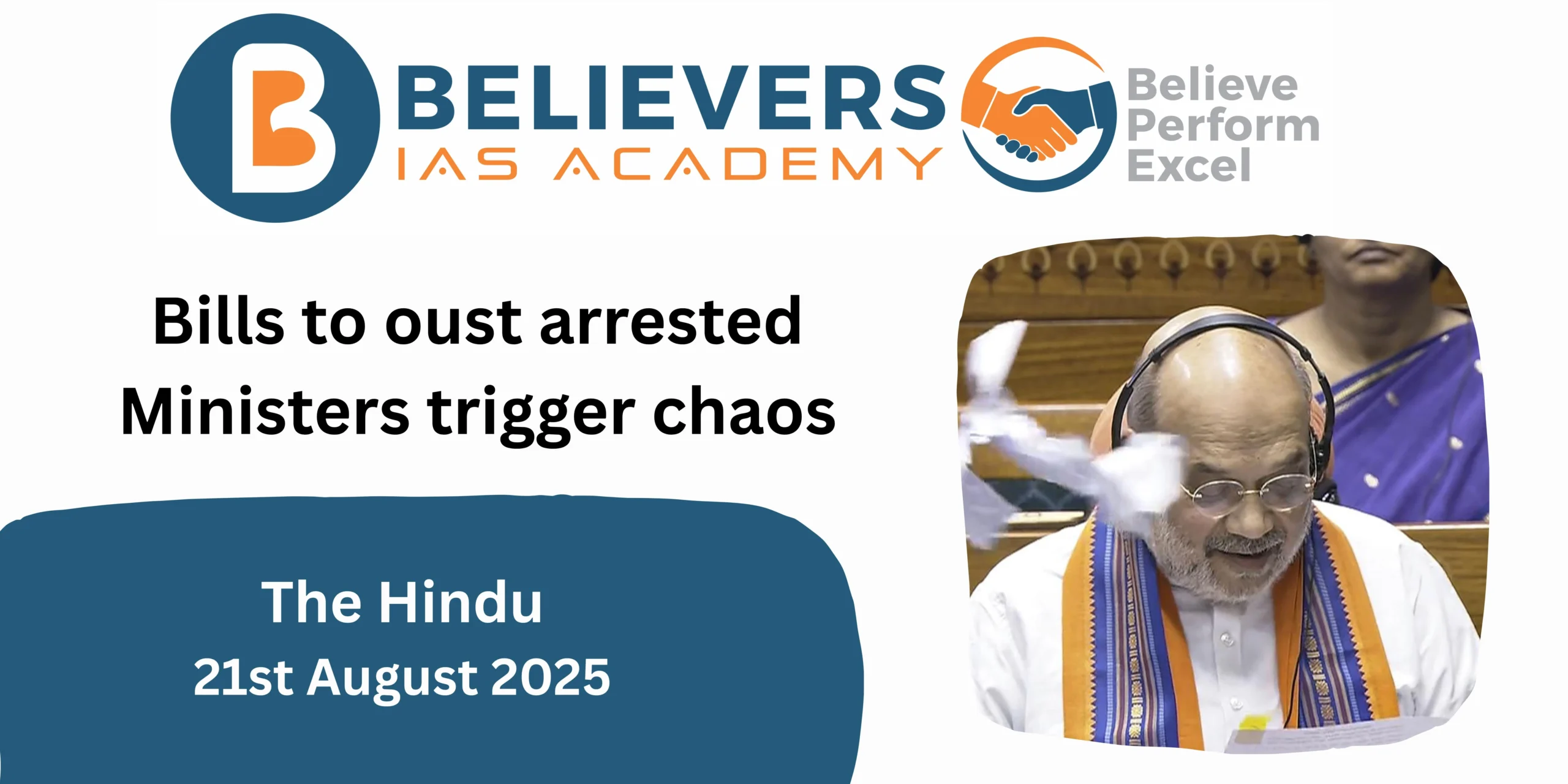
Bills to oust arrested Ministers trigger chaos
The Story so far
-
In August 2025, the Union government introduced three Bills proposing that Prime Ministers, Chief Ministers, or Ministers arrested and detained for 30 consecutive days (without bail) in offences punishable with ≥5 years imprisonment shall be removed from office automatically on the 31st day.
-
Bills introduced:
-
Government of Union Territories (Amendment) Bill, 2025
-
Constitution (130th Amendment) Bill, 2025
-
Jammu & Kashmir Reorganisation (Amendment) Bill, 2025
-
-
Opposition termed these Bills “unconstitutional” and “anti-federal”, leading to uproar in Parliament.
Key Provisions of the Bills
-
If a PM/CM/Minister is arrested for a serious offence (≥ 5 years punishment) and remains in custody for 30 days without bail, he/she must:
-
Resign voluntarily; or
-
Be removed by authority: President (for PM/Union Minister), Governor (for CM/State Minister).
-
-
Objective stated by Govt: to bring “political morality” into governance and ensure ministers facing serious charges do not continue in office.
Opposition Criticism
-
Violation of Constitutional Principles
-
Undermines presumption of innocence (Art. 21).
-
Removal without conviction → punishment without trial.
-
Contradicts basic structure (democracy, federalism).
-
-
Political Misuse
-
Fear that Centre can weaponise ED/CBI cases to remove elected leaders within 30 days.
-
Risk of vendetta politics (false cases to dislodge rivals).
-
-
Federalism Concerns
-
Governors empowered to remove elected CMs → “anti-federal” intrusion.
-
-
Opposition Leaders’ Statements
-
Rahul Gandhi: “Return to medieval times where king could remove anyone at will.”
-
Mamata Banerjee: “Hitlerian assault on democracy.”
-
M.K. Stalin: “Dictatorship begins this way – steal votes, silence rivals, crush States.”
-
Owaisi: “Turning Constitution into police state.”
-
Government’s Stand
-
Home Minister Amit Shah: Bills aim to enforce political morality and ethics.
-
Recalled his own 2010 resignation when arrested (later acquitted) as example of upholding morality.
-
Claims Opposition is misinterpreting intent; law ensures accountability of elected leaders.
Constitutional & Legal Angle
-
Current framework:
-
Art. 75(2): Ministers hold office during the pleasure of President.
-
Art. 164(2): Same for State Ministers (Governor).
-
Representation of People Act, 1951: Disqualification only after conviction (≥2 years imprisonment).
-
-
New Bills alter this by creating a new ground for removal based on arrest, not conviction.
-
Raises potential basic structure challenge: violates principles of democracy, presumption of innocence, separation of powers.
Way Forward
-
Balance between political morality and constitutional safeguards.
-
Reforms could include:
-
Speedy trial of cases against legislators.
-
Bar on appointment of ministers with serious framed charges (as suggested by SC in Lily Thomas v. Union of India, 2013).
-
Independent tribunal instead of executive discretion.
-


