
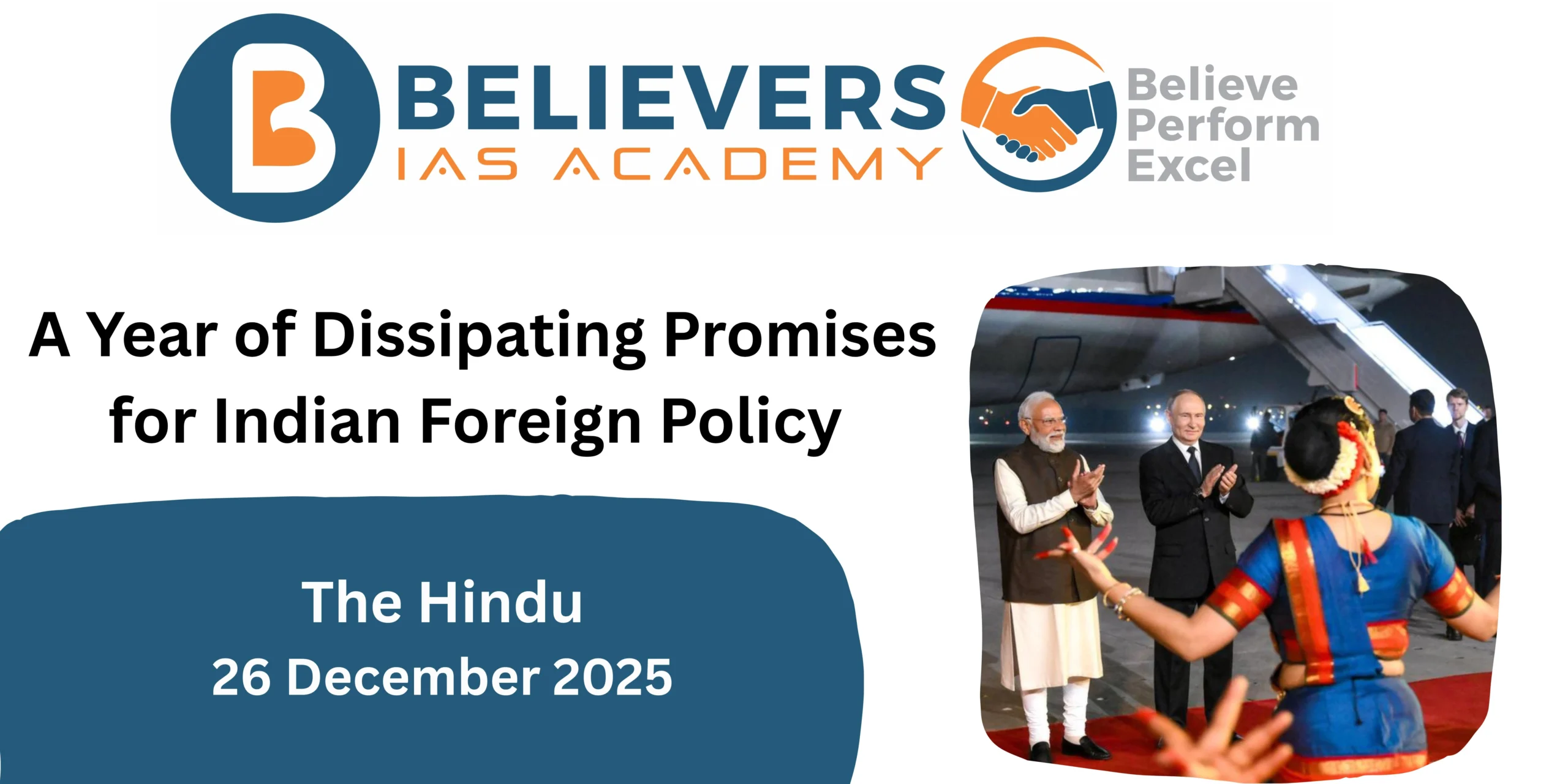
A Year of Dissipating Promises for Indian Foreign Policy
Context
-
2025 began with high expectations for Indian foreign policy after a politically busy 2024.
-
Anticipated:
-
Reset in India–U.S. relations under Trump’s second term.
-
Conclusion of major Bilateral Trade Agreements (BTAs).
-
Thaw in ties with China and consolidation with Russia.
-
Stabilisation of the neighbourhood.
-
-
However, by end-2025, these promises largely failed to materialise.
Key Challenges Identified
A. Economic & Energy Security
India–U.S. Relations
-
Most difficult year in India–U.S. ties in decades.
-
Key issues:
-
25% reciprocal tariffs on Indian exports (apparel, gems, seafood).
-
25% surcharge on Indian imports of Russian oil.
-
Continued impact of GSP withdrawal.
-
H-1B visa restrictions affecting remittances.
-
-
Result:
-
Job losses, factory closures, trade uncertainty.
-
Trust deficit deepened.
-
Trade Agreements
-
Signed FTAs: UK, Oman, New Zealand.
-
Pending big-ticket deals:
-
India–U.S. BTA
-
India–EU FTA
-
-
Undermines India’s export-led growth ambitions.
Energy Security & Russia
-
Russian oil imports reached ~$52 billion.
-
Renewed U.S. sanctions pressure raised uncertainty.
-
Risk of repeating past episodes (Iran, Venezuela oil halt).
-
India–Russia summit failed to deliver major strategic outcomes.
B. Major Power Relations
China
-
Symbolic engagement (SCO summit optics).
-
Limited outcomes:
-
Restoration of flights, visas, pilgrimages.
-
No resolution on LAC security guarantees.
-
No easing of investment restrictions.
-
-
Incidents (e.g., detention of Indian passenger) highlighted trust deficit.
Russia
-
Optics strong, substance weak.
-
No new breakthroughs in defence, nuclear, energy, space cooperation.
C. Global Strategic Environment
Changing U.S. National Security Strategy (2025)
-
Softer stance on:
-
China’s aggression (South China Sea, Taiwan).
-
Russia’s actions.
-
-
India’s role downgraded:
-
Reduced from “leading global power” (2017 NSS) to limited Indo-Pacific partner.
-
-
Risk of over-alignment with an unpredictable U.S.
-
Trump’s “G-2” references (U.S.–China) marginalise India.
Erosion of Rules-Based Order
-
Acceptance of Gaza & Ukraine peace plans favouring aggressors.
-
China’s push for alternative Global Governance framework.
-
UN’s declining conflict-management credibility.
-
India lacks a clearly articulated vision for future global order.
D. Regional Security Challenges
Pakistan & Terrorism
-
Pahalgam terror attack (April 2025) exposed security vulnerabilities.
-
Operation Sindoor:
-
Militarily effective.
-
Diplomatic support limited.
-
-
Allegations of Indian jet losses dented credibility due to official silence.
-
Concerns over rapid escalation after “new normal” doctrine.
-
Pakistan’s politics dominated by hardliners (Asim Munir).
Neighbourhood Instability
-
Bangladesh: Post-regime change instability; ties at historic low.
-
Nepal: Gen-Z protests, fragile transition.
-
Myanmar: Junta-led elections despite Indian outreach.
-
External alignments against India:
-
Saudi–Pakistan defence pact.
-
Deterioration of ties with Türkiye & Azerbaijan.
-
Key Takeaways / Lessons for 2026
Limits of Performative Diplomacy
-
Symbolism ≠ Strategic outcomes.
-
Summits, hugs, optics do not replace sustained diplomacy.
Performative Aggression Has Limits
-
Threats, boycotts work only with multilateral backing.
Narrative Correction Needed
-
Shift from:
-
Vishwaguru → Vishwamitra (positive)
-
Avoid sliding into “Vishwa-victim” narrative.
-
Consistency & Credibility
-
Double standards weaken India’s moral standing:
-
Minority rights concerns abroad vs silence at home.
-
Democracy advocacy vs engagement with Taliban.
-
-
Principles must be applied consistently, not selectively.
Way Forward
-
Rebalance foreign policy towards strategic autonomy.
-
Reduce overdependence on any single power bloc.
-
Articulate India’s own vision of global governance reform.
-
Strengthen neighbourhood-first policy with political realism.
-
Align values with actions to preserve credibility.
-
Invest in substance-driven diplomacy over optics.


