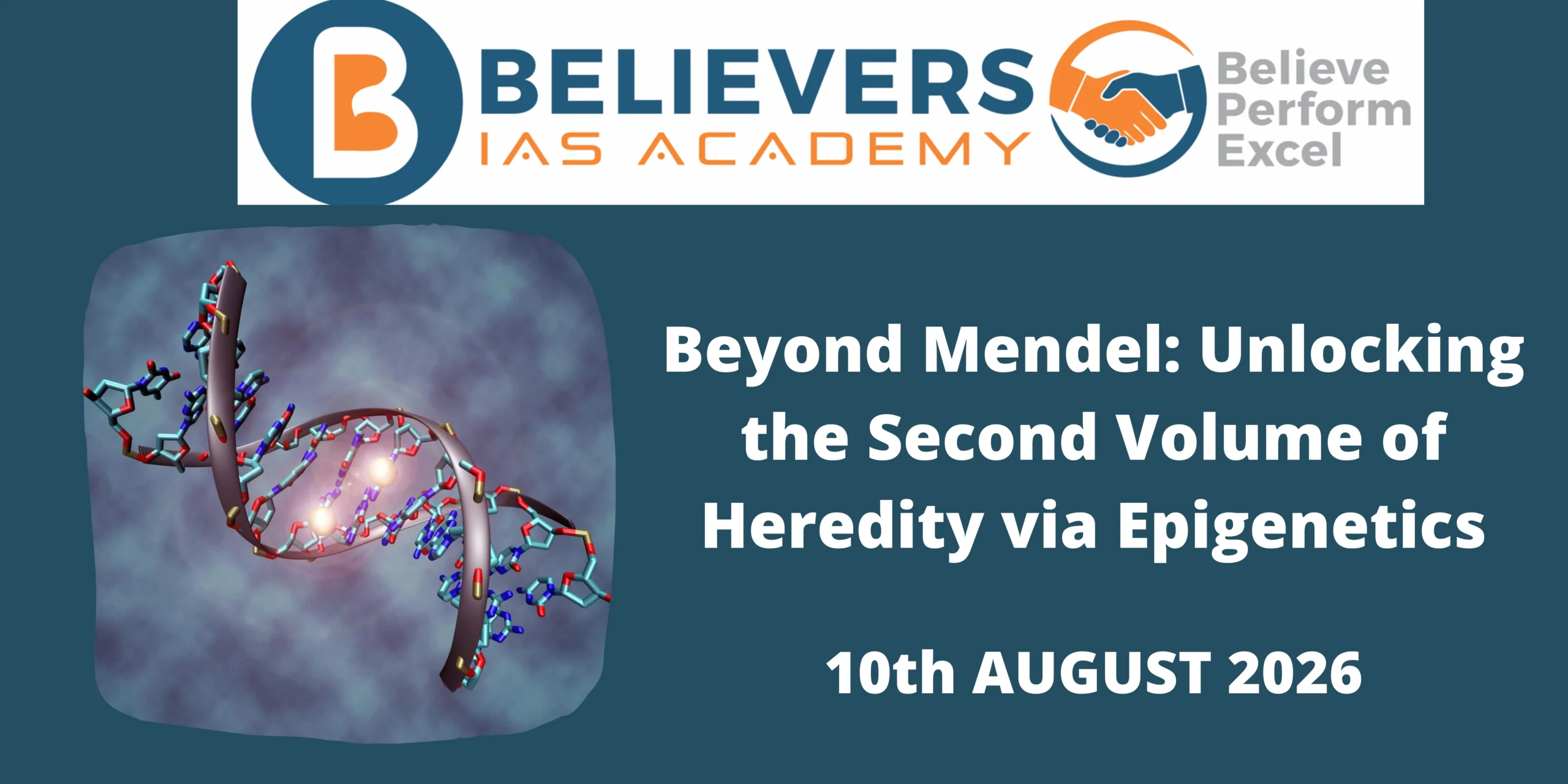
Beyond Mendel: Unlocking the Second Volume of Heredity via Epigenetics
Subject: Science & Technology
Context & Scientific Breakthrough
-
The Discovery: Researchers at the Johns Hopkins School of Medicine have identified inherited epigenetic traits in mice that appear to violate classical Mendelian laws of inheritance.
-
Core Difference: Unlike traditional genetics which rely on changes to the underlying DNA sequence, these traits arise through epigenetic modifications—chemical alterations that regulate gene activity without altering the genetic code itself.
-
Mendel’s Laws Reminder: Gregor Mendel’s principles state that traits are inherited through discrete genes that segregate and assort independently during gamete formation. The new findings reveal that epigenetic marks can bypass normal reset mechanisms to pass across generations.
Understanding Epigenetics & DNA Methylation
-
Mechanism: Epigenetic changes switch genes “on” or “off.” A primary mechanism is DNA methylation, where methyl groups ($\text{–CH}_3$) attach to DNA, typically silencing the associated gene.
-
Conventional Assumption vs. Reality: Epigenetic marks normally vary between tissues and are completely erased during the creation of new sperm and eggs. However, this study proves that certain methylation patterns can persist across generations, defying the expected complete reset.
Key Findings of the Study
Using advanced nanopore sequencing (which detects methylation through electrical signal variations as DNA passes through a microscopic pore), researchers uncovered groundbreaking insights:
-
Non-Mendelian Inheritance: Out of roughly 7,600 genomic locations showing methylation differences between two mouse strains:
-
93% followed standard Mendelian inheritance.
-
About 7% did not follow these traditional rules.
-
-
Genomic Imprinting: The study identified at least five new genes exhibiting genomic imprinting, where a gene’s activity depends strictly on its parent of origin (whether inherited from the mother or father).
-
Naturally Occurring Paramutation in Mammals:
-
Paramutation occurs when the epigenetic state of one gene copy “rewrites” or influences the corresponding copy inherited from the other parent.
-
While observed previously in plants and engineered mice, this study marks the first reported instance of naturally occurring paramutation in a mammal.
-
-
Specific Genes Involved:
-
Capn11: Implicated in testicular meiosis; abnormalities affecting its protein could link to male infertility and azoospermia.
-
Vps37c & Viral Remnants: Similar paramutation was observed near Vps37c and regions containing intracisternal A particles (remnants of ancient viruses), which appear capable of resisting normal epigenetic reprogramming during gamete formation.
-
Implications for Human Health and Heredity
-
Explaining Unsolved Diseases: These insights offer a missing puzzle piece for understanding complex, heritable human traits and diseases that defy conventional genetic analysis.
-
Case Study: The unique inheritance pattern of conditions like hypertrichosis pinnae auris (coarse hair on the outer ear, historically noted among South Asian men) could potentially be explained by these sex-dependent epigenetic mechanisms.