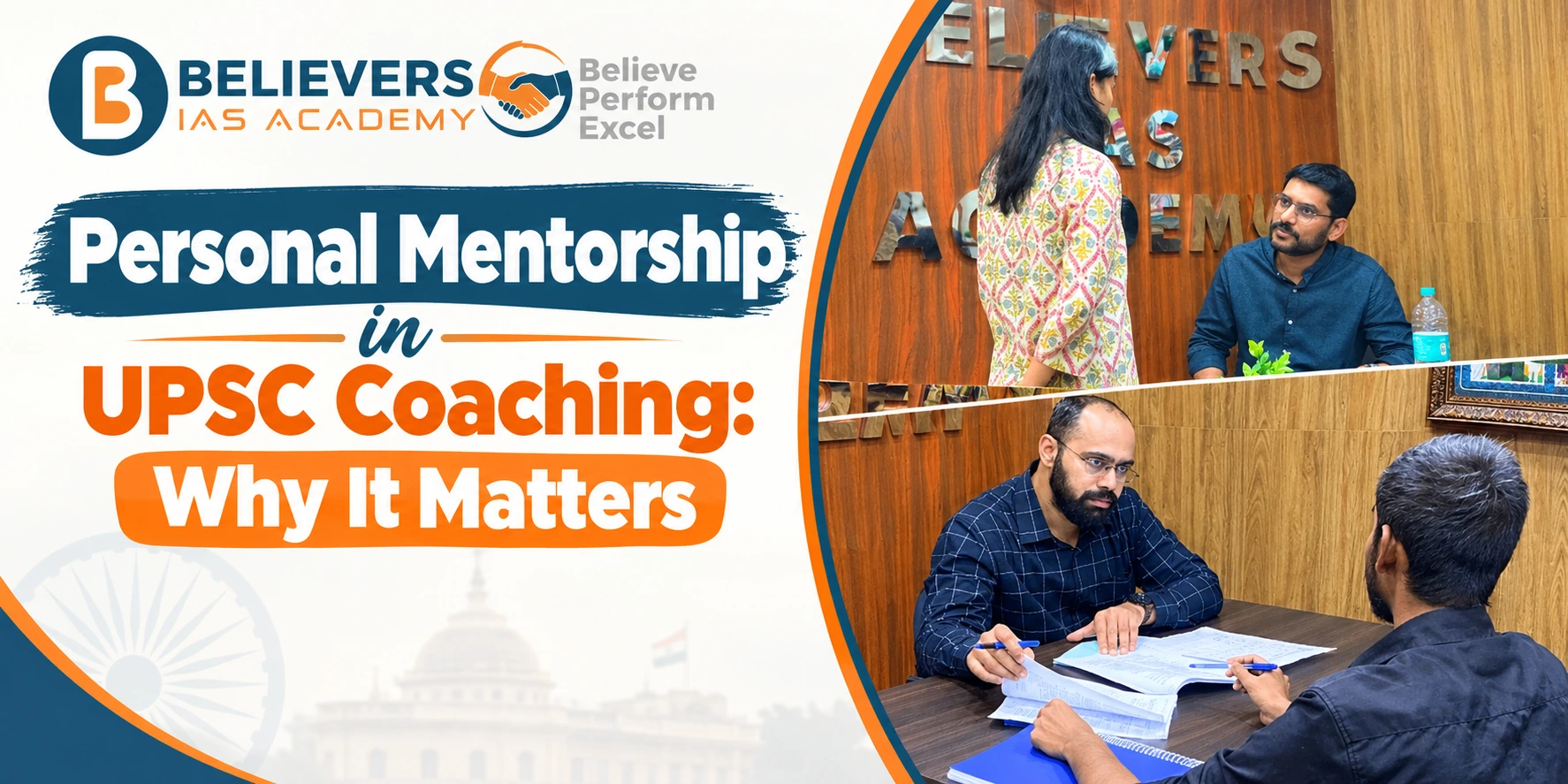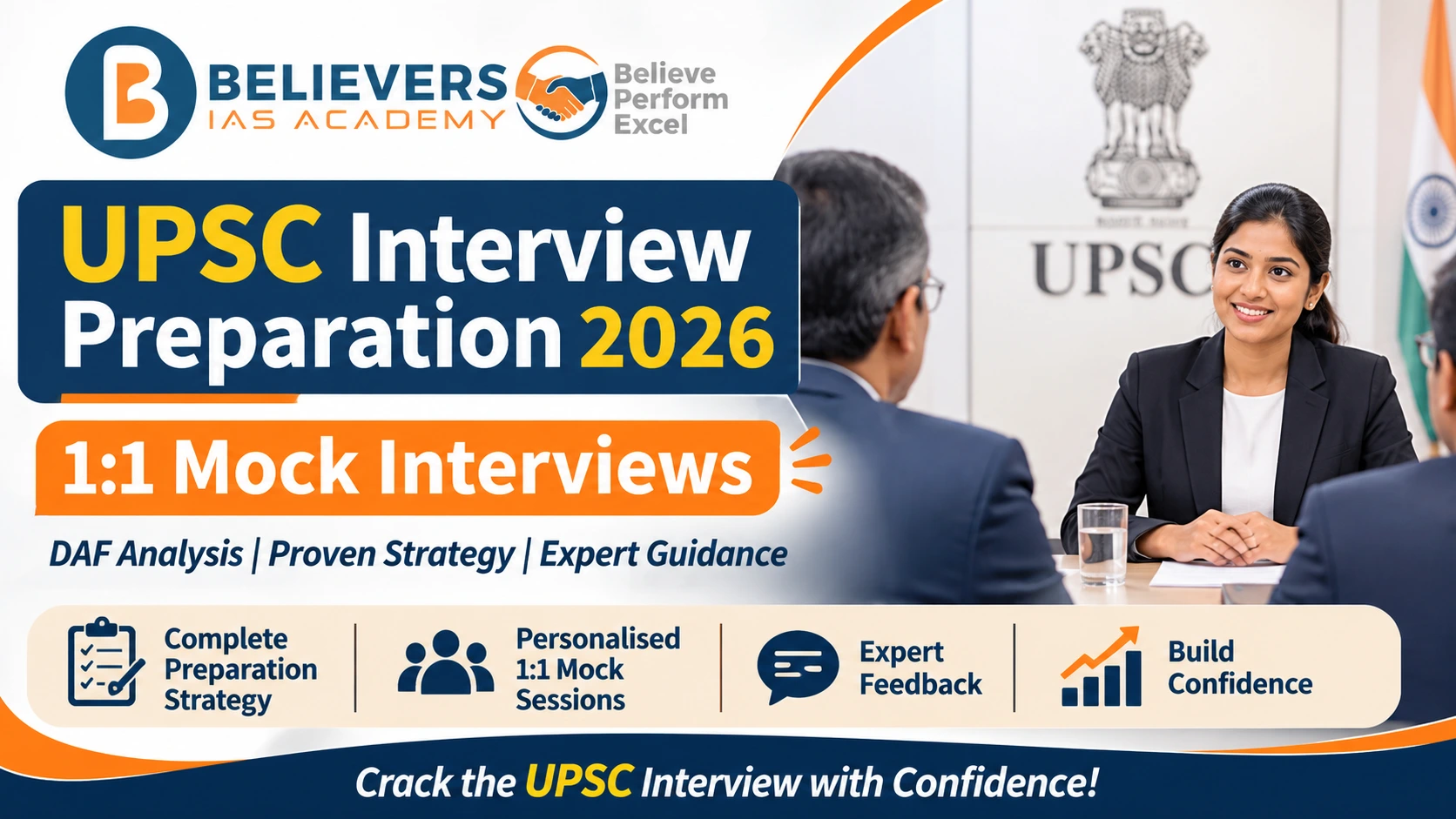
UPSC Interview Preparation 2026: Complete Guide to Personality Test & 1:1 Mock Interviews
By Believers IAS Academy | Last updated: November 2026 | Reading time: 9 minutes
How Do You Prepare for the UPSC Interview?
To prepare for the UPSC interview (Personality Test), analyse your Detailed Application Form (DAF) line by line, practise answering questions aloud, stay updated on current affairs and take several mock interviews with expert feedback. A 1:1 mock interview is the most effective format because a panel can focus entirely on your profile, simulate the real board and give personalised feedback on content, communication and confidence.
Key Facts: UPSC Interview at a Glance
| Item | Detail |
|---|---|
| Stage | Final stage of the UPSC Civil Services Examination (after Prelims and Mains) |
| Official name | Personality Test |
| Marks | 275 |
| Total for final merit | 2025 (Mains 1750 + Interview 275) |
| Format | Face-to-face discussion with a UPSC board (a chairperson and members) |
| Typical duration | Around 25 to 35 minutes, though it varies |
| Based on | Your DAF, background, interests, current affairs and judgement |
| Qualifying or ranking | Ranking: marks are added to your Mains score |
Why Is Mock Interview Preparation Important for UPSC?
The interview carries 275 marks, and in a close merit list a few marks can change your service and cadre. Unlike written papers, it tests how you think, speak and respond under pressure. Reading alone cannot prepare you for that.
A mock interview lets you practise in a realistic setting, discover blind spots in your DAF, and build the calm and clarity the board looks for. Most candidates improve noticeably between their first and third mock.
What Does the UPSC Interview Board Assess?
UPSC describes the Personality Test as an assessment of suitability for a career in public service. The board looks at qualities such as:
- Mental alertness
- Critical powers of assimilation
- Clear and logical exposition
- Balance of judgement
- Variety and depth of interest
- Ability for social cohesion and leadership
- Intellectual and moral integrity
This means the interview is not a general knowledge quiz. Board members are interested in how you reason, how honest you are about what you know, and how you would act as an officer.
What Is a 1:1 Mock Interview for UPSC?
A 1:1 mock interview is a personalised practice session in which one candidate faces a panel or interviewer in a setting designed to mirror the real UPSC board. The questions are built around your own DAF, hobbies, optional subject, work experience, home state and current affairs, followed by detailed feedback.
How is a 1:1 mock interview different from a group mock interview?
| Feature | 1:1 mock interview | Group or batch mock |
|---|---|---|
| Focus | Entirely on your profile | Shared across several candidates |
| Question depth | Detailed follow-ups on your DAF | Often more general |
| Feedback | Personalised and specific | Common observations |
| Pressure level | Closer to the real board | Lower |
| Best for | Final preparation and fine-tuning | Early practice and observation |
The best approach combines both: watch group mocks to learn what the board asks, then take 1:1 mocks to refine your own answers.
How Does Believers IAS Academy Conduct 1:1 Mock Interviews?
At Believers IAS Academy, the mock interview programme is designed to help candidates face the Personality Test with clarity and confidence. The 1:1 format typically works in four steps:
- DAF review: your profile, education, hobbies, service preferences and work history are reviewed before the session.
- Simulated board interview: you face a realistic interview with questions on your background, optional subject, current affairs and situational judgement.
- Detailed feedback: you receive feedback on content, structure of answers, language, body language and confidence.
- Improvement plan: you get focused action points to work on before your next mock or the actual interview.
Candidates are encouraged to take more than one mock so they can track improvement and fix recurring weaknesses.
What are the benefits of taking a 1:1 mock interview at Believers IAS Academy?
- Personalised questioning built around your own DAF.
- Realistic exam atmosphere that reduces nervousness.
- Honest, actionable feedback on both content and delivery.
- Better answer structure so you stay concise and logical.
- Greater confidence from repeated practice before the real board.
How to Prepare for the UPSC Interview: Step-by-Step
1. How do you prepare your DAF for the UPSC interview?
Your DAF is the single most important document. Anything you have written can be asked.
- Prepare every entry: education, hometown, hobbies, work experience, optional subject and service preferences.
- Write out probable questions for each entry and answer them aloud.
- Be ready to explain why you chose your optional subject, services and cadre preferences.
- Never include a hobby or claim you cannot discuss in depth.
2. How do you prepare current affairs for the UPSC interview?
Focus on understanding issues rather than memorising facts. For each major national and international issue, know the background, the main arguments, the government’s position and your own balanced view.
3. How do you prepare your optional subject and academic background?
Revise your graduation subject and optional subject at a conceptual level. Be ready to link them with governance and real-world problems.
4. How do you improve communication for the UPSC interview?
- Answer in a clear structure: direct answer first, then reasons or examples.
- Speak at a steady pace and use simple language.
- Maintain natural eye contact and calm posture.
- Say “I am not sure, but my understanding is…” when you do not know. Honesty is valued over bluffing.
5. How do you prepare for opinion and situational questions?
The board often asks what you would do in a situation. Present balanced answers, consider all stakeholders, respect law and ethics, and avoid extreme positions.
What Are Common UPSC Interview Questions?
The board’s questions fall into predictable categories:
| Category | Example theme |
|---|---|
| Personal and DAF | Your name, hometown, education, hobbies, work experience |
| Motivation | Why civil services, why your service and cadre preferences |
| Academic | Graduation subject and optional subject |
| Current affairs | Policy, economy, international relations, social issues |
| Situational | How you would handle a dilemma as an officer |
| Opinion | Your balanced view on a debated issue |
Practise answering each category aloud rather than only reading about it.
What Is a Good 4-Week UPSC Interview Preparation Plan?
| Week | Focus | Key actions |
|---|---|---|
| Week 1 | DAF and profile | Analyse every DAF entry, prepare probable questions and answers |
| Week 2 | Content and current affairs | Revise key national and international issues, optional subject and academic background |
| Week 3 | Mock interviews | Take 1:1 mock interviews, record yourself and note feedback |
| Week 4 | Refinement | Fix weak areas, practise communication, attend final mocks, rest well |
How Many Mock Interviews Should You Take?
Take at least three to four mock interviews: the first to find weaknesses, the middle ones to fix them, and the last to build confidence. Review each mock the same day while feedback is fresh.
How Should You Present Yourself at the UPSC Interview?
Dress code and appearance: Choose simple, formal and comfortable clothing. Neat and professional matters more than expensive.
Body language: Sit upright, keep your hands relaxed, make natural eye contact with the member who asked the question, and begin with a polite greeting.
Attitude: Be respectful, humble, honest and confident. The board is not trying to defeat you; it is assessing your suitability for public service.
What Are Common Mistakes to Avoid in the UPSC Interview?
| Common mistake | Better approach |
|---|---|
| Not preparing the DAF in depth | Prepare every line as if it will be asked |
| Memorising scripted answers | Understand ideas and answer naturally |
| Bluffing when unsure | Admit it honestly and share what you know |
| Taking extreme or one-sided views | Give balanced, well-reasoned answers |
| Skipping mock interviews | Take multiple 1:1 mocks with feedback |
| Long, rambling answers | Be concise, structured and to the point |
Frequently Asked Questions: UPSC Mock Interview Preparation
How many marks is the UPSC interview?
The UPSC interview (Personality Test) carries 275 marks. These are added to your Mains marks to decide the final merit list.
What is a UPSC mock interview?
A UPSC mock interview is a practice interview designed to simulate the real Personality Test, with questions based on your DAF and feedback to help you improve.
What is a 1:1 mock interview?
A 1:1 mock interview is a personalised session where one candidate is interviewed in a realistic setting, with questions built around their own profile and detailed individual feedback.
When should I start preparing for the UPSC interview?
Start as soon as you clear Prelims and work on your DAF, current affairs and communication. Intensify the preparation with mock interviews after the Mains result.
How many mock interviews are enough?
Three to four mock interviews are a practical target for most candidates, with more if you need extra practice in specific areas.
Can I clear the UPSC interview without coaching?
Yes, many candidates do. However, mock interviews and expert feedback help you identify blind spots that self-preparation can miss.
What should I wear for the UPSC interview?
Wear simple, formal and comfortable clothes that make you feel confident.
Does Believers IAS Academy offer 1:1 mock interviews?
Yes. Believers IAS Academy offers 1:1 mock interviews with DAF-based questioning and personalised feedback to help candidates prepare for the UPSC Personality Test.
How do I answer a question I do not know in the UPSC interview?
Be honest. Say you are not sure, share what you do understand and show how you would reason about it. Bluffing is usually caught and harms your credibility.
What is the most important thing in the UPSC interview?
Clear thinking, honesty and balance matter most. The board wants to see how you reason and whether you are suited to a career in public service.
About Believers IAS Academy
Believers IAS Academy is a UPSC Civil Services preparation academy that helps aspirants build strong conceptual foundations, practise consistently and prepare in an exam-oriented way for the Prelims, Mains and Interview stages.
What does Believers IAS Academy focus on?
- Conceptual clarity: understanding the logic behind every topic.
- Consistent practice: regular tests, feedback and revision.
- Exam-oriented preparation: realistic mocks, error analysis and strategy.
- Personality Test readiness: DAF-based guidance and 1:1 mock interviews.
To explore UPSC preparation programmes and book a 1:1 mock interview, visit Believers IAS Academy.
Believe. Perform. Excel.