
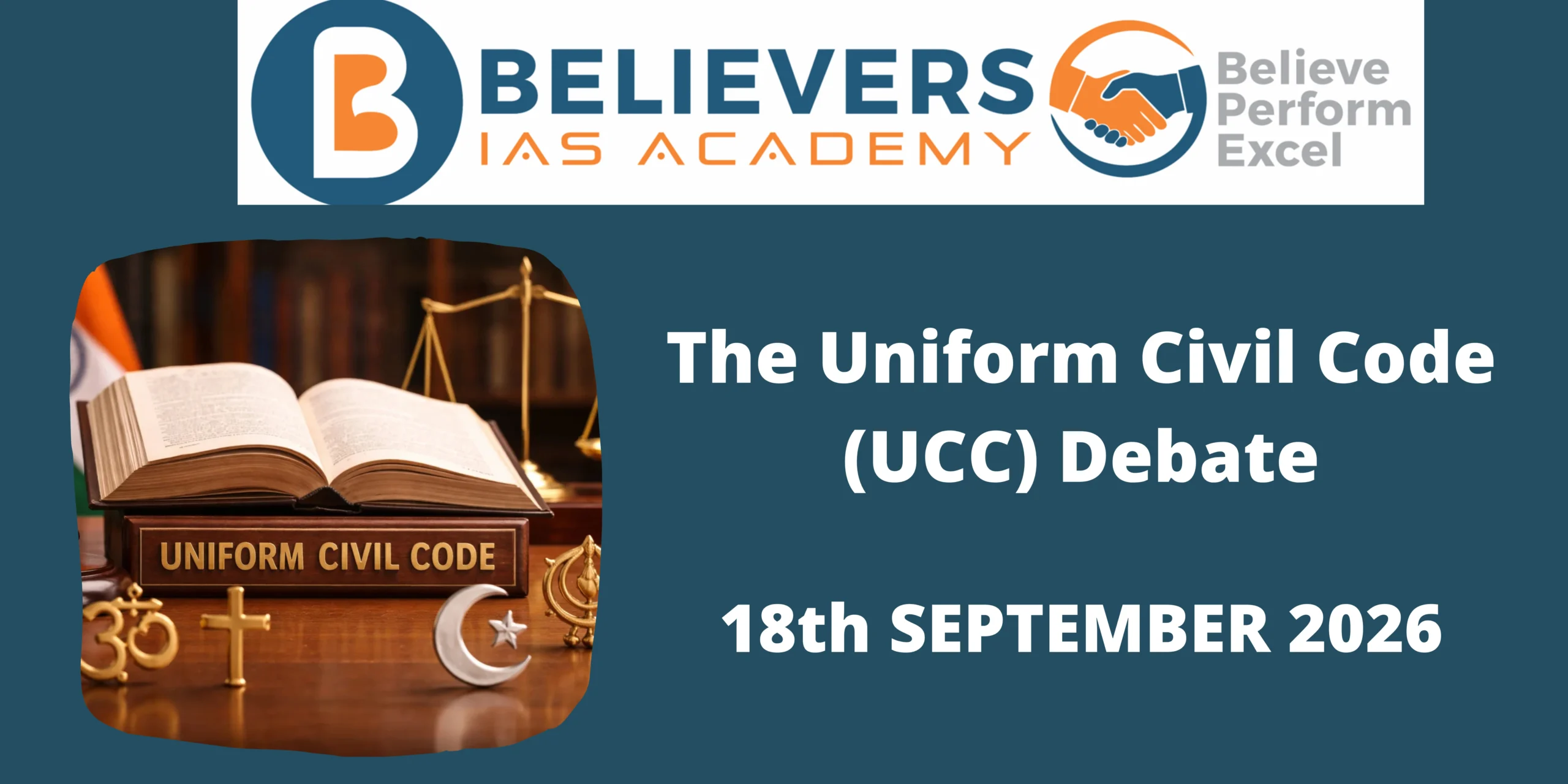
The Uniform Civil Code (UCC) Debate
Subject: GS II- Polity & Governance
Context
The debate over the Uniform Civil Code (UCC) has gained renewed urgency following landmark legislative developments, notably Uttarakhand implementing a UCC in January 2025, and similar Bills passed by States like Assam, Gujarat, and Madhya Pradesh seeking Presidential assent. The core issue centers on how India can balance the constitutional promise of gender justice and secular equality with the protection of religious freedom and cultural diversity.
Constitutional Foundations and Assembly Debates
-
Article 44 (Directive Principles of State Policy): Directs the State to endeavor to secure for citizens a Uniform Civil Code throughout the territory of India. Being part of Part IV, it is non-justiciable (not enforceable by courts), unlike fundamental rights.
-
Current Civil Framework: While India possesses uniform criminal laws (e.g., the Bharatiya Nyaya Sanhita) and common civil laws governing contracts, property, and taxation, personal matters (marriage, divorce, inheritance, adoption, and maintenance) continue to be governed by distinct religious and customary codes (e.g., Hindu personal laws, Muslim Personal Law (Shariat) Application Act, 1937, alongside distinct Christian, Parsi, and tribal customs).
-
Constituent Assembly Compromise: Deep divisions characterized the drafting stage. While leaders like Dr. B.R. Ambedkar advocated for a UCC to promote national unity and gender equality, strong resistance from minority communities regarding freedom of religion led to its placement in the DPSP rather than as an enforceable Fundamental Right. (Dr. Ambedkar famously suggested that the code could initially be voluntary, allowing citizens to opt in).
The Arguments: Proponents vs. Critics
1. Proponents’ Perspective: Equality and Gender Justice
-
Eradicating Discrimination: Advocates argue that multiple personal laws contain patriarchal provisions that institutionalize gender inequality, particularly in property succession, polygamy, divorce, and maintenance.
-
Constitutional Morality: A common civil framework reinforces the principle of “one nation, one law,” ensuring that individual rights under the Constitution supersede community-based customary laws.
2. Critics’ and Minority Concerns: Cultural Autonomy and Freedom
-
Fundamental Rights Tension: Critics argue that a rigid UCC could infringe upon Article 25 (freedom of religion) and Article 29 (right of distinct cultural groups to conserve their script, language, and culture).
-
The Tribal Exception Paradox: State-level implementations (like Uttarakhand’s UCC) often carve out explicit exemptions for tribal communities to protect their traditional customs. Critics note that such exemptions create structural inconsistencies in the pursuit of “uniformity.”
Judicial Precedents and Constitutional Principles
-
Balancing Culture and Equality: In landmark cases, the Supreme Court has consistently held that religious and cultural practices cannot claim blanket immunity if they violate constitutional morality or fundamental rights. For instance, in the Section 6A Citizenship Act case (2024), the Court underscored that practices contrary to foundational constitutional values cannot seek shelter under cultural rights.
-
The Law Commission’s Stance (2018): The Law Commission’s Consultation Paper cautioned that a wholesale UCC might be neither necessary nor desirable at that stage. Instead, it advocated a pragmatic approach: “equality within communities” (reforming discriminatory provisions within each personal law to establish gender justice) rather than merely “equality between communities” (forcing a single identical code).
Conclusion
A balanced approach to the UCC debate requires harmonizing three vital pillars: gender equality, constitutional morality, and the preservation of legitimate cultural diversity. Reform should focus on removing systemic gender biases across all personal laws through broad-based public consultation, ensuring that the pursuit of uniformity does not inadvertently undermine the pluralistic fabric of Indian society.


