The Mahadayi (Mandovi) River
Subject: GS l- Geography of India (Drainage System); GS ll- Inter-State Water Disputes.
Context
Recent statements by the Union Environment Ministry in the Lok Sabha—clarifying that no Karnataka proposal for the environmental clearance of the Mahadayi diversion is currently under consideration, and that the National Board for Wildlife (NBWL) has withheld forest diversion for the Kalasa Nala scheme—have once again thrust the Mahadayi (Mandovi) River into the national spotlight. As a key inter-state river, the dispute underscores the complex friction between developmental demands, federal water-sharing, and Western Ghats conservation.
Geographic Profile and Course
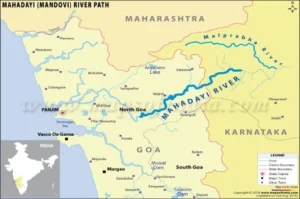
- Origin: The river originates from a cluster of 30 natural springs in the Bhimgad Wildlife Sanctuary near Khanapur in the Belagavi (Belgaum) district of Karnataka, nestled within the Western Ghats.
- Course and Length: Spanning a total length of approximately 117 km, it flows for roughly 35 km in Karnataka, a minor catchment stretch in Maharashtra, and about 81 km in Goa, finally discharging into the Arabian Sea at Panaji through the Mormugao and Aguada bays. (In Goa, it is famously known as the Mandovi River).
- States Involved: Karnataka, Maharashtra, and Goa.
- Major Tributaries: Key streams include the Kalasa Nala and Banduri Nala (central to Karnataka’s drinking water project), alongside the Bail Nala, Pansheer Nala, Andher Nala, Khandepar, Ragada, and Mapusa rivers.
Key Geographical and Ecological Features
- High-Yield, Compact Catchment: Covering a basin area of about 2,032 sq km, the region receives heavy orographic monsoon rainfall (ranging from nearly 2,000 mm in the plains to over 5,400 mm in the Ghats), generating an abundant water yield.
- Dramatic Topography and Waterfalls: Steep elevation drops across the Braganja Ghats give rise to iconic cascades, notably the Dudhsagar Falls and Vajra-Poha Falls.
- The Kali-Sahyadri Ecological Corridor: The basin is heavily forested (over 36% cover) and forms an indispensable ecological bridge connecting the Kali Tiger Reserve (Karnataka), Bhagwan Mahaveer/Mhadei Wildlife Sanctuary (Goa), and Sahyadri Tiger Reserve (Maharashtra). It harbors critical biodiversity, including tigers, black panthers, and the rare, endemic Wroughton’s Free-tailed Bat.
- Economic and Lifeline Status: Serving as Goa’s primary freshwater lifeline, it supports municipal drinking water, irrigation, inland navigation, fisheries, and vibrant eco-tourism.
The Core Controversy: The Mahadayi Inter-State Dispute
- The Conflict: The dispute primarily involves Karnataka and Goa over the diversion of Mahadayi waters from the west-flowing Arabian Sea basin toward the east-flowing Malaprabha basin to meet drinking water needs in arid districts (like Belagavi, Dharwad, and Bagalkot).
- Goa’s Concerns: Goa strongly opposes any diversion, arguing that it would drastically reduce downstream freshwater flow, trigger ecological degradation, harm fisheries, and accelerate saline water intrusion into coastal aquifers.
- Institutional Hurdles: Beyond the Mahadayi Water Disputes Tribunal (MWDT) adjudications, projects like the Kalasa-Banduri Nala face strict environmental bottlenecks, requiring explicit clearances from the Ministry of Environment, Forest and Climate Change (MoEFCC) and the National Board for Wildlife due to their direct impact on sensitive tiger corridors.
Conclusion
The Mahadayi River is far more than a resource-sharing flashpoint; it is a vital ecological anchor for the central Western Ghats. As legal and administrative battles persist, the challenge lies in balancing the legitimate drinking water requirements of parched populations in northern Karnataka with the imperative of preserving the fragile hydrology and biodiversity of Goa’s lifeline.