
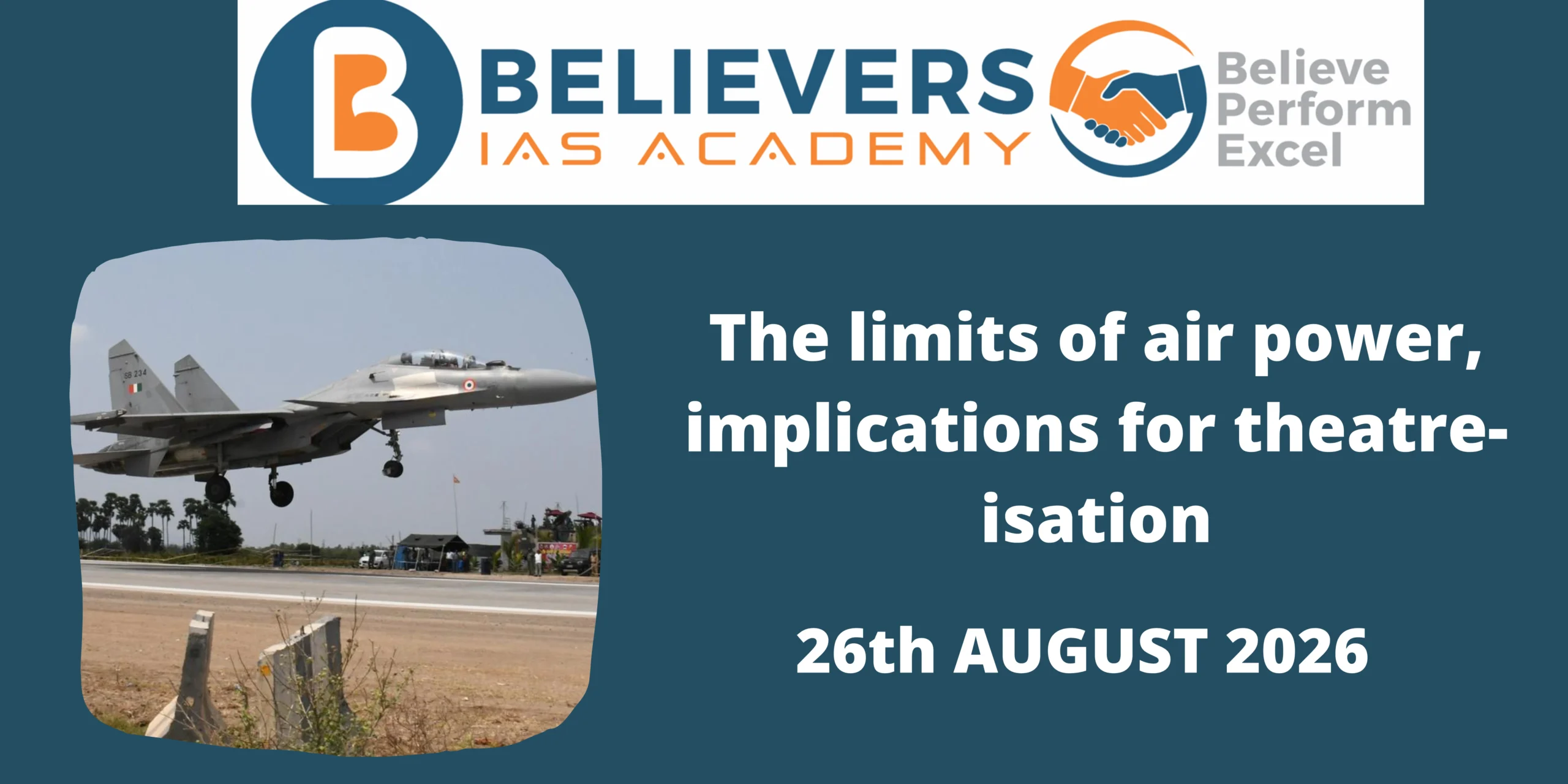
The limits of air power, implications for theatre-isation
Subject: GS III — Defence Preparedness, Security Challenges.
Context
Recent geopolitical conflicts—including the war in Ukraine, regional escalations involving Iran, and operations along India’s borders—have triggered a profound global re-evaluation of modern military doctrine. While air power remains a critical component of modern warfare, ongoing conflicts highlight that air superiority alone is no longer sufficient to guarantee strategic victory. These lessons carry urgent implications for India as it debates the structural overhaul of its armed forces through military theatre-isation.
Three Fundamental Limitations of Modern Air Power
-
Air Superiority Does Not Equal Strategic Victory:
-
In Ukraine, Russia’s larger air force was heavily constrained by advanced, networked Ukrainian air-defence systems, preventing total airspace control.
-
In Iran, despite opponents achieving substantial air dominance, Tehran was not compelled to capitulate, demonstrating that controlling the skies does not automatically translate into political or strategic victory. For India, this underscores the dual necessity of deploying robust integrated air defences to deter adversaries while avoiding the trap of over-reliance on air power alone.
-
-
The Problem of Strategic Depth:
-
Converting air dominance into decisive outcomes fails against opponents possessing massive strategic depth and economic capacity to absorb continuous losses.
-
India’s historical operational experiences against Pakistan cannot be directly replicated against China, which commands vastly superior industrial, economic, and military depth.
-
-
The Cost Asymmetry of Modern Warfare:
-
Inexpensive loitering munitions and drones (e.g., Shahed-type drones costing $20,000–$50,000) force defenders to deploy multi-million-dollar interceptor missiles.
-
India faced a similar cost asymmetry during Operation Sindoor (May 2025), when defending against low-cost drones required expensive countermeasures. Against a technologically advanced adversary like China, such cost imbalances pose severe fiscal and logistical strains, necessitating layered, affordable counter-drone architectures.
-
Implications for India: The Air Force (IAF) and the China Challenge
-
The Constraints of Flexibility: Historically, the Indian Air Force (IAF) has favored centralized operational flexibility over fixed regional commands. While this model proved effective against Pakistan (e.g., Balakot 2019 and Operation Sindoor), it remains untested against China.
-
The Force Ratio Mismatch: With the IAF operating roughly 460–520 combat aircraft against the People’s Liberation Army Air Force (PLAAF)’s massive squadron strength—compounded by difficult Himalayan terrain, limited high-altitude airbases, and long transit distances—efficient asset allocation is critical.
-
The Risk of Simultaneous Crises: An unresolved jointness deficit could become catastrophic during a multi-front conflict (such as a Chinese offensive in Ladakh concurrent with Western sector flashpoints), creating competing demands for scarce high-value assets like Rafale jets and S-400 air-defence systems.
Roadblocks to Military Theatre-isation in India
India’s long-standing push to reorganize its military into unified theatre commands has encountered distinct institutional and doctrinal bottlenecks:
-
The Jointness Deficit: Persistent gaps remain in joint force generation, shared tactical planning, and peacetime integration among the Army, Navy, and Air Force—weaknesses first highlighted during the 1999 Kargil War and re-exposed during the 2020 Ladakh standoff.
-
Institutional Resistance and Rank Disparities: Bureaucratic friction, divergent career progression pathways, and differing rank structures across the three services complicate the creation of unified chains of command.
-
Command Authority and Consultation Models: While global militaries (such as the U.S., China, and Israel) have adopted decisive theatre-level structures where single commanders hold operational authority, the IAF’s proposed Joint Coordination Centre relies heavily on inter-service consultation, potentially slowing down crisis-time responses. Without true theatre command, Integrated Battle Group (IBG) commanders along the Line of Actual Control (LAC) risk missing timely, assured air support.
Conclusion
The limits of air power and the complex realities of a two-front threat environment demand that India move beyond inter-service turf wars. Embracing comprehensive military theatre-isation is no longer merely an administrative reform; it is an operational necessity. To secure its borders, India must transition toward unified, integrated commands that optimize resource utilization, bridge jointness gaps, and ensure seamless synergy across land, air, and sea.
Related Posts

Streamlining the PF & Pension scheme
Posted on
Daily Static Quiz – 9th October 2022
Posted on
