
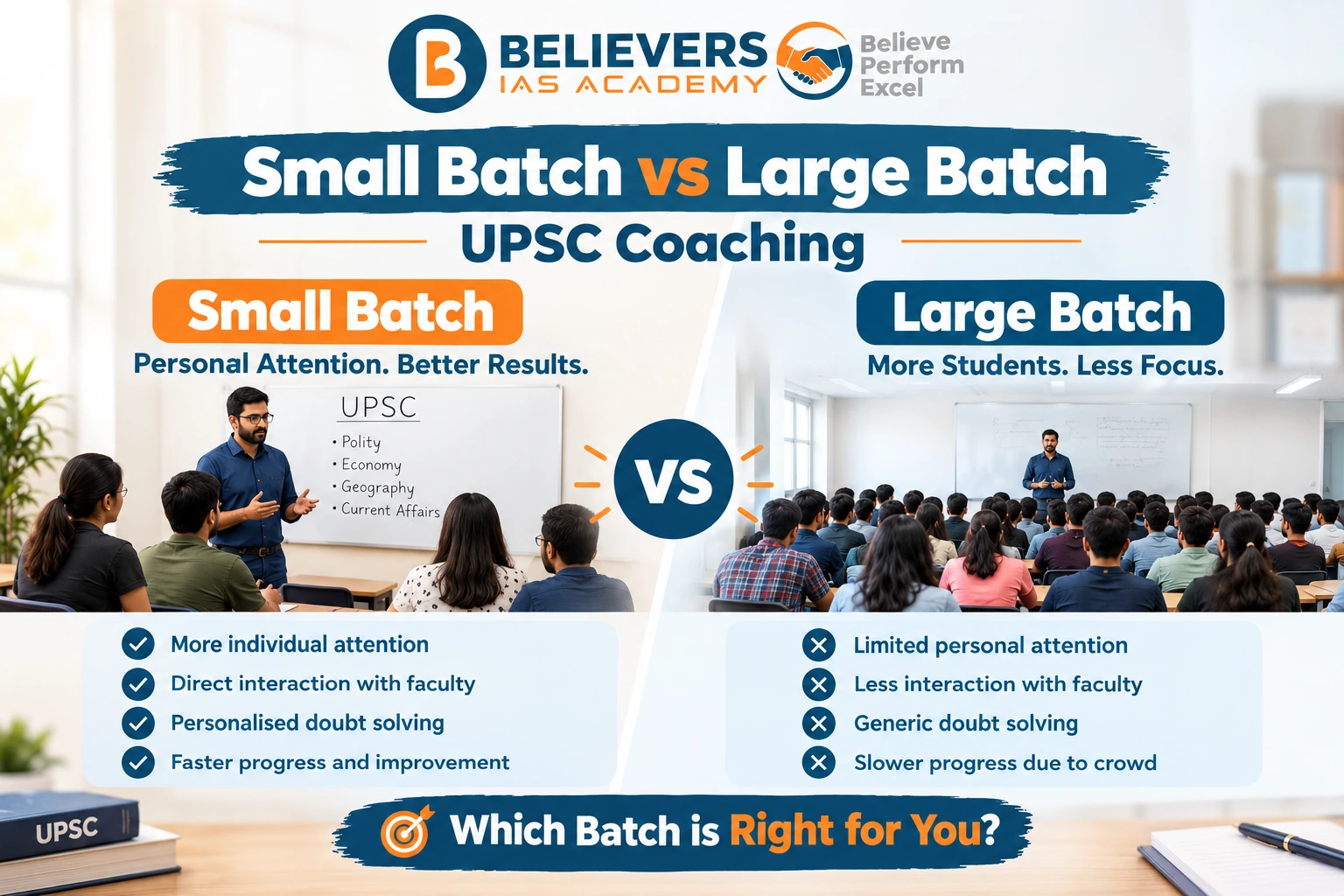
Small Batch vs Large Batch UPSC Coaching
Choosing the right coaching institute is an important decision for every UPSC Civil Services Examination aspirant. One of the most common questions students ask is: Is small batch or large batch UPSC coaching better?
Small batch coaching can provide more opportunities for personal attention, doubt clarification, answer-writing feedback and individual mentorship. Large batch coaching, on the other hand, may offer access to experienced faculty, structured lectures and more affordable courses.
The right choice depends on your learning style, preparation level, budget and the quality of academic support offered by the institute.
In this guide, we compare small batch vs large batch UPSC coaching, explain their advantages and limitations, and help you decide which learning environment best suits your UPSC preparation in 2026.
Quick Answer: Small Batch vs Large Batch UPSC Coaching
For aspirants who need individual attention, regular feedback and structured mentorship, small batch UPSC coaching can be a strong choice. Large batch coaching can also work well for disciplined students who are comfortable with independent study and have access to effective testing and doubt-clearing support.
A small batch generally refers to a class of around 20–30 students, while a large batch may include 100–300 or more students. These ranges are illustrative rather than fixed industry standards.
Before enrolling, evaluate the institute’s teaching quality, faculty accessibility, answer evaluation process, mentorship system and overall course structure—not just the number of students in a classroom.
Why Does Batch Size Matter in UPSC Preparation?
UPSC preparation requires more than attending lectures and collecting study materials. Aspirants need conceptual clarity, consistent revision, analytical thinking, answer-writing practice and regular assessment over an extended period.
Batch size can influence how easily students interact with faculty and receive individual guidance.
Here are five important areas where batch size may make a difference:
- Personal attention: Smaller classes can make it easier for faculty to understand individual learning needs.
- Doubt clarification: Students may have more opportunities to ask questions and receive detailed explanations.
- Answer-writing evaluation: Individual feedback can help aspirants identify weaknesses in structure, analysis, presentation and time management.
- Academic mentorship: Progress reviews and personalised guidance may be easier to organise in smaller groups.
- Classroom participation: Smaller classes can encourage more students to participate in discussions and clarify concepts.
However, batch size alone does not determine the quality of coaching. An institute’s teaching methods, faculty strength and academic support systems are equally important.
Small Batch vs Large Batch UPSC Coaching: Detailed Comparison
| Parameter | Small Batch Coaching (20–30 students) | Large Batch Coaching (100–300+ students) |
|---|---|---|
| Personal attention | More opportunities for individual interaction | Individual interaction may be limited |
| Doubt clarification | More scope for detailed discussions | Depends on the institute’s support system |
| Answer-writing feedback | Individual feedback may be easier to provide | Quality depends on evaluation capacity |
| Mentorship | Personal progress tracking may be more practical | May rely more on group mentoring |
| Classroom interaction | Greater opportunity for participation | Participation is shared among more students |
| Teaching pace | Potentially easier to adapt to student needs | Often follows a common schedule |
| Peer learning | Close-knit discussions | Larger and more diverse peer network |
| Cost | May be comparatively higher | May offer more budget-friendly options |
| Best suited for | Aspirants seeking structured guidance and regular feedback | Self-directed aspirants comfortable with independent study |
The key takeaway: Choose the institute that provides effective teaching, meaningful evaluation and consistent academic support. A smaller classroom is beneficial only when it translates into better learning opportunities.
Advantages of Small Batch UPSC Coaching
1. More Opportunities for Personal Attention
In a smaller classroom, students may find it easier to interact with faculty, ask questions and discuss difficult topics.This can be particularly useful for beginners who are learning how to approach the extensive UPSC syllabus and organise their preparation.
2. Better Scope for Answer-Writing Feedback
UPSC Mains requires aspirants to present relevant information in a structured, analytical and time-efficient manner.
Regular answer-writing practice is most useful when students receive feedback on areas such as:
- Introduction and conclusion.
- Relevance of arguments.
- Use of examples, facts and constitutional provisions.
- Structure, presentation and clarity.
- Time management and word limits.
A smaller batch can make detailed individual evaluation easier to organise. Before joining a coaching program, ask how frequently answers are evaluated and whether feedback is personalised.
3. Easier Doubt Clarification
Unresolved doubts can affect conceptual understanding and revision. Smaller classes may provide more opportunities to clarify questions during or after lectures.
However, the actual quality of doubt resolution depends on faculty availability and the institute’s academic support system.
4. Structured Mentorship and Progress Tracking
UPSC preparation can extend over several months or years. Aspirants need to monitor their progress, identify weak areas and adjust their strategies.
A well-designed mentorship system can help students review their preparation schedule, test performance, revision habits and answer-writing skills.
When evaluating an institute, check whether mentorship includes regular progress reviews or is limited to occasional group sessions.
5. Greater Classroom Participation
Smaller groups can encourage students to participate in discussions, ask questions and exchange ideas.
Peer learning is especially valuable when students discuss current affairs, practise analytical thinking and evaluate different approaches to UPSC Mains questions.
The objective is to create a collaborative learning environment that supports consistent preparation.
Limitations of Large Batch UPSC Coaching
Large batch coaching is not necessarily ineffective, but aspirants should understand its possible limitations.
1. Limited Individual Interaction
When many students attend the same lecture, faculty may have less time to address every student’s individual concerns.
Aspirants should check whether the institute offers separate doubt-clearing sessions or faculty interaction outside regular classes.
2. Individual Feedback May Require Additional Support
Detailed answer-writing evaluation takes time. In a large batch, the quality and frequency of feedback depend on the institute’s evaluation team, systems and student-to-evaluator ratio.
Ask whether you will receive individual comments, marks alone or model answers for comparison.
3. Less Personalised Academic Guidance
Large programs may follow a common teaching and revision schedule. Students who need additional support may have to seek help through separate mentorship sessions or supplementary classes.
4. Classroom Participation Can Vary
In a large classroom, some students may participate frequently while others remain less involved.
Aspirants who prefer interactive learning should attend a demo class and assess how effectively faculty engage with students.
5. The Importance of Self-Discipline
Students attending large batches may need to independently manage revision, practise answer writing and track their progress.
A strong personal study plan can help overcome these challenges.
Who Should Choose Small Batch UPSC Coaching?
Small batch coaching may be suitable for:
- First-time aspirants who need structured guidance through the syllabus.
- College students balancing graduation and UPSC preparation.
- Students working on answer writing who need regular individual feedback.
- Aspirants who benefit from accountability and progress tracking.
- Students who prefer interactive classes and frequent faculty engagement.
- Aspirants who need help identifying weaknesses and improving their preparation strategy.
The important consideration is whether the coaching program provides the level of support you need.
Who Can Benefit from Large Batch UPSC Coaching?
Large batch coaching may work well for:
- Aspirants who are disciplined and comfortable with self-study.
- Students who primarily need structured lectures and syllabus coverage.
- Candidates who already have a strong foundation in basic subjects.
- Aspirants who have independent access to test series and answer evaluation.
- Students looking for a more budget-conscious classroom program.
Large batches can be a practical option when the faculty, course content, testing system and supplementary academic support meet the student’s requirements.
How to Choose the Right UPSC Coaching Institute
Before enrolling in a UPSC coaching program, compare the following factors rather than relying only on advertisements or batch-size claims.
1. Check the Actual Batch Strength
Ask how many students are enrolled in the specific batch you intend to join. The advertised batch size may differ from the actual classroom strength.
2. Evaluate Faculty Accessibility
Find out whether you can interact with faculty, clarify doubts and receive guidance outside regular lectures.
3. Understand the Answer Evaluation Process
Ask to see a sample evaluated UPSC Mains answer. Check whether feedback explains how to improve your arguments, structure and presentation.
4. Review the Mentorship System
Determine how frequently progress is reviewed and whether academic guidance is individual or group-based.
5. Check Syllabus Coverage and Testing
Ensure that the program provides a clear schedule for Prelims, Mains, revision, practice tests and current-affairs preparation.
6. Compare Fees and Learning Flexibility
Evaluate the total course fee, additional charges, class timings, available learning modes and access to recorded lectures, where applicable.
7. Attend a Demo Class
A demo class helps you assess the faculty’s teaching style, classroom interaction, clarity of explanations and suitability for your learning needs.
Small Batch UPSC Coaching at Believers IAS Academy
Believers IAS Academy offers UPSC preparation programs designed to combine structured classroom teaching with academic guidance and assessment.
According to the academy’s stated program model, its Comprehensive Classroom Program and College Integrated Course follow a small-batch approach with a target strength of 25 students. Aspirants should confirm the current batch size and availability directly with the academy.
The academy’s program offerings include the following features, subject to the specific course selected:
- Small-batch learning: A stated target of 25 students per batch.
- Structured syllabus coverage: Preparation focused on the UPSC Prelims and Mains syllabus.
- Answer-writing practice: Tests, assignments and evaluation opportunities.
- Academic mentorship: Guidance from faculty and mentors according to the program.
- Study resources: Classroom handouts, current-affairs materials, NCERT-based resources and subject-specific content.
- Testing and revision: Mock tests and revision programs, depending on the course.
- Flexible learning modes: Online, offline and hybrid options where available.
- College-integrated preparation: A program designed for eligible students who want to combine their academic studies with UPSC preparation.
Why Consider a Small Batch Program?
For aspirants who prefer interactive learning and closer academic guidance, a small-batch program may offer a suitable learning environment.
Before enrolling at Believers IAS Academy, students can ask about the current batch strength, faculty allocation, evaluation frequency, mentorship arrangements, course schedule and fee structure.
A demo class can help you understand whether the teaching approach aligns with your preparation goals.
Frequently Asked Questions (FAQs)
1. Is small batch coaching better than large batch coaching for UPSC?
Small batch coaching can provide more opportunities for individual interaction, personalised feedback and mentorship. However, the quality of teaching, evaluation and academic support matters more than batch size alone.
2. What is the ideal batch size for UPSC coaching?
There is no universally prescribed ideal batch size. A class of around 20–30 students may allow more individual interaction, provided the institute has effective faculty and evaluation systems.
3. Can I clear UPSC through large batch coaching?
Yes. Aspirants can prepare successfully through large batch coaching when they maintain consistent self-study, practise regularly and have access to adequate testing, feedback and doubt-clearing support.
4. Is small batch coaching useful for UPSC Mains answer writing?
It can be useful when the program includes regular practice and detailed individual feedback. Aspirants should verify the frequency and quality of answer evaluation before enrolling.
5. Is small batch UPSC coaching more expensive?
It may be more expensive in some institutes, but fees vary by faculty, course duration, teaching mode and included services. Compare the total fee with the actual academic support provided.
6. Which is better for college students: small batch or large batch coaching?
Small batch coaching may suit college students who need structured guidance, academic accountability and opportunities to clarify doubts. Flexible schedules and a manageable workload are also important.
7. Why does Believers IAS Academy follow a small-batch model?
The academy states that its small-batch approach is intended to support personal attention, classroom interaction and academic guidance. Students should confirm the current batch strength and specific services offered in their chosen program.
8. Does small batch coaching guarantee UPSC selection?
No. Neither batch size nor coaching enrollment guarantees selection. Success depends on preparation quality, consistency, practice, revision, examination performance and several other factors.
9. What should I look for in UPSC coaching in Bangalore?
Compare faculty expertise, batch strength, course structure, answer evaluation, mentorship, fees, classroom experience and student feedback. Attending a demo class can help you make a more informed decision.
Final Verdict: Small Batch vs Large Batch UPSC Coaching in 2026
Both small and large batch coaching can support UPSC preparation. The better choice depends on your learning preferences, preparation level, budget and the quality of academic support available.
Small batch coaching may be particularly helpful for aspirants who value individual interaction, regular answer-writing feedback and structured mentorship. Large batch coaching can suit disciplined students who prefer lecture-based learning and can manage their progress independently.
For aspirants considering Believers IAS Academy, the academy’s stated small-batch approach and its UPSC classroom and college-integrated programs are options worth exploring. Confirm current course details and attend a demo class before making your decision.
Choose a coaching environment that helps you understand concepts, practise consistently, learn from feedback and improve throughout your UPSC journey.


