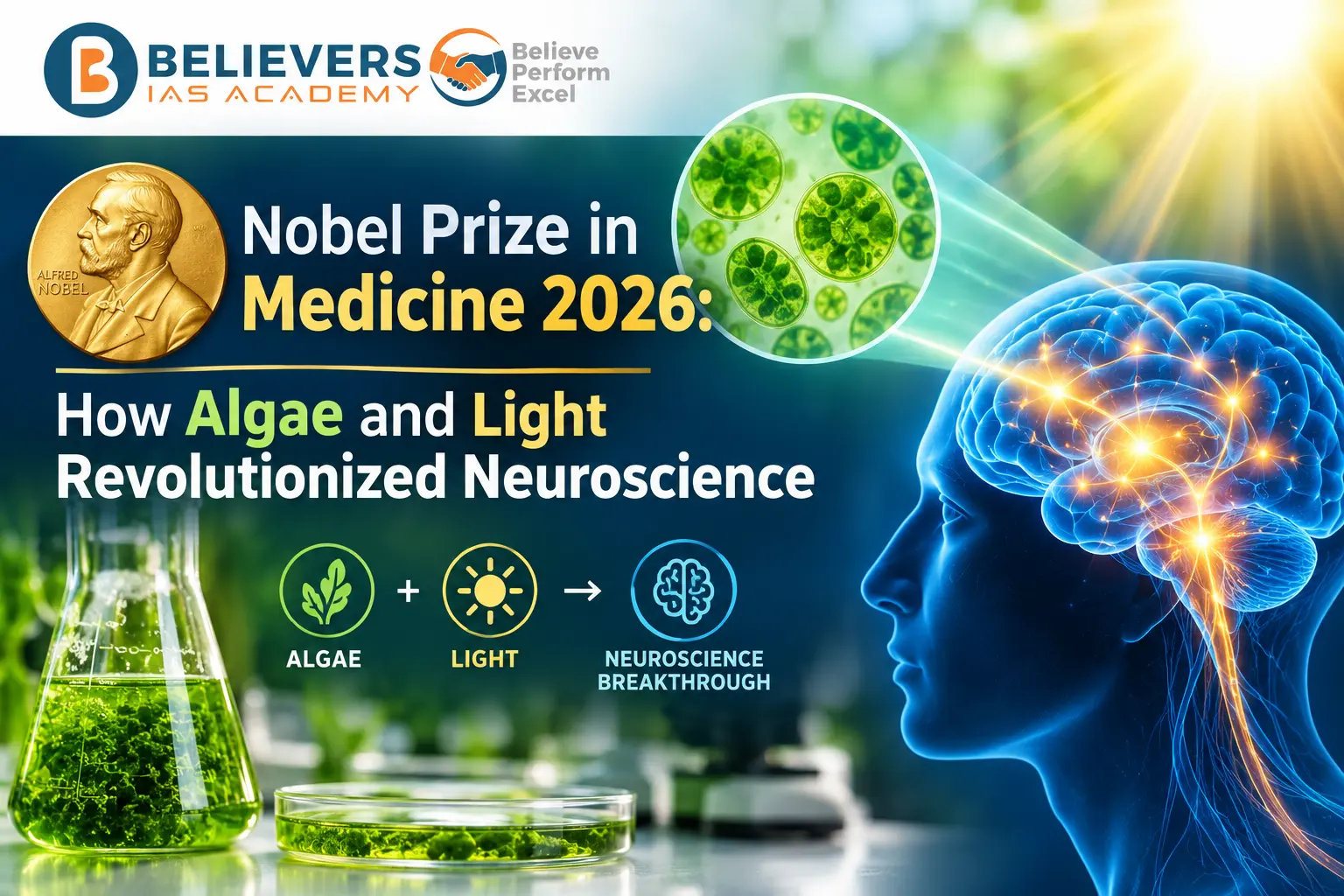
The 2026 Nobel Prize in Physiology or Medicine has been awarded jointly to Karl Deisseroth, Peter Hegemann, and Georg Nagel for their groundbreaking discoveries concerning light-gated ion channels and optogenetics.
Announced by the Nobel Assembly at the Karolinska Institute, this year’s prize celebrates a revolutionary technique that allows scientists to control the activity of individual nerve cells using flashes of light.
Quick Overview: 2026 Nobel Prize in Medicine
- The Laureates: Karl Deisseroth, Peter Hegemann, and Georg Nagel
- Awarded For: Discoveries concerning light-gated ion channels and optogenetics
- Core Breakthrough: Transforming light-sensitive proteins from single-celled algae into precise, light-controlled switches for brain cells.
- Prize Amount: 12 million Swedish kronor, shared equally
From Pond Algae to Brain Mapping: The Science Behind Optogenetics
For decades, neuroscience faced a massive roadblock: scientists could map where different areas of the brain were located, but they couldn’t prove direct cause and effect. Traditional tools like electrodes or chemicals lacked precision, often activating entire clusters of tissue rather than specific circuits.
The breakthrough came from an unexpected place—single-celled algae (Chlamydomonas) swimming toward light.
- The Algal Discovery: In the early 2000s, Peter Hegemann and Georg Nagel discovered channelrhodopsin, a unique protein on the surface of algae that opens a channel when hit by blue light, letting charged ions flow into the cell to create an electrical impulse.
- The Neural Switch: In 2005, Karl Deisseroth took the gene for this protein and introduced it into mammalian nerve cells. By shining blue light on them, he successfully triggered precise nerve signals. By 2007, this light-controlled switch was successfully working in living brain tissue.
This fusion of microbiology and neurobiology gave birth to optogenetics—a method allowing researchers to switch specific neurons on and off with millisecond precision using light.
Why Optogenetics Matters: Impact on Medicine and Research
Optogenetics completely transformed our understanding of the human brain. Its applications stretch far beyond basic laboratory research:
- Decoding Neural Circuits: Researchers use optogenetics to isolate the exact neural pathways responsible for memories, fear, motivation, and complex behaviors.
- Targeting Psychiatric & Neurological Disorders: By mapping circuits linked to disorders like depression, Parkinson’s disease, and addiction, scientists can better understand root causes.
- Clinical Horizons: In clinical medicine, researchers are actively trialing optogenetic therapies to restore sight in individuals with degenerative visual impairments by re-sensitizing retinal cells to light.
Frequently Asked Questions (FAQs)
Q: Who won the 2026 Nobel Prize in Medicine?
The 2026 Nobel Prize in Physiology or Medicine was awarded jointly to Karl Deisseroth (Stanford University/Howard Hughes Medical Institute), Peter Hegemann (Humboldt University of Berlin), and Georg Nagel (University of Würzburg).
Q: What is optogenetics in simple terms?
Optogenetics is a technique that combines optics and genetics to control the behavior of cells (typically neurons) in living tissue using light. Proteins derived from algae act as microscopic “switches” that turn cells on or off when illuminated.
Q: When was optogenetics discovered?
The foundational discovery of light-gated ion channels occurred in the early 2000s through Hegemann and Nagel’s work on algae, followed by Deisseroth’s breakthrough application in mammalian neurons published in 2005.