
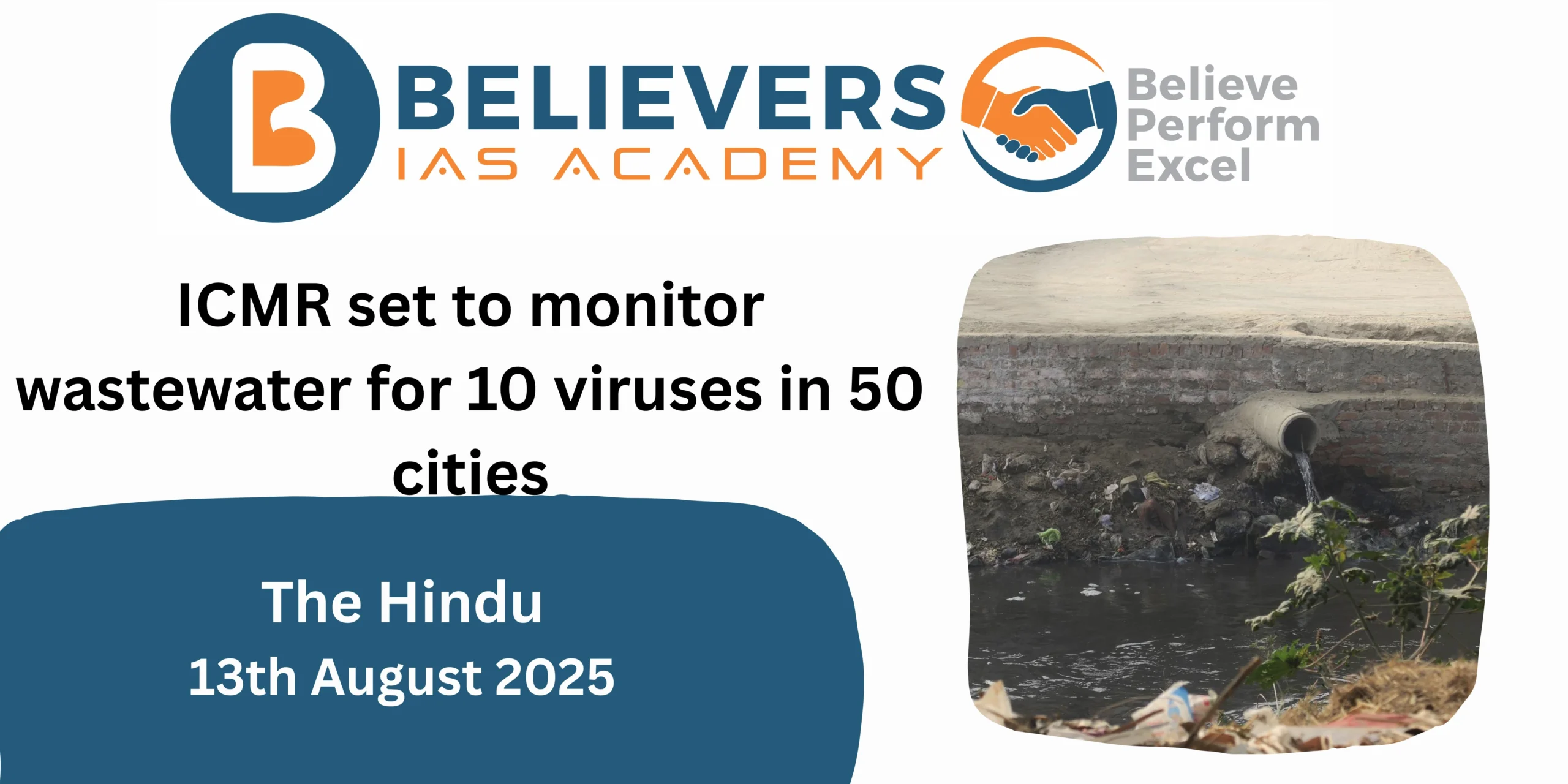
ICMR set to monitor wastewater for 10 viruses in 50 cities
Context
-
Indian Council of Medical Research (ICMR) to scale up wastewater surveillance from 5 cities → 50 cities.
-
Target: 10 viruses to be monitored (currently COVID-19 & polio).
-
Purpose: Detect early rise in viral load in the community.
What is Wastewater Surveillance?
-
Definition – Monitoring sewage and surface water for the presence of pathogens.
-
Rationale – Many viruses are shed in human waste before symptoms appear → early detection of outbreaks.
-
Application – Acts as an early warning system for community-level spread.
Viruses Under Surveillance (Current & Proposed)
-
Currently –
-
SARS-CoV-2 (COVID-19)
-
Poliovirus
-
-
Proposed Expansion –
-
Avian Influenza Virus (AIV)
-
Other respiratory & enteric viruses (exact list TBD)
-
Related Surveillance Systems in India
-
ILI (Influenza-like Illness) surveillance.
-
SARI (Severe Acute Respiratory Illness) surveillance.
-
AMR (Antimicrobial Resistance) surveillance in multiple hospitals.
Antimicrobial Resistance (AMR) – Key Facts
-
Definition – Microorganisms (bacteria, viruses, fungi, parasites) evolve to resist drugs meant to kill/inhibit them.
-
Consequences –
-
Ineffective treatments
-
Prolonged illness
-
Higher treatment costs
-
Increased mortality
-
-
Relevance – WHO lists AMR as one of the top 10 global health threats.
Significance of Expanded Wastewater Surveillance
-
Public Health – Early outbreak detection → timely containment measures.
-
Pandemic Preparedness – Lessons from COVID-19 applied to future threats.
-
One Health Approach – Links human, animal, and environmental health monitoring.
-
Cost-Effective – Monitors large populations without individual testing.
Challenges
-
Infrastructure & lab capacity for large-scale environmental testing.
-
Standardisation of protocols across states.
-
Data integration with health surveillance systems.
-
Need for rapid response after detection.
Way Forward
-
Build state-level labs for environmental virology.
-
Integrate wastewater data with ILI/SARI/AMR surveillance.
-
Train manpower in molecular detection from environmental samples.
-
Establish public reporting dashboards for transparency.
Related Posts


