
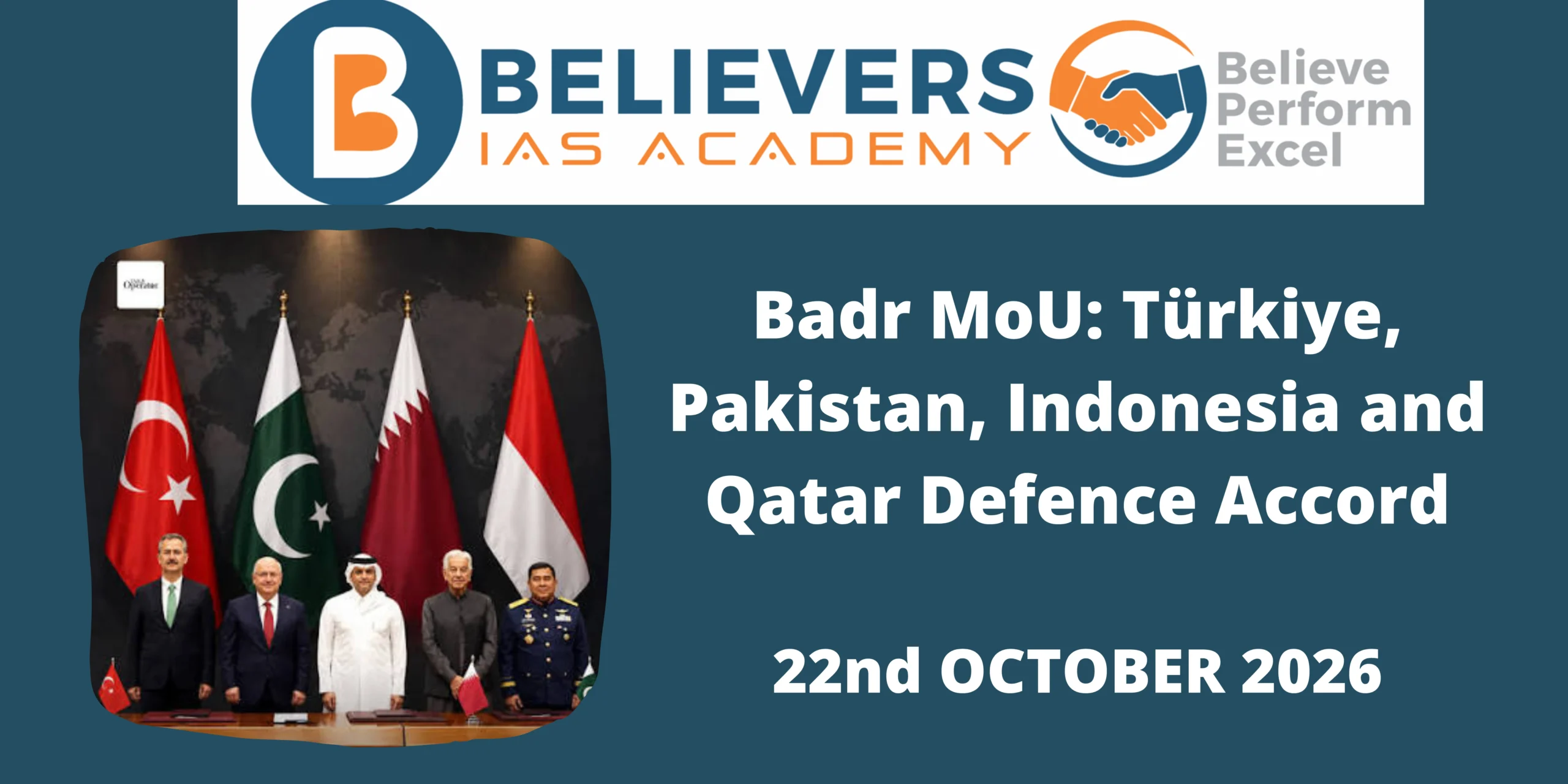
Badr MoU: Türkiye, Pakistan, Indonesia and Qatar Defence Accord
UPSC Probability
| Exam | Probability | Where it can come |
|---|---|---|
| Prelims | Medium | GS Paper II (International Relations): current-affairs question on groupings, locations or members. |
| Mains | Medium | GS Paper II: India’s neighbourhood, West Asia, groupings affecting India’s interests. Best used as an example. |
Why in News?
- Türkiye, Qatar, Pakistan and Indonesia signed the Badr Memorandum of Understanding (MoU) in Doha to strengthen defence cooperation and their defensive capabilities.
- It matters for India because Pakistan and Türkiye are both signatories.
Background
- Türkiye has NATO’s second-largest army, a strong defence industry, and a military base in Qatar. It has been helping Gulf states strengthen their security.
- Related developments (beyond the article, verify before use):
- Pakistan signed a Strategic Mutual Defence Agreement with Saudi Arabia in September 2025.
- Türkiye’s support for Pakistan has strained India-Türkiye ties.
- An MoU is a non-binding understanding, unlike a treaty or alliance with mutual-defence clauses.
Key Points
- Objective: deepen military partnerships and improve preparedness for security challenges.
- Defence industrial integration: link military production capabilities and encourage joint manufacturing and technology work.
- Economic benefits: stronger defence industries, industrial cooperation and higher production capacity.
- Self-reliance: pooling expertise and resources to meet needs and reduce dependence on external suppliers.
- Note: the report mentions no mutual-defence clause, so it should not be read as a military alliance.
Additional Data to remember for Prelims:
- Badr MoU: signed in Doha by Türkiye, Qatar, Pakistan, Indonesia.
- Focus: defence industrial cooperation.
- Türkiye: NATO’s second-largest army, base in Qatar.
- Indonesia is the world’s most populous Muslim-majority country and a G20 member.
Additional Data to remember for Mains:
- Emerging defence groupings in West Asia and the Islamic world, and their strategic implications for India.
- Pakistan’s diversification of defence partners (China, Türkiye, Gulf states).
- India’s response: multi-alignment, ties with Gulf states (UAE, Saudi Arabia, Qatar), defence exports and Atmanirbhar Bharat.
- Defence industrial cooperation as a new form of strategic partnership.
Way Forward
- Engage Gulf states and Indonesia through trade, energy, defence and diaspora ties.
- Monitor how far the MoU moves from cooperation to joint operations or a mutual-defence pact.
- Strengthen defence exports and partnerships with friendly countries.
- Use diplomacy to keep Gulf and Southeast Asian partners balanced.
Conclusion
The Badr MoU is mainly a defence-industrial cooperation framework, but it adds to a shifting security landscape around India. India should watch it closely and respond through balanced diplomacy and its own partnerships.
POSSIBLE QUESTIONS
“Evolving defence partnerships among Pakistan, Türkiye and Gulf states pose new challenges for India. Discuss.” (10 marks)
Related Posts


