

Vizhinjam International Seaport
Subject: Polity & Governance
Why in News?.
Adani Ports and Special Economic Zone (APSEZ) has sought Kerala Government’s approval to sell a 49% stake in the Vizhinjam International Seaport project to Mediterranean Shipping Company (MSC), Switzerland. The State is scrutinising the proposal for its legal, commercial, and competition implications.
Key Highlights
- APSEZ has assured that Vizhinjam Port will remain a common-user port with non-discriminatory access for all shipping lines.
- Kerala Government is examining:
- Concession agreement provisions.
- Competition concerns.
- Strategic and commercial implications.
- Concerns remain that MSC could gain dominance over seaside and landside logistics, affecting competition.
Legal Framework Governing the Stake Sale
1. Seventh Schedule of the Constitution
- State List (Entry 13): Communications, including minor ports (subject to Union law).
- Union List (Entry 27): Major ports declared by Parliament.
- Though Vizhinjam is a major port, its development has been entrusted to Kerala under a PPP concession framework.
2. Article 298
- Empowers State Governments to enter into, manage and enforce contracts relating to trade, business and property.
- Enables Kerala to scrutinise compliance with the concession agreement.
3. Indian Contract Act, 1872
- Concession agreement is legally enforceable.
- Any transfer of ownership or control requiring government consent must receive State approval.
4. PPP Concession Agreement
- Change in shareholding or transfer of concession rights generally requires prior approval from the granting authority.
5. Major Port Authorities Act, 2021
- Governs administration and regulation of major ports, including Vizhinjam.
6. Competition Act, 2002
- Large transactions may require approval from the Competition Commission of India (CCI) to prevent market dominance.
About Vizhinjam International Seaport
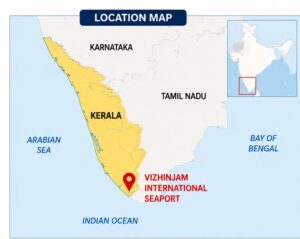

- India’s first Deep-Water Container Transshipment Port.
- Developed by the Government of Kerala.
Development Model
- Public Private Partnership (PPP)
- Landlord Model
- DBFOT (Design, Build, Finance, Operate & Transfer)
Purpose
- Container transshipment
- Multi-purpose cargo handling
- Break-bulk cargo
What is Transshipment?
Transshipment is the transfer of cargo or containers from one ship to another before reaching the final destination port.
Types of Transshipment
1. Hub-and-Spoke
- Large mother ships unload at a hub.
- Smaller feeder vessels distribute cargo to nearby ports.
2. Intersection
- Cargo is exchanged between major deep-sea vessels operating on different international routes.
3. Relay
- Cargo is shifted between ships operating within the same region but serving different ports.
UPSC Mains Question
Q. Discuss the constitutional and legal framework governing Public-Private Partnership (PPP) infrastructure projects in India. Examine the role of State Governments in regulating strategic infrastructure such as ports
