
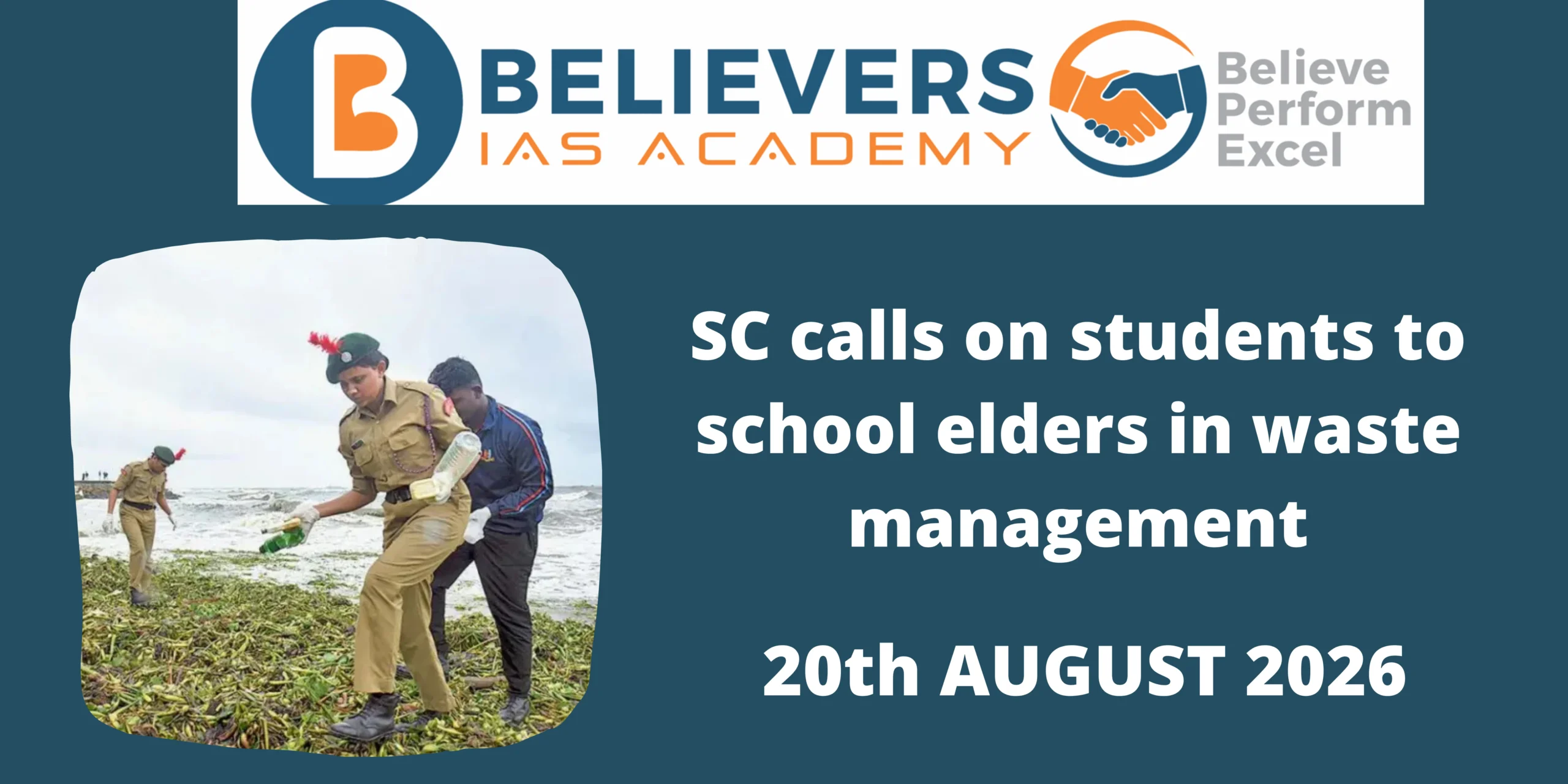
SC calls on students to school elders in waste management
Subject: GS Paper II – Governance; GS Paper III – Environment
Context & Background
In a stern observation on civic responsibility, the Supreme Court of India urged Gen Z and Gen Alpha students to act as change agents by educating their families on responsible waste generation. The bench emphasized that sanitation workers alone cannot shoulder the burden of managing waste generated by a population of 1.4 billion.
-
The Core Critique: The Court rejected the prevailing citizen mindset that treats waste generation as an individual right while leaving its disposal entirely to sanitation workers, branding this approach as constitutionally unethical and practically unsustainable.
-
Public Health Risks: Warning that continued complacency could spark severe pandemic or endemic public-health crises, the apex court called for a fundamental restructuring of civic behavior and infrastructure audit.
Key Observations and Directives of the Supreme Court
-
Inadequate Infrastructure: Noting the growing complexity of solid waste—spanning biodegradable, hazardous, e-waste, and construction debris—the Court called for a comprehensive audit of current municipal infrastructure.
-
Inter-Ministerial Monitoring: Highlighting the mismatch between waste generation and collection capacity, the Court had previously mandated a multi-ministry monitoring committee comprising urban affairs, environment, water resources, Panchayati Raj, rural development, and sanitation ministries alongside the CPCB.
-
Civic Behavior and “Jan Andolan”:
-
Directed District Collectors to actively engage with households and educational institutions.
-
Instructed the Department of School and Higher Education to integrate theoretical and practical waste-management modules into curricula, training teachers as master trainers to empower students to lead behavioral shifts at home.
-
Spotlight: Solid Waste Management (SWM) Rules, 2026
Superseding the 2016 framework under the Environment (Protection) Act, 1986, the SWM Rules, 2026 (effective April 1, 2026) introduce rigorous, modern standards for urban and rural bodies:
-
Four-Stream Source Segregation: Mandates rigid separation at the household level into:
-
Wet Waste: Kitchen scraps and food leftovers (destined for composting/bio-methanation).
-
Dry Waste: Plastics, paper, metal, and glass (channeled to Material Recovery Facilities for recycling).
-
Sanitary Waste: Diapers and sanitary napkins (securely wrapped and stored separately).
-
Special Care Waste: Bulbs, batteries, and medicines (handed over strictly to authorized collection centers).
-
-
Extended Bulk Waste Generator Responsibility (EBWGR):
-
Defines Bulk Waste Generators (BWGs) as entities with $\ge 20,000 \text{ m}^2$ floor area, water consumption $\ge 40,000 \text{ litres/day}$, or waste generation $\ge 100 \text{ kg/day}$ (covering residential societies, universities, and government offices, which account for 30% of total waste).
-
BWGs must process wet waste on-site or secure a formal responsibility certificate.
-
-
Polluter Pays Principle: Environmental compensation levies will be imposed for non-compliance, set by the CPCB and enforced by State Pollution Control Boards.
-
Refuse Derived Fuel (RDF) Mandate: Industrial units like cement kilns and waste-to-energy plants must scale up RDF (high-calorific fuel processed from non-recyclable municipal waste) usage from 5% to 15% over six years to replace fossil fuels.
-
Landfill Restrictions & Legacy Waste: Landfills are strictly restricted to non-recyclable, inert waste with heavy financial penalties for dumping unsegregated trash. Time-bound biomining and bioremediation of legacy dumpsites are legally mandated.
-
Hilly and Island Eco-Sensitivities: Local bodies in sensitive terrains can levy eco-fees on tourists and regulate visitor inflow based on local carrying capacities.
-
Digital Governance: A centralized online portal will track generation, collection, and disposal, replacing manual paperwork with transparent digital audits.
Way Forward: From Legislation to Lifestyles
-
Institutionalizing Habits: True circular economy success under the SWM Rules, 2026 requires translating legal mandates into daily civic habits.
-
Empowering Local Bodies: Decentralized monitoring via State-level committees chaired by Chief Secretaries must be matched with adequate financial empowerment for urban and rural local bodies.
-
Bridging Generations: By treating youth as primary educators, India can transform waste management from an administrative burden into a participatory Jan Andolan.


