
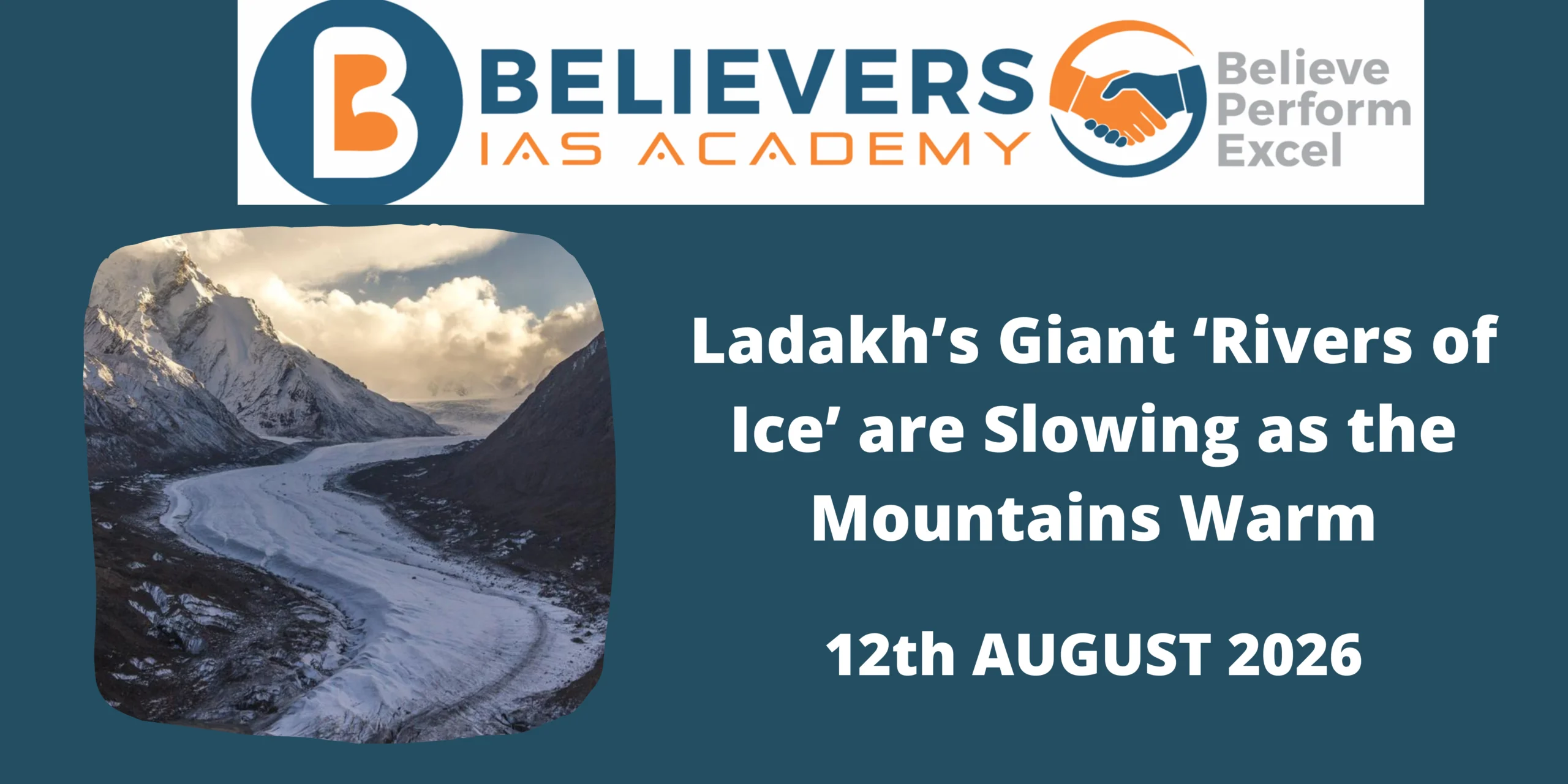
Ladakh’s Giant ‘Rivers of Ice’ are Slowing as the Mountains Warm
Subjet: GS l-Geography, GS lll-Environmental Pollution and Degradation, Climate Change
Context
A recent scientific study reveals that 12 major glaciers in the Zanskar Himalaya of Ladakh experienced a significant slowdown in their flow rates between 1992 and 2023. This physical shift serves as a clear bellwether of climate-change impacts on high-altitude cryospheric systems, highlighting critical long-term risks for regional water security in the Indus Basin.
The Zanskar Cryosphere: Significance and Unique Setting
-
Freshwater Lifeline: The extensive glaciers of the Zanskar range act as vital natural freshwater reservoirs in the arid cold-desert landscape of Ladakh. Their seasonal meltwater sustains local rivers, fragile ecosystems, and traditional agriculture during warm summer months.
-
Distinct Climatic Drivers: Unlike the eastern and central Himalayas—which rely heavily on the summer monsoon—Zanskar glaciers receive the bulk of their snowfall from mid-latitude westerly disturbances during winter.
The Physics of Glacier Slowdown: What the Study Shows
-
Deceleration Rate: The studied glaciers slowed down by an average of 2.4 metres per year per decade between 1992 and 2023.
-
The Mass Loss-Thinning-Slowdown Loop: The deceleration is directly linked to progressive glacier thinning, caused by net ice loss exceeding snow accumulation.
-
Physical Mechanism: Thinner glaciers experience reduced internal driving stress, impairing their mechanical capacity to transport ice downslope. Consequently, lower glacier termini are starved of ice replenishment, creating a self-reinforcing cycle of shrinkage.
-
-
Variability: Glacier response is heterogeneous; local topography, varying debris cover, and terminus conditions cause distinct flow behaviors among individual ice bodies.
-
Validation Gap: While satellite observations effectively map multi-decadal trends, comprehensive ground-based measurements of ice thickness, thermal regimes, bed conditions, and meltwater discharge remain urgently needed to validate these findings.
Implications for the Indus Basin and Downstream Security
Glacier dynamics in Zanskar have direct hydrological implications for the wider Indus River Basin:
-
The “Peak Water” Trajectory: Initially, warming temperatures accelerate melting, temporarily boosting river runoff (“peak water”). However, once ice reserves shrink past a critical threshold, glacier-fed contributions to summer discharge will sharply decline.
-
Vulnerability of Downstream Sectors: Reduced meltwater threatens long-term water security, agrarian livelihoods, hydropower generation, and downstream biodiversity, though the Indus system is also replenished by seasonal rain, snowfall, and groundwater.
Global Context
This phenomenon is not isolated to Ladakh. Similar glacier slowdowns linked to accelerated thinning and climate warming have been documented globally in the European Alps, Alaska, the Canadian Arctic, the Andes, and parts of the Tibetan Plateau—underscoring a planetary crisis in high-mountain cryospheric stability.
Related Posts


14 July 2023 Current Affairs Quiz
Posted on
