
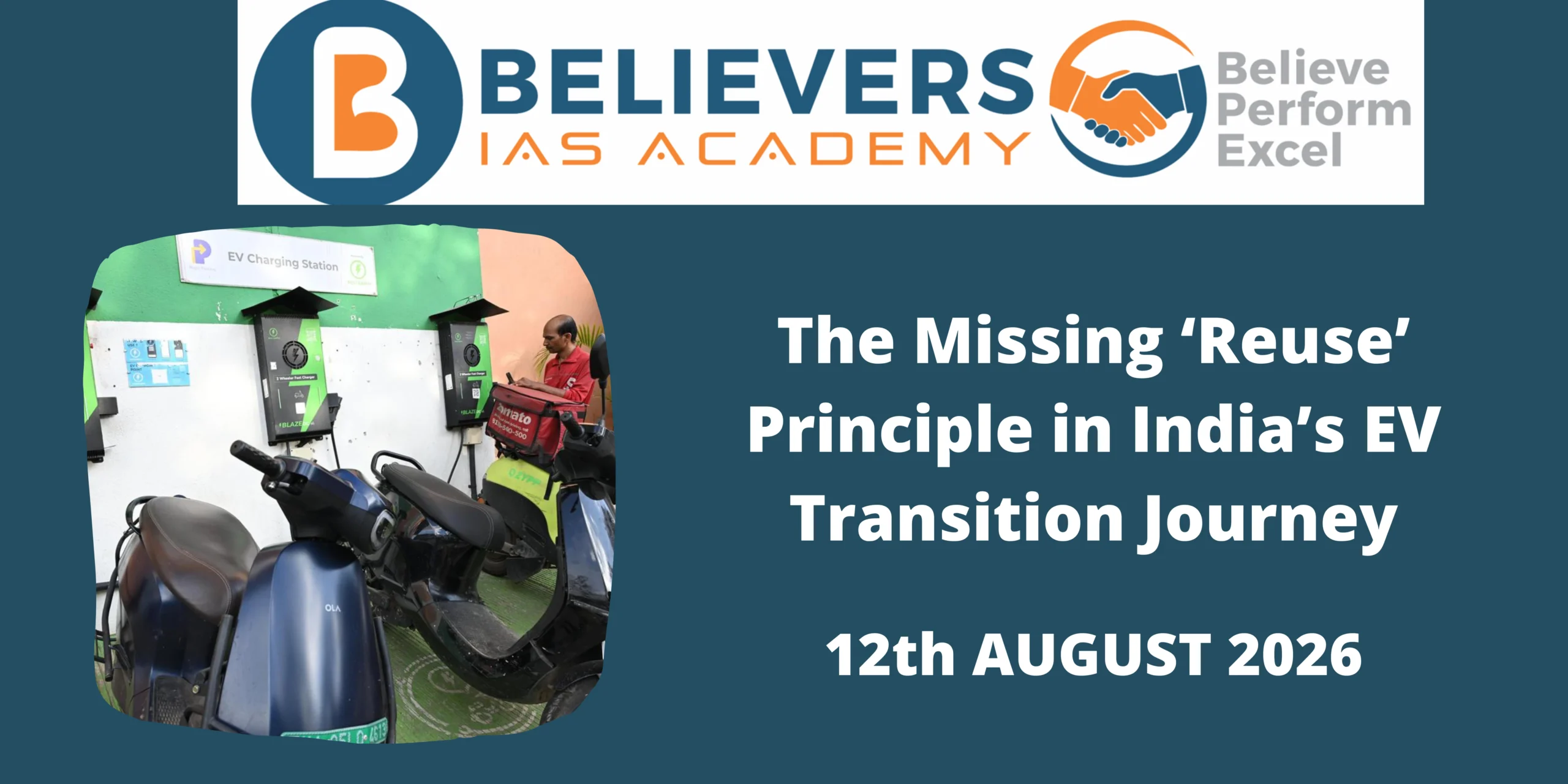
The Missing ‘Reuse’ Principle in India’s EV Transition Journey
Subject: GSIII —Economic Development, Conservation, Environmental Pollution and Degradation
Context
India’s electric vehicle (EV) transition is gathering tremendous momentum, supported by robust manufacturing investments and progressive regulatory frameworks. However, as the nation champions circular economy principles, its current policy trajectory suffers from a glaring blind spot: an over-emphasis on end-of-life recycling while completely sidelining the crucial ‘reuse’ principle, particularly through vehicle retrofitting.
The Circular Economy Hierarchy and India’s Current Focus
A genuine circular economy adheres to a strict resource-efficiency hierarchy: reduce resource use $\rightarrow$ reuse existing assets $\rightarrow$ recycle materials only after their useful operational life has expired.
India has made commendable strides in the downstream recycling ecosystem:
-
The Motor Vehicles (Registration and Functions of Vehicle Scrapping Facility) Rules, 2021 and the Environment Protection (End of Life Vehicles) Rules, 2025 laid down formal frameworks for responsible material recovery.
-
By January 2026, 129 Registered Vehicle Scrapping Facilities (RVSFs) across 21 States and UTs had processed around 4.3 lakh vehicles.
The Policy Gap: While vehicle scrapping is essential for critically unsafe and dilapidated vehicles, current regulations heavily tie scrappage to chronological age rather than vehicle condition. Automatically forcing out structurally sound older vehicles creates premature waste and ignores the immense value of asset preservation.
Retrofitting: The Missing Pathway
Vehicle retrofitting—replacing an internal-combustion engine (ICE), fuel system, and associated parts with an electric powertrain while retaining the original chassis and body—bridges this gap.
-
Functionality vs. Material Recovery: Recycling breaks down a product to recover raw materials, whereas reuse (via retrofitting) preserves the complex, embedded economic and manufacturing value of the vehicle’s chassis and structure.
-
Mitigating Environmental Burdens: Scrapping a single two-wheeler generates roughly 90 kg of recyclable material and 18 kg of landfill waste. Scaled across India’s mammoth vehicle population of nearly 30 crore, a rigid scrap-first approach risks generating 2.7 crore tonnes of recyclable material and 0.54 crore tonnes of landfill waste, exerting immense pressure on urban land and environmental sinks.
-
SDG Alignment: Embracing retrofitting directly advances UN Sustainable Development Goal 12 (Responsible Consumption and Production) by curbing resource extraction, cutting down waste, and promoting resource circularity.
Towards a National Vehicle Hierarchy Framework
Scrappage and retrofitting should not be viewed as mutually exclusive or competing strategies; rather, they must form a harmonious triad based on vehicle condition rather than age alone:
-
Pathway 1 (Maintenance & Operation): Safe, compliant, and well-maintained vehicles should continue to operate; age alone should not be a trigger for mandatory disposal.
-
Pathway 2 (Certified EV Retrofitting): Structurally sound vehicles with polluting or inefficient powertrains should be routed through certified conversion programs to transition into electric mobility.
-
Pathway 3 (Scrappage & Recycling): Vehicles with severe structural degradation, corrosion, major accident damage, or compromised safety should be systematically scrapped and recycled.
Conclusion
India’s mobility transition must graduate from a binary framing of “new EVs versus old vehicles” to a comprehensive, resource-efficient reduce-reuse-recycle model. By institutionalizing vehicle retrofitting alongside advanced scrappage, India can make its EV transition not only environmentally sustainable and resource-conscious, but also economically inclusive for millions of vehicle owners.


