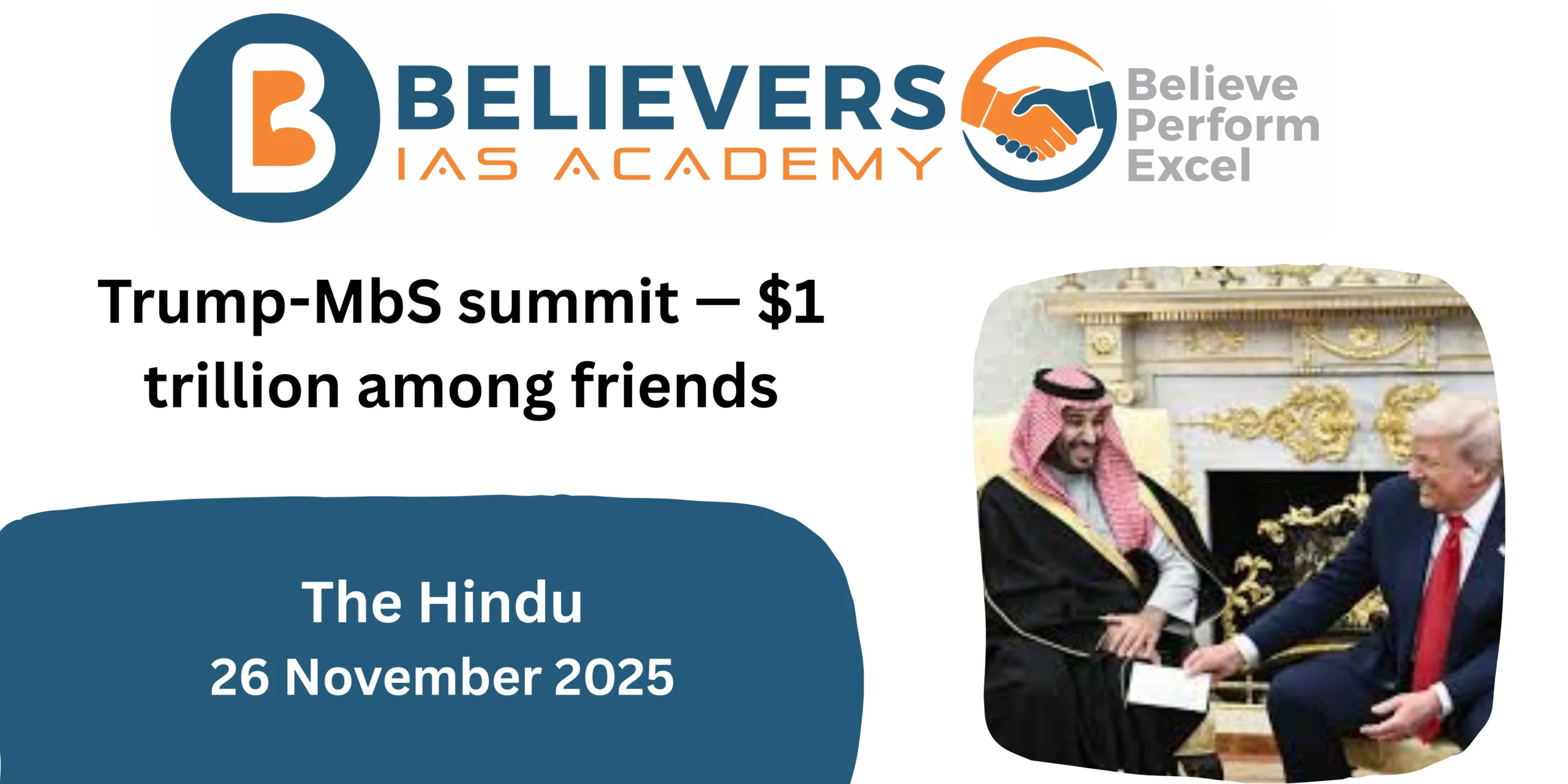
Trump-MbS summit — $1 trillion among friends
Context
-
A major Saudi–U.S. Summit in Washington (2025) showcased renewed warmth under Trump 2.0 and Mohammed bin Salman (MbS).
-
Saudi investments were raised to $1 trillion, a Strategic Defence Agreement was signed, and major AI–nuclear cooperation was discussed.
Historical Background of U.S.–Saudi Ties
-
Origin: 1945 “oil-for-security” pact (Roosevelt–King Abdul Aziz), signed on USS Quincy.
-
Predates UN, NATO, Bretton Woods — one of the oldest functioning alliances.
-
Renewed in 2005.
-
Traditionally:
U.S. → Security guarantees
Saudi Arabia → Stable oil supply
Trajectory of Relations — Key Phases
1. Periods of Strain
-
1973 Ramadan War: Saudi-led oil embargo angered U.S.
-
1980s: Saudi purchase of Chinese missiles.
-
2010s:
-
U.S. shale revolution reduced dependence on Saudi oil.
-
Khashoggi assassination (2018) strained ties.
-
Biden initially distanced from MbS.
-
Saudi tilt towards China and Russia.
-
2. China’s Growing Influence (2022–2023)
-
Xi Jinping’s Riyadh visit (2022).
-
China brokered Saudi–Iran rapprochement (2023).
3. Gaza War (2023–2025)
-
U.S. support for Israel made Saudi normalization with Israel difficult.
The New Phase: Trump 2.0 and MbS (2025)
Key Outcomes of the 2025 Summit
-
Major Military Deal
-
U.S. to supply $142 billion of military equipment.
-
Saudi Arabia formally designated a Major Non-NATO Ally (MNNA).
-
U.S. committed to defend Saudi Arabia in case of attack.
-
-
Massive Investment Pledges
-
MbS increased promised Saudi investments:
-
From $600 billion → $1 trillion (no timeline).
-
-
PIF already has 40% of foreign assets in the U.S.
-
-
Tech & Nuclear Cooperation
-
Progress on:
-
Civil nuclear energy collaboration
-
Supply of top-tier AI chips
-
-
Gives U.S. edge over China in Gulf tech race.
-
-
Strategic Signalling
-
Grand honors: fly-past, state banquet, investment forum.
-
Signed deals worth $270 billion during the summit.
-
Skepticism
-
Trump’s tendency for “truthful hyperbole”.
-
Saudi budget constraints.
-
No final communiqué → unresolved issues.
Areas of Continuing Disagreement
-
Oil prices & production strategy
-
Saudi–Israel normalization (still tied to Palestinian statehood)
-
Saudi push for strategic autonomy
-
Iran policy differences
Regional Implications
1. Saudi Arabia’s Growing Assertiveness
-
More active regional diplomacy.
-
Post-Gaza scenario: Iran weakened → Saudi geopolitical leverage rising.
2. MbS’s Expanded Influence
-
Influencing Trump on:
-
Dropping sanctions on Syria’s new regime.
-
American intervention in Sudan.
-
Facilitating Iran–U.S. nuclear talks restart.
-
3. Oil Market Coordination
-
Although oil is no longer the foundation of ties:
-
U.S. sanctions on Iran, Venezuela, Russia → limit supply → stabilise prices.
-
Helps both U.S. and Saudi oil exports.
-
Implications for India
1. Possible U.S. Military Supply to Pakistan
-
Due to Saudi–Pakistan Strategic Defence Agreement (Sep 2025).
-
Could affect India’s security calculus.
2. Oil Market Stability
-
India prefers low oil prices, but moderate & stable prices help:
-
Long-term contracts.
-
Diversification away from Russia.
-
3. Vision 2030 Opportunities
-
Saudi push into:
-
AI
-
Data centres
-
Smart infrastructure
→ Large opportunities for Indian IT, engineering, and workforce.
-
4. Check on China’s Influence
-
Stronger U.S.–Saudi ties may:
-
Reduce China’s footprint.
-
Create more strategic room for India.
-
-
India should expedite CEPA with Saudi Arabia.
5. India–Middle East–Europe Economic Corridor (IMEC)
-
Improved U.S.–Saudi synergy helps IMEC progress.
6. Lessons for India–U.S. Relations
-
U.S. prioritises transactional economic ties over rights issues.
-
Suggests scope for India to push deeper economic engagement with Washington.
Significance of the Summit
-
Marks U.S. reclaiming influence in Riyadh after China’s recent gains.
-
Alliance shifting from:
“Oil-for-security” → Strategic tech + investment + regional management -
Relationship now more complex, with:
-
AI
-
Defense tech
-
Nuclear energy
-
Geopolitical coordination
becoming new pillars.
-
Conclusion
The Trump–MbS summit represents a recalibrated U.S.–Saudi relationship grounded in massive investments, renewed security guarantees, and expanding cooperation in AI and nuclear technology. While the traditional oil-security logic is fading, new transactional drivers are emerging. The shift will shape West Asian geopolitics significantly, with important implications for India’s energy security, strategic environment, and economic opportunities.