
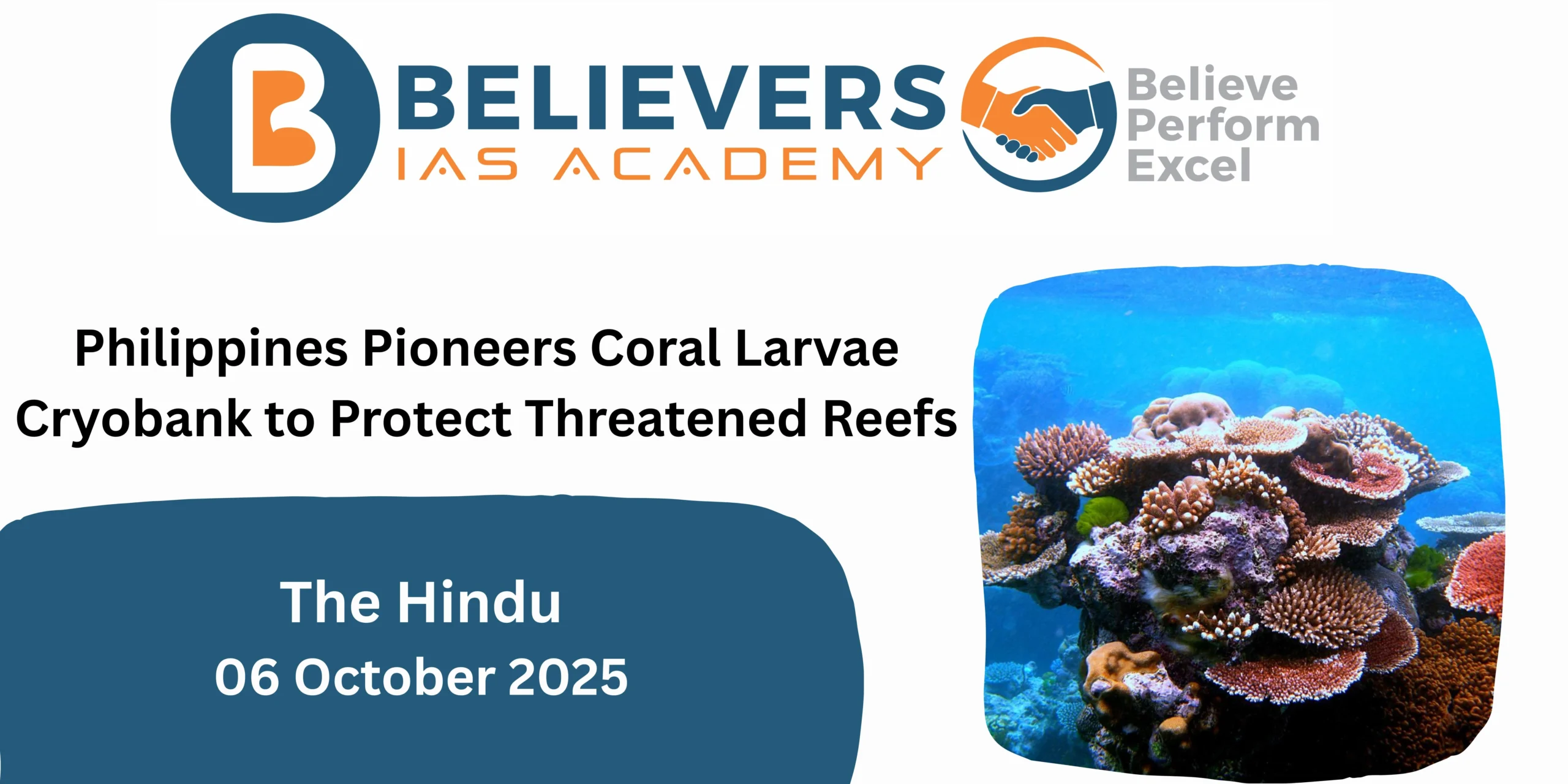
Philippines Pioneers Coral Larvae Cryobank to Protect Threatened Reefs
Context
The Philippines has launched Southeast Asia’s first coral larvae cryobank, a landmark step toward conserving and restoring coral reefs. The facility, set up by the University of the Philippines Marine Science Institute, will freeze and preserve coral larvae — the free-swimming “seeds” of corals — at extremely low temperatures to safeguard genetic diversity and help revive damaged reefs in the future.
This initiative is part of a regional project to create a network of coral cryobanks across the Coral Triangle, the world’s richest marine ecosystem.
About the Coral Triangle
| Feature | Details |
|---|---|
| Area | 5.7 million sq. km |
| Countries covered | Indonesia, Malaysia, Papua New Guinea, Philippines, Solomon Islands, Timor-Leste |
| Nickname | “Amazon of the Seas” |
| Biodiversity | >75% of global coral species, 33% of reef fish species, 6 of 7 marine turtle species |
| People dependent | ~120 million for food and livelihood |
The region plays a vital ecological and economic role, but is now under severe threat due to climate change, pollution, and destructive fishing.
Threats to Coral Ecosystems
-
14% global coral loss between 2009–2018 (Status of Coral Reefs of the World 2020).
-
Without urgent climate action, 70–90% of live corals could vanish by 2050.
-
Ocean temperatures may take decades to stabilise, leaving reefs exposed.
-
Local stressors: pollution, waste discharge, unsustainable tourism, and overfishing.
The Cryobank Project
Objective
To preserve coral larvae and genetic material through cryopreservation, enabling reef restoration and future research.
🧪 How It Works
-
Collection of Coral Larvae: Free-swimming coral “seeds” are collected during spawning.
-
Cryopreservation (Vitrification):
-
Larvae are treated with protective cryosolutions.
-
Rapidly frozen using liquid nitrogen at –196°C.
-
Prevents ice crystal formation that could damage cells.
-
-
Revival Process:
-
Larvae are thawed rapidly using lasers to avoid re-crystallisation.
-
Rehydrated in seawater and monitored for activity (swimming/settling).
-
Transferred to tanks for growth and reef restoration.
-
This technique, known as vitrification, ensures long-term preservation without cellular damage.
Regional and Institutional Collaboration
-
Led by Dr. Chiahsin Lin, Taiwan’s National Museum of Marine Biology and Aquarium & National Dong Hwa University.
-
Supported by Coral Research & Development Accelerator Platform via the Marine Environment and Resources Foundation, Inc.
-
Partner countries: Philippines, Taiwan, Indonesia, Malaysia, and Thailand.
-
In Thailand, Dr. Preeyanuch Thongpoo (Phuket Rajabhat University) is developing cryobanks for coral symbionts — algae that live inside corals and are essential for their survival.
Challenges in Cryopreservation
-
Coral larvae and reproductive cells are large, lipid-rich, and sensitive to cold.
-
Presence of symbiotic algae complicates freezing.
-
Technical limitations in maintaining coral husbandry systems for larvae collection.
-
Model species approach: Scientists first test on abundant corals (e.g., Pocillopora, Acropora, Galaxsia) before applying protocols to endangered ones.
Significance of Coral Cryobanks
| Benefit | Explanation |
|---|---|
| Genetic Insurance | Protects coral genetic diversity for future restoration. |
| Climate Resilience | Supports coral adaptation and recovery post-bleaching. |
| Research Resource | Enables controlled experiments on coral biology and climate impact. |
| Regional Cooperation | Encourages shared scientific expertise and collective conservation. |
| Community Impact | Long-term support for coastal livelihoods dependent on reefs. |
Big Picture
-
Coral cryobanks may soon become “museums for extinct coral species”, underscoring the urgency of conservation.
-
Yet, they also represent hope — a proactive scientific response to climate threats, complementing global reef restoration goals.
-
Community awareness and participation are crucial, as local actions (like sustainable fishing and pollution control) directly affect reef survival.
Conclusion
The Philippine coral larvae cryobank symbolizes a major technological and ecological milestone. It combines cutting-edge science with regional collaboration, providing a genetic safety net for coral ecosystems under climate stress. As the Coral Triangle faces unprecedented decline, such initiatives reflect “active adaptation” — not waiting for reefs to vanish, but preserving life at its cellular roots.
Related Posts

Impact of Hungary Election results on EU
Posted on

