
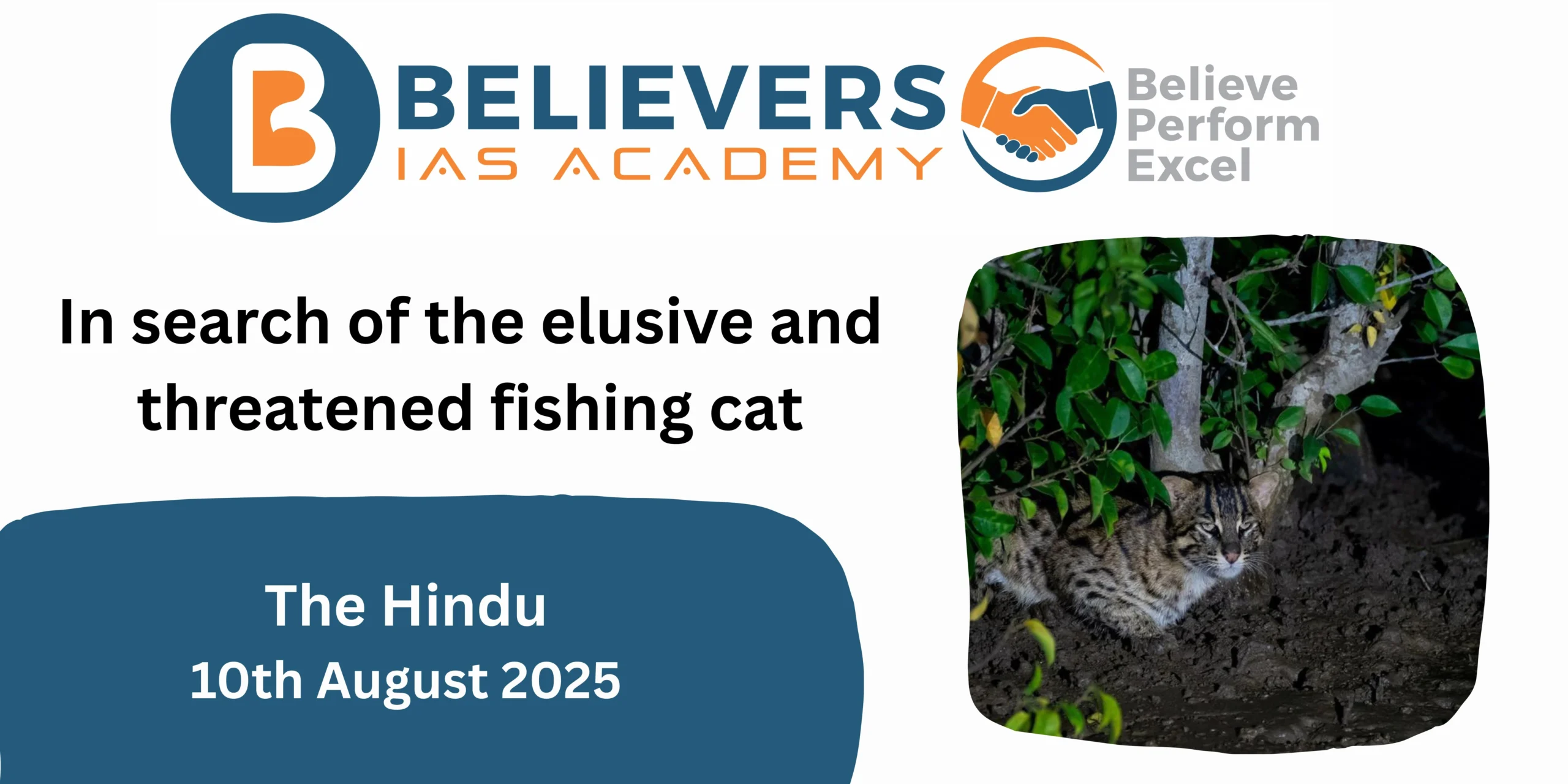
In search of the elusive and threatened fishing cat
Why in News?
-
Wildlife Institute of India (WII) has initiated a GPS collar tracking project in Coringa Wildlife Sanctuary, Andhra Pradesh (2025), to study habitat use, movement patterns, and human interaction zones of the Fishing Cat.
Overview
-
Scientific Name: Prionailurus viverrinus
-
Family: Felidae
-
IUCN Red List: Vulnerable (downlisted from Endangered)
-
CITES: Appendix II
-
Wildlife (Protection) Act, 1972: Schedule I
-
State Animal: West Bengal
Physical & Behavioural Features
-
Size: ~ Twice the size of a domestic cat; weight 7–12 kg.
-
Appearance: Greyish-brown coat with black spots.
-
Nocturnal: Primarily active at night.
-
Apex Predator in wetland ecosystems.
-
Adaptations:
-
Partially webbed paws → swimming & mud-walking.
-
Dense, water-resistant coat → aquatic survival.
-
Protruding claws → grip on slippery fish & surfaces.
-
Can swim fully submerged.
-
Hunting Behaviour
-
50%: Waiting/crouching at water edge.
-
5%: Fully submerged hunting.
-
In shallow water → moves slowly, flushes fish with paws, grabs with mouth.
Habitat & Distribution
-
Wetlands: River floodplains, mangroves, swamps, estuarine floodplains, inland freshwater habitats.
-
India: Terai (Himalayas), marshes of Western India, Eastern Ghats, Sundarbans, Coringa & Krishna mangroves (AP), East Coast wetlands.
-
Outside India: Sri Lanka, Bangladesh.
-
Recent Rediscovery: Keoladeo NP, Rajasthan (2025).
Population Highlights
-
Chilika Lake, Odisha: ~750 cats in 1,100 sq. km (Fishing Cat Project, 2024) → Healthy due to abundant fish & low conflict.
-
Sundarbans: Rapid decline due to habitat loss & human pressures.
Threats
-
Habitat Loss & Degradation:
-
30–40% of India’s wetlands lost in last four decades.
-
Shrimp farming → mangrove destruction.
-
-
Human-Wildlife Conflict:
-
Seen as threat to fish ponds & poultry → retaliatory killings.
-
-
Poaching & Ritual Hunting:
-
Occasionally hunted for skin.
-
-
Poisoning & Snaring:
-
Indiscriminate trapping.
-
-
Encroachment & Urbanisation:
-
Conversion of wetlands to agriculture, aquaculture, settlements.
-
Conservation Initiatives
-
Fishing Cat Project (2010) → Awareness & research in West Bengal.
-
Fishing Cat Conservation Alliance (2021) → Mapping in unprotected Eastern Ghats (AP).
-
Chilika Development Authority → 5-year action plan for fishing cat conservation.
-
State Initiatives:
-
West Bengal → Declared State Animal (2012), dedicated enclosures in Calcutta Zoo.
-
Odisha NGOs & wildlife societies actively engaged.
-
-
WII Godavari Project (2025):
-
GPS collars + GIS mapping → track movement, habitat use, human interaction zones.
-
Aim → Data-driven conflict mitigation & habitat protection.
-


