
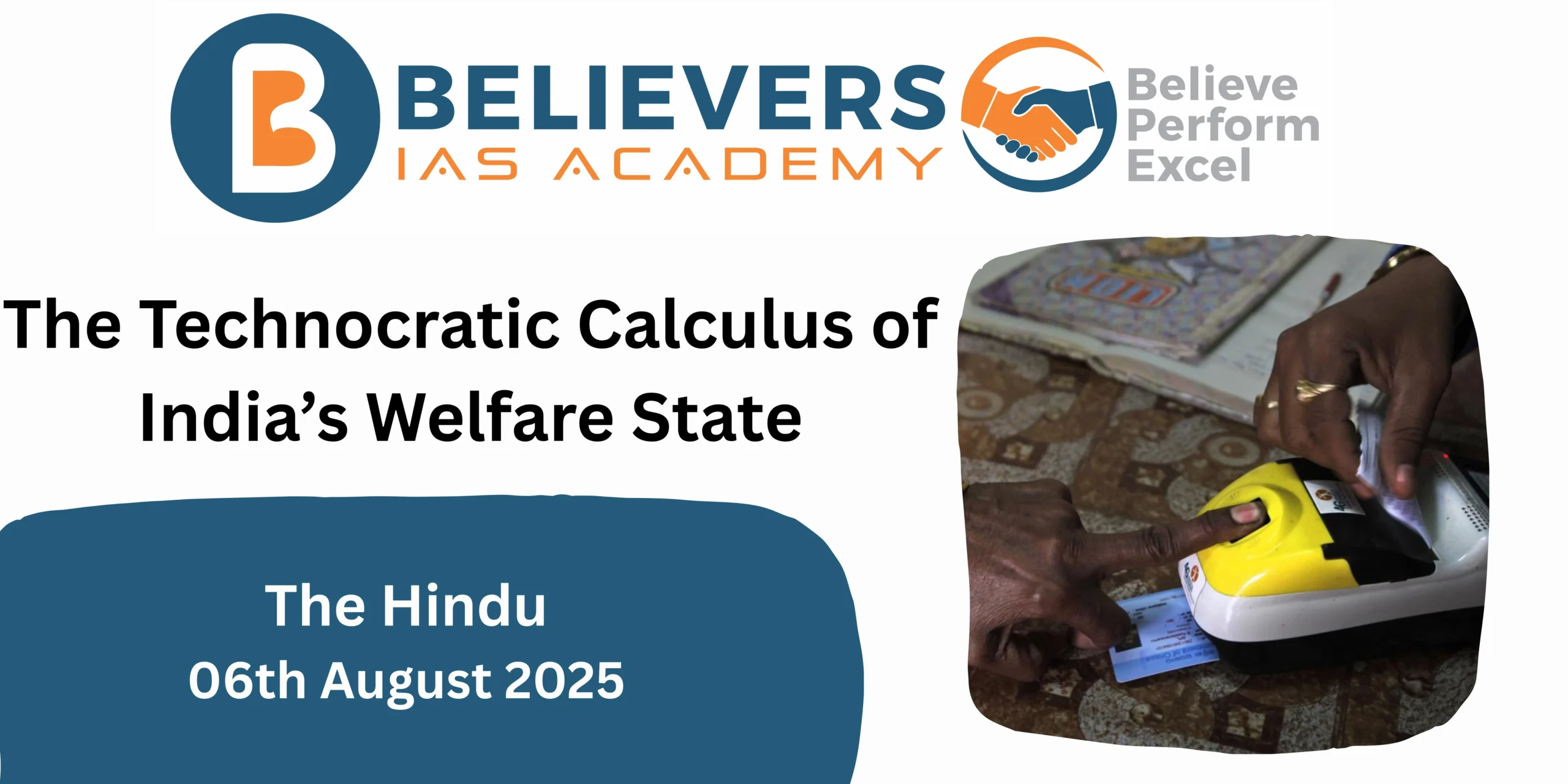
The Technocratic Calculus of India’s Welfare State
Context
India has emerged as a global leader in digitally administered welfare using platforms like Aadhaar, Direct Benefit Transfers (DBT), E-SHRAM, and Centralised Grievance Systems. This digitised architecture promises efficiency, scalability, and transparency, replacing traditional, leaky welfare systems.
However, this shift is raising ethical, political, and constitutional concerns. The article critiques this trend as technocratic governance, where citizens are reduced to data points and auditable beneficiaries, often at the cost of democratic deliberation, participatory planning, and context-sensitive delivery.
Key Issues and Analysis
1. Technocracy vs Democracy
| Parameter | Technocratic Welfare State | Democratic Welfare State |
|---|---|---|
| Focus | Efficiency, Coverage, Data Integrity | Inclusion, Deliberation, Rights-Based Approach |
| Decision-making | Algorithmic, Top-down | Participatory, Contextual |
| Beneficiary Status | Auditable IDs, Enrolled Profiles | Rights-bearing Citizens |
| Error Handling | Rejection via automated filters | Discretionary, Human-involved redress |
| Visibility | Computable suffering (data-based) | Contestable suffering (rights-based visibility) |
2. Erosion of Rights-Based Framework
-
Decline in Social Sector Spending:
From 21% (2014–24) to 17% (2024–25) — indicating a move away from welfare expansion despite a professed socialist commitment in the Constitution. -
Marginalised Sectors Affected:
Welfare Domain Pre-COVID Allocation (%) Post-COVID Allocation (%) Minorities & Labour 11% 3% Employment & Nutrition Decline observed Under-funded Social Security Significantly reduced Minimal expansion
3. Algorithmic Insulation and Accountability Gap
-
The CPGRAMS grievance portal, while technologically sound, risks:
-
Centralising data but not responsibility
-
Flattening federal hierarchies
-
Minimising the role of state-level institutions and local accountability
-
-
RTI Regime in Crisis:
-
4 lakh+ pending cases
-
8 vacancies in Information Commissions
-
Functionally paralyzed grievance redress structure.
-
4. Theoretical Underpinnings
| Thinker | Concept Used | Relevance to Indian Welfare |
|---|---|---|
| Jürgen Habermas | Technocratic Consciousness | Over-reliance on auditability and quantification |
| Michel Foucault | Governmentality | Rationalised governance undermining agency |
| Giorgio Agamben | Homo Sacer | Citizens stripped of rights become mere recipients |
| Jacques Rancière | Visibility and Suffering | Whose voices are rendered politically visible? |
| Nassim Taleb | Antifragility | Hyper-integrated systems fail catastrophically under stress |
Proposed Solutions: Democratic Antifragility
| Reform Area | Proposed Actions |
|---|---|
| Decentralised Governance | Empower states to tailor welfare based on local needs |
| Community Impact Audits | Institutionalise audits via Gram Panchayats (GPDP + RGSA synergy) |
| Platform Cooperatives | Promote self-help group-based digital interfaces (e.g. Kudumbashree) |
| Offline Fallback Mechanisms | Strengthen grievance redress with human interfaces and RTI |
| Bias Audits in AI Systems | Embed “Right to Explanation & Appeal” in algorithmic decisions |
| Civic Education & Legal Aid | Civil society to invest in grassroots political and legal literacy |
Conclusion
India’s transition to a digital welfare regime must not come at the cost of constitutional morality, local discretion, and citizen agency. Efficiency is necessary but not sufficient. The future of a Viksit Bharat must rest on a democratic and anti-fragile architecture, where citizens are partners in governance, not mere data points or passive recipients.
India must reimagine welfare as a dialogic, bottom-up process—rooted in rights, reflexivity, and responsiveness, ensuring that visibility and justice are not algorithmically filtered out but politically guaranteed.
Possible Mains Question (GS2/GS3)
Q. “India’s welfare architecture is being reshaped by a technocratic rationality that sidelines democratic deliberation.” Critically examine with suitable examples. Also suggest reforms to restore citizen-centric welfare delivery.
Related Posts

Complexities in India – Nepal Relations
Posted on

