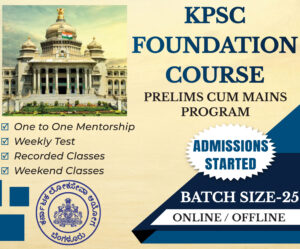
KPSC COURSE 2026-27

Our KPSC Course is meticulously designed to be your trusted companion throughout this transformative journey. With a structured approach, expert faculty guidance, comprehensive study materials, and consistent practice, we ensure that every aspirant is equipped with the knowledge, confidence, and skills required to achieve success in the KAS examination.


Batch Starts on – 24th May 2026


KEY FEATURES OF KPSC FOUNDATION COURSE

BATCH STRENGTH OF 25

No more feeling lost in a sea of faces. Get more personalized attention, deeper understanding, and a chance to truly connect with your peers and mentors

SYLLABUS MASTERY

Master the syllabus through our well designed learning path, covering every topic, with 100% Syllabus Coverage( Prelims + Mains)

ONE TO ONE MENTORSHIP BY OFFICERS

Get direct guidance from experienced professionals who’ve cracked the code

LEARN FROM ACADEMIC EXPERTS

Embark the journey with Expert Senior Faculties, UPSC & KPSC Toppers and Subject Matter Experts

KNOWLEDGE ARSENAL

Dive into a treasure trove of curated study materials: Daily Classroom Handouts, MANTRA( Current Affairs magazine) , NCERT arsenal, and Subject Materials

DAILY VALUATION

Get instant feedback on your performance, every single day with our Daily Valuation Test, Assignments, Answer writing practice on GS and optional Subject.

CHOOSE YOUR PATH

Online, Offline, or a Hybrid blend – we’ve got it all! Learn the way that suits your style and schedule

TEST YOUR METTLE

Prepare UPSC CSE with the help of our All-India Mock Test Series, Subject Tests, Sectional Tests and Full Length Tests.

PRACTICE MAKES PERFECT

Master Prelims & Mains with our Rapid Revision Recap Series after completing the syllabus.


KPSC KAS SYLLABUS 2026-27


Unleashing your full potential in the KPSC Exam begins with unlocking ย and understanding the KPSC Syllabus thoroughly.. Every aspiring candidate must meticulously dissect the syllabus to unlock the key to exam victory.

The KPSCย  exam is conducted in three stages:

Stage 1: Preliminary Exam– Objective Type(MCQs)

Stage 2: Mains โ€“ 7 papers โ€“ Essay/descriptive type

Stage 3: Interview


KPSC KAS PRELIMS SYLLABUS

The KPSC syllabus 2024 for the prelims paper is as follows.

PAPER PATTERN SYLLABUS MARKS
PAPER 1 100 objective type questions โ€“ 2 marks each

0.25 marks Negative Marking

2-hour exam duration

General Studies (National and

International Importance)

ย  ย 80
Humanities ย  ย 120
PAPER 2 100 objective type questions โ€“ 2 marks each

0.25 marks Negative Marking

2-hour exam duration

General Studies (State Importance) ย  ย 80
General Science and Tech. Environment and Ecology ย  ย 60
General Mental Ability ย  ย 60


The detailed KPSC KAS syllabus of Prelims Paper 1 is:

  1. Current Affairs
  2. National and International Importance
  3. Indian History
  4. Broad understanding of Cultural, Social, Political and Economic aspects
  5. Special Emphasis on Karnataka State
  6. Focus on the Indian National Movement
  7. Indian and World Geography
  8. Focus on Indian and world Geography
  9. Special Emphasis on Geography of Karnataka
  10. Polity and Indian Economy
  11. Indian Political System
  12. Economic Reforms
  13. Rural Development and Poverty Alleviation
  14. Social Sector initiatives etc.


The detailed KPSC KAS syllabus of Prelims Paper 2 is:

  1. Current Affairs (State of Karnataka)
  2. Important State Government schemes.
  3. General Science and Technology
  4. Environment and Ecology
  5. Climate Change& Health
  6. General Mental Ability
  7. Basic numeracy
  8. Data interpretation (data sufficiency, charts, tables, graphs etc.)
  9. Logical reasoning and analytical ability
  10. Comprehension

ย 

KPSC KAS Detailed Syllabus 2024 for Mains

Mains consists of seven descriptive papers: two qualifying language papers (Kannada or English),Essay, four General Studies papers, with a total of 1250 marks

Qualifying Papers:

  1. Kannada
  2. English
Kannada Language English
150 marks

Duration โ€“ 2hrs

35% qualifying criteria

150 marks

Duration โ€“ 2hrs

35% qualifying criteria


Syllabus

Comprehension โ€“ 25 marks

Precis โ€“ 25 marks

Usage- 25 marks

Vocabulary โ€“ 25 marks

Short Essay โ€“ 25 marks

Communication Skills โ€“ 25 marks

Syllabus

Comprehension โ€“ 25 marks

Precis โ€“ 25 marks

Usage- 25 marks

Vocabulary โ€“ 25 marks

Short Essay โ€“ 25 marks

Communication Skills โ€“ 25 marks


Both the qualifying papers aim to test the candidateโ€™s ability to read, understand and express in the given language.

ย 

Merit-Ranking Papers:

  1. Essay
  2. General Studies 1
  3. General Studies 2
  4. General Studies 3
  5. General Studies 4
PAPER SUBJECT NAME TOPICS MARKS
Paper I Essay
  • ย National and International issues
  • ย State or Local Issues
250


Paper II General Studies I
  • Cultural Heritage of India
  • Decentralization of Power
  • Modern History of India (beginning of the 19th century onwards)
  • ย  Socio-economic system
  • ย Kadambas โ€“ Hoysalas
  • ย Rural social system and Rural dev
  • The Vijaynagar Empire (1336-1799)
  • Indian Economy
  • Modern Mysore (1799-1947)
  • India and International Economic Relations
  • Karnataka Freedom movement and Unification (1885-1956)
  • Development Patterns
  • Post-Independence Karnataka
  • Planning and Planning Goals
  • Social Change & Movements
  • Decentralisation
  • Social Change & Modernization
  • Rural Development
  • Political System and Government
  • Rural Development Initiatives
  • ย Data Collection Analysis & Interpretation
250


Paper III General Studies II
  • Lithosphere, Atmosphere, Hydrosphere Distribution of Powers (Legislative)
  • Continental physiography and demographic distribution
  • Unicameral and Bicameral legislatures
  • Indian Physiography
  • Important Amendments
  • Industrial Planning & Development Welfare machinery in India
  • Physiographic divisions (Karnataka)
  • Union and State services, Urban land use policy and Urbanisation (Karnataka) Public and Private Administration
  • Nature of the Indian Constitution
  • Organisation structure, Fundamental Rights, Organisational behaviour and concepts of management
  • Informal and formal organization, Administrative Reforms, Management techniques and tools
  • ย UN and Specialised agencies
250
Paper IV General Studies III
  • Basics of Science and Tech, Biotechnology initiatives, Space Tech & Science
  • Animal Husbandry (dairy, fishery and veterinary sciences), Energy Resources
  • Development policies (Agriculture), programmes and trade, Disasters, Pollution and Pests Hygiene & health
  • Related Perception, Environment Conservation, Knowledge society, Natural Resources
  • Rural upliftment and Science & Tech, Biodiversity & Ecosystem, Natural Science
  • Solid Waste Management & Environmental Pollution, Agriculture Science
  • Role of Information Tech in Environment and Human Health, Sericulture and Horticulture
  • State-community-civil society interface
ย 


250

ย  ย  ย  ย ย  ย 
Paper V General Studies IV
  • Ethics โ€“ determinants, essence and consequences, Ethics in public administration,
  • Accountability and ethical governance, RTI and concept of public service
  • Human values, Impartiality, integrity and non-partisanship, Aptitude and foundational values for civil service
  • Emotional intelligence and contribution of social thinkers
250


Stage 3: Interview

The last step of the recruitment process for the KPSC is the personal interview. The candidates who qualify both the preliminary and the mains appear for the interview session


KAS Exam Notification DOWNLOAD HERE